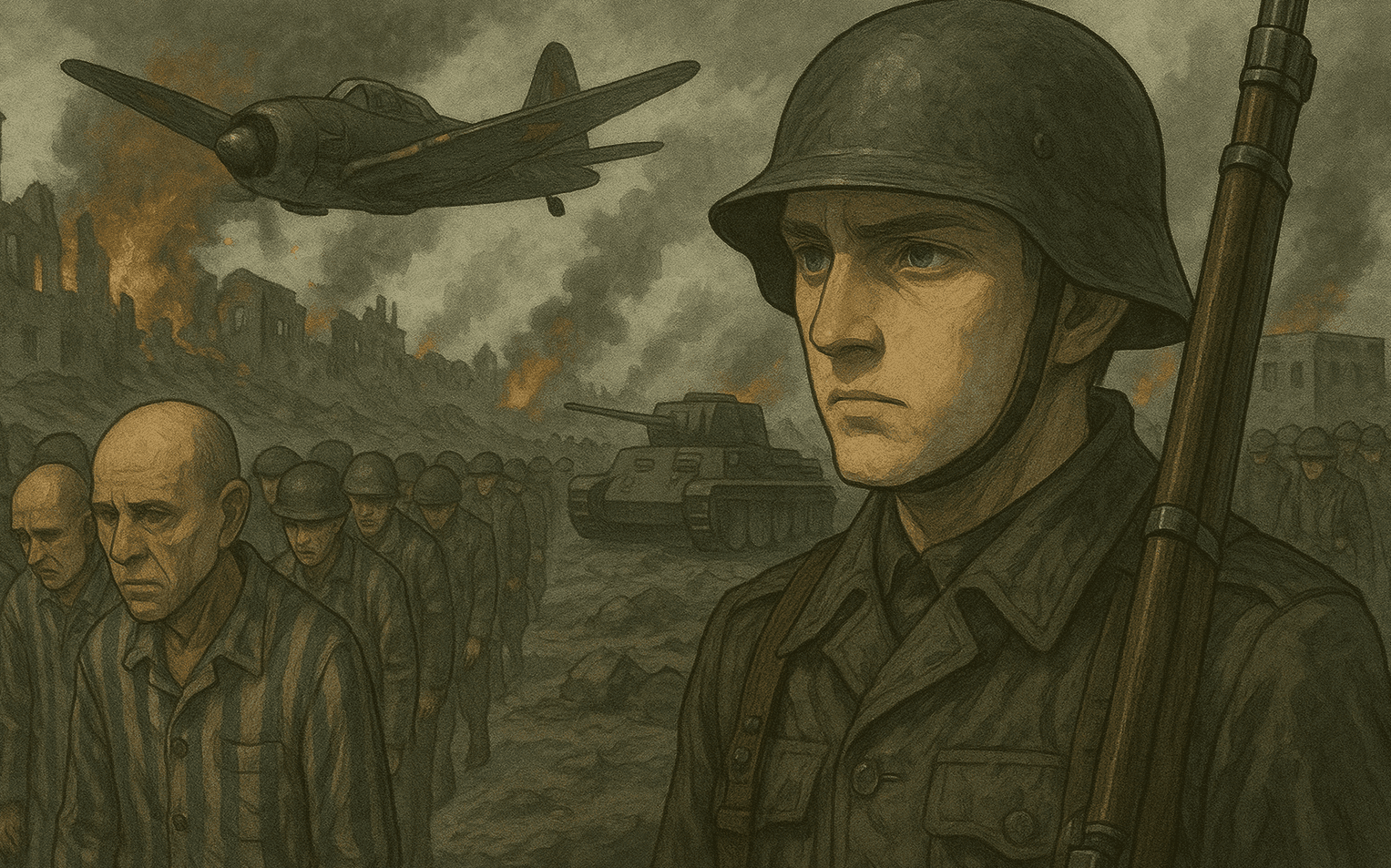
The War That Broke the World — and the Genocide at Its Center
September 1, 1939. A German battleship fires on a Polish garrison at Westerplatte. Within six years, between 70 and 85 million people will be dead. Cities will vanish under firebombs. An entire people will be tracked by bureaucrats, loaded onto freight trains, and murdered in purpose-built killing centers. And the political order that emerges from the wreckage — the United Nations, NATO, the European project, the nuclear standoff — will govern the planet you live on right now.
World War II was not a single event. It was a cascade: economic collapse feeding political extremism, feeding territorial aggression, feeding industrial slaughter. Understanding how each link in that chain connected to the next is the difference between memorizing dates and actually grasping why the modern world looks the way it does.
The Holocaust sits at the moral center of this story. Not as a footnote. Not as a sidebar. As the defining crime of a regime that turned bureaucratic efficiency into a weapon of annihilation. We owe the victims the discipline of looking squarely at what happened, how it happened, and what conditions made it possible.
The Soil That Grew Fascism: Economics, Humiliation, and Fear
Fascism did not spring from nowhere. It grew in soil that democratic governments had failed to tend. Understanding the economic and psychological conditions of the 1920s and 1930s is not an academic exercise — it is a warning manual.
The Versailles Wound
Germany exited World War I with its army undefeated on home soil (or so millions of Germans believed) yet saddled with a peace treaty that stripped territory, gutted the military, and assigned reparations of 132 billion gold marks — roughly $400 billion in today's money. The new Weimar Republic inherited a legitimacy problem from day one. Hardliners called its leaders "November criminals." The stab-in-the-back myth infected public discourse like a slow poison, giving demagogues a grievance narrative they could weaponize for years.
France and Britain wanted security. Understandable. But the treaty's punitive structure created something economists recognize instantly: a debtor with no viable path to repayment. When Germany fell behind on payments in 1923, France occupied the Ruhr industrial heartland. The German government printed money to pay striking workers. Hyperinflation followed.
A loaf of bread that cost 250 marks in January 1923 cost 200 billion marks by November. Savings accounts became worthless overnight. The middle class — the backbone of any stable democracy — watched a lifetime of careful accumulation evaporate. That kind of economic shock does not just damage wallets. It shatters trust in institutions. And people whose trust in institutions is shattered go looking for someone strong enough to promise order.
The Great Depression Finishes the Job
Germany stabilized briefly in the mid-1920s, propped up by American loans. Then Wall Street collapsed in October 1929, and U.S. banks called in those loans. German industry cratered. Unemployment surged past six million by 1932 — nearly a third of the workforce. Young men with no jobs and no prospects filled beer halls where political organizers told them exactly who to blame.
The psychology here matters as much as the economics. Sociologist Erich Fromm, writing in 1941, described what he called "the fear of freedom" — the anxiety that comes when traditional structures collapse and individuals feel powerless. Democratic politics, with its compromises and coalition-building, felt weak to people craving certainty. Authoritarian movements offered something democracy could not: a clear enemy, a strong leader, and an identity that felt solid when everything else felt liquid.
Economic crisis destroys the middle class. Loss of status breeds resentment. Resentment seeks a scapegoat. A charismatic leader channels that resentment into a political movement. The movement dismantles democratic safeguards in the name of national emergency. This sequence is not unique to 1930s Germany. It has repeated, in different forms, on every continent since.
Hitler's National Socialists won 37% of the Reichstag vote in July 1932 — not a majority, but enough to become the largest party. He was appointed Chancellor in January 1933 through backroom dealing by conservatives who thought they could control him. They were catastrophically wrong. Within eighteen months, rival parties were banned, unions dissolved, the press muzzled, and the Reichstag reduced to a rubber stamp. A functioning democracy died not in a revolution but in a series of legal maneuvers, each one seeming incremental until the sum was totalitarian.
Italy followed a parallel track. Mussolini's Fascists exploited postwar frustration, fear of communism, and weak parliamentary coalitions to seize power in 1922. In Japan, the military gradually sidelined civilian government through assassinations and fait accompli invasions, starting with Manchuria in 1931 and escalating to full-scale war in China by 1937.
From Power Grab to Continental War, 1933–1939
Nazi policy moved in linked stages, each one testing how much the world would tolerate.
Domestically, the regime dismantled civil society with methodical speed. First rival parties and unions. Then the press. Then the judiciary. The Nuremberg Laws of 1935 stripped Jews of citizenship and banned marriage with "Aryans." Businesses passed into German hands through forced sales called "Aryanization" — legalized theft dressed in paperwork. On November 9–10, 1938, Kristallnacht smashed synagogues and storefronts across Germany and Austria and sent roughly 30,000 Jewish men to concentration camps at Dachau, Buchenwald, and Sachsenhausen. The regime was testing a hypothesis: that state violence against a minority would be met with silence from the majority. The hypothesis held.
Foreign policy grew bolder in lockstep. Hitler reoccupied the Rhineland in 1936 against treaty rules. Germany annexed Austria in March 1938. At Munich that autumn, Britain and France ceded the Sudeten borderlands of Czechoslovakia after Hitler promised no further demands. Chamberlain returned to London waving a piece of paper. Six months later, German troops swallowed the rest of Bohemia and Moravia.
On August 23, 1939, Germany and the Soviet Union signed the Molotov–Ribbentrop Pact — a cynical deal between ideological enemies that secretly carved Eastern Europe into spheres of control. Germany invaded Poland on September 1. The Soviet Union invaded from the east on September 17. Britain and France declared war. The century of nationalist competition that had been building since the 1800s finally detonated.
Turning Points: The Moments That Bent the Arc
Wars are not steady slopes. They pivot on specific weeks, sometimes specific days, where the trajectory shifts and everything after flows from what happened in that narrow window. Here are the turns that decided this one.
Blitzkrieg shatters Poland in weeks. Combined armor, motorized infantry, and close air support rewrite tactical doctrine. Britain and France enter the war but cannot intervene in time.
Germany bypasses the Maginot Line through the Ardennes. France surrenders in six weeks. Over 300,000 Allied troops evacuate at Dunkirk — saving the army that will return four years later.
The RAF, aided by radar and integrated fighter control, denies Germany air superiority. Britain stays in the war. Hitler shelves invasion plans.
Germany invades the Soviet Union across a front stretching over 1,800 miles. The largest land invasion in history opens a war of annihilation — and the deadliest phase of the Holocaust.
Japan attacks Pearl Harbor, bringing the United States into the war. The same month, Soviet counterattacks halt the German advance outside Moscow in brutal winter fighting.
American codebreakers anticipate Japan's plan. Dive bombers sink four Japanese carriers in minutes. Japan loses offensive capability in the Pacific permanently.
A German field army of 300,000 is encircled and destroyed. The psychological and material blow marks the beginning of Germany's long retreat in the East.
The largest tank battle in history ends in German failure. Simultaneously, the Allies land in Sicily. Mussolini falls. Germany now fights on three fronts.
150,000 Allied troops land on five Normandy beaches. German deception failures delay the armored reserve. The Western Front reopens for good.
Hiroshima and Nagasaki are destroyed. The Soviet Union invades Manchuria. Japan surrenders. The nuclear age begins.
Barbarossa: Where Warfare Became Annihilation
On June 22, 1941, over three million German and Axis soldiers crossed the Soviet border along a front longer than the continental United States is wide. This was not a conventional invasion. Nazi planners envisioned a colonial empire in the east: Ukraine as a breadbasket, its population starved or enslaved, its cities hollowed out for German settlers. The Commissar Order instructed troops to execute Soviet political officers on capture. The Hunger Plan anticipated the death of millions of Soviet civilians through deliberate starvation.
German spearheads encircled vast Soviet formations at Minsk, Smolensk, and Kiev. Hundreds of thousands of Red Army soldiers were captured — and in German POW camps, Soviet prisoners died at staggering rates from starvation, exposure, and deliberate neglect. Of roughly 5.7 million Soviet soldiers captured during the war, over 3 million died in captivity. That is not a side effect of war. That is policy.
Yet the Wehrmacht's logistics could not sustain a knockout blow. Autumn mud bogged down wheeled transport. Winter arrived with temperatures dropping below minus 30 degrees Celsius, and German troops lacked proper cold-weather gear. Soviet factories, meanwhile, had been dismantled and shipped east by rail — entire plants reassembled beyond bomber range near the Urals. New T-34 tanks and Katyusha rocket batteries began reaching the front in growing numbers. In December 1941, Soviet counterattacks saved Moscow.
By 1943, Soviet factories were producing over 24,000 tanks per year compared to Germany's roughly 12,000. The United States, through Lend-Lease, shipped over 400,000 trucks, 13,000 armored vehicles, and millions of tons of food to the Soviet Union. Wars of attrition are won in factories, not just on battlefields.
The Holocaust: Bureaucracy as a Weapon of Mass Murder
What follows demands careful attention. The Holocaust was not chaos. It was not a war crime committed in the heat of battle. It was a planned, documented, bureaucratically administered campaign to murder every Jewish man, woman, and child in Europe — and it came terrifyingly close to succeeding.
From Laws to Ghettos
Persecution began with pen strokes. Laws expelled Jews from professions. Boycotts strangled businesses. Identity papers were stamped. Once war started, German authorities herded Jews into ghettos near rail lines. Warsaw, Lodz, Krakow, Vilna, and hundreds of smaller towns saw sealed districts where families — sometimes eight or ten people — crowded into a single room and survived on official rations calculated to produce slow starvation: roughly 184 calories per day in the Warsaw Ghetto, compared to the 2,600 allocated to Germans.
The Judenrat councils faced impossible choices. Comply with German demands and hope to save some by sacrificing others? Or resist and risk immediate liquidation of the entire ghetto? There were no good options. Only less terrible ones. Underground networks like the Jewish Combat Organization in Warsaw gathered weapons through sewers and smuggling routes, preparing for a fight they knew they could not win but refused not to make.
Mass Shootings: The First Phase of Systematic Murder
Barbarossa did not just open a military front. It opened the door to mass murder. Einsatzgruppen — mobile killing squads of SS and police — followed the army eastward. Their orders were explicit: kill Jews, Roma, and Soviet officials.
At Babyn Yar, a ravine outside Kyiv, over 33,000 Jewish men, women, and children were marched to the edge, forced to undress, and shot over two days in September 1941. Similar massacres unfolded at Kamenets-Podolski, Rumbula near Riga, Ponary outside Vilnius, and hundreds of villages whose names most people have never heard. Local collaborators — Ukrainian, Lithuanian, Latvian, and others — participated in many of these killings. The perpetrators were not all fanatics. Many were ordinary men who chose to pull triggers when they could have stepped aside.
1.5 million+ — Jews murdered by shooting in the occupied Soviet Union and Eastern Europe, 1941–1943
The shootings were psychologically destructive even to the killers. SS leader Heinrich Himmler, after witnessing an execution in Minsk, complained about the strain on his men. The solution the regime found was not to stop the killing. It was to industrialize it.
Industrialized Murder: The Killing Centers
By late 1941, the regime began shifting to a system designed for efficiency and psychological distance. Gas replaced bullets. In January 1942, the Wannsee Conference gathered fifteen senior officials in a lakeside villa near Berlin. Over lunch and cognac, they coordinated the logistics of what they called the "Final Solution to the Jewish Question" — the deportation and murder of every Jew in Europe. The meeting lasted ninety minutes. The minutes, discovered after the war, are written in the bloodless language of a corporate planning session.
Six killing centers operated in occupied Poland. Chelmno used sealed vans that piped engine exhaust into the cargo area. Belzec, Sobibor, and Treblinka were built solely for murder — no labor selection, no barracks for long-term prisoners. Trains arrived. People were herded into gas chambers disguised as showers. Bodies were burned. The entire process, from arrival to cremation, could take under two hours.
Auschwitz-Birkenau operated on a different model: a combined labor and extermination complex. Arriving prisoners faced a "selection" on the platform. SS doctors pointed left or right. Those sent left — the elderly, children, the sick, most women — walked directly to gas chambers that used Zyklon B, a cyanide-based pesticide. Those sent right entered a forced labor system where death came through starvation, disease, beatings, and exhaustion. Majdanek, near Lublin, combined similar functions.
Trains ran on schedules. Deportees from France, the Netherlands, Greece, Hungary, and across the continent traveled for days in sealed cattle cars without food, water, or sanitation. Many died in transit. German rail officials filed routine paperwork. The freight manifests listed human beings as cargo.
The Victims
Roughly six million Jews were murdered. Two-thirds of Europe's prewar Jewish population. One and a half million of the dead were children.
Roma and Sinti people were targeted under what the regime called "Gypsy policy." Estimates of Roma dead range from 220,000 to 500,000 — entire communities erased from the map. Disabled people were murdered under the T4 program through gas and lethal injection; at least 70,000 died in official facilities, with many more killed through deliberate neglect in hospitals. Homosexual men were imprisoned and subjected to brutal conditions in concentration camps. Jehovah's Witnesses, political prisoners, and Soviet POWs died in vast numbers. Polish civilians were targeted for their national identity, their intellectuals rounded up and shot in the thousands.
Each number is a person. A name. A family. That fact can get lost in statistics, and the loss of that fact is itself a form of erasure.
Collaborators, Bystanders, and Rescuers
Collaboration was not limited to Germany. Vichy France created its own anti-Jewish laws and helped round up families for deportation — including children the Germans had not specifically requested. The Slovak state paid Germany to deport its Jews. Croatia's Ustasha regime ran its own killing centers at Jasenovac. Hungary's Arrow Cross marched Jews to the banks of the Danube and shot them into the river.
Millions of ordinary Europeans saw their neighbors disappear. Some helped. Most did not. The reasons were complicated — fear, indifference, antisemitism, self-preservation — but the cumulative effect of bystanding was that the machinery of murder operated with minimal friction.
Against that darkness, acts of rescue stand out with a moral clarity that still cuts. Danes organized a flotilla to ferry nearly the entire Jewish population to neutral Sweden in October 1943. Oskar Schindler bribed and bluffed to shelter over a thousand workers in his factories. Raoul Wallenberg issued protective Swedish papers in Budapest and personally pulled people off deportation trains. Chiune Sugihara, a Japanese diplomat in Lithuania, wrote thousands of transit visas against his government's orders, staying at his post until the last possible day. Zegota, an underground network in occupied Poland, forged documents and hid children in convents and private homes.
These rescuers did not reverse the death toll. But they proved that moral choice existed even inside the worst conditions human beings have created.
Why the Holocaust is distinct: Genocides scar many eras. The Holocaust stands apart because a modern industrial state mobilized its ministries, railroads, corporations, and police forces to identify, transport, and murder an entire people across an entire continent — while simultaneously fighting a multi-front war. The bureaucratic precision is what makes it so disturbing. Deportation lists, freight timetables, property inventories, dental gold tallies. The paperwork survives in archives. It speaks in the language of logistics, and that language is chilling precisely because it is so ordinary.
The Global War Beyond Europe
The Battle of the Atlantic
Britain survived or starved by sea tonnage. German U-boats hunted in wolf packs, sinking merchant ships faster than Allied shipyards could replace them — at first. The Allies countered with convoy systems, sonar, depth charges, long-range air patrols, and codebreaking at Bletchley Park that cracked the Enigma cipher. By mid-1943, escort carriers and centimeter-wavelength radar turned the balance. North American shipyards launched mass-produced Liberty ships at a pace that outran the U-boats. The crisis passed, and the lifeline held.
North Africa, Sicily, and the Italian Campaign
Rommel's Afrika Korps drove toward Alexandria in 1942 until Montgomery stopped it at El Alamein. Operation Torch landed American forces in Morocco and Algeria. Axis units retreated into Tunisia and surrendered in May 1943. The Allies invaded Sicily in July, Mussolini fell, and Italy switched sides — but German divisions dug into mountain lines and fought a grinding defense that lasted until spring 1945.
The Eastern Front After Stalingrad
Stalingrad broke the myth of German invincibility. At Kursk in the summer of 1943, the Wehrmacht threw its last major offensive punch and failed against prepared Soviet defenses in depth. After Kursk, the Red Army held the initiative permanently. Operation Bagration in June 1944 — timed to coincide with D-Day — destroyed German Army Group Center and killed or captured over 300,000 soldiers. The road to Warsaw, and eventually Berlin, lay open.
Strategic Bombing
The RAF attacked German cities by night. The US Eighth Air Force hit industrial targets by day. Hamburg, Dresden, and dozens of other cities suffered firestorms that killed tens of thousands of civilians in single raids. The moral questions remain contested. What is less contested is the material effect: the bombing campaign forced Germany to divert enormous resources — fighters, anti-aircraft guns, repair labor — away from the front lines, and it steadily degraded fuel production, ball-bearing supply, and transportation networks.
The Pacific Theater
Japan's leadership sought resources — oil, rubber, metals — and strategic depth. After the United States imposed an oil embargo, Admiral Yamamoto planned a carrier strike against Pearl Harbor on December 7, 1941. The attack crippled battleships but missed the aircraft carriers that would decide the Pacific war.
Midway in June 1942 was the hinge. American codebreakers decrypted Japanese plans. Dive bombers caught four Japanese carriers with fueled planes on their decks. In five minutes, the strategic balance of the Pacific shifted permanently.
The island-hopping campaign that followed — Guadalcanal, Tarawa, Saipan, Iwo Jima, Okinawa — was measured in yards and casualties. American submarines strangled Japanese shipping. B-29s flying from the Marianas firebombed Tokyo and other cities, killing hundreds of thousands and incinerating vast urban districts. The ethical debates about area bombing and, ultimately, the atomic bombings of Hiroshima and Nagasaki remain among the most difficult in modern history.
Japan surrendered on August 15, 1945. The formal signing took place aboard the USS Missouri on September 2.
D-Day, the Final Campaigns, and the End of the Third Reich
Operation Overlord opened on June 6, 1944, with airborne drops and amphibious landings on five Normandy beaches. Allied deception operations — phantom armies, double agents, inflatable tanks — convinced German command that Normandy was a feint and the real invasion would hit Calais. By the time the error was recognized, the beachheads held.
After weeks of hedgerow fighting, the breakout at Saint-Lo and the closing of the Falaise pocket destroyed German forces in France. Paris was liberated in August. The rush to the German border brought Market Garden — an attempt to jump the Rhine through the Netherlands by airborne assault. It failed at Arnhem. A bridge too far.
In December, Hitler gambled everything on a surprise attack through the Ardennes — the Battle of the Bulge. American lines bent but did not break. Fuel shortages crippled German armor, and within weeks the offensive collapsed. In spring 1945, the Western Allies crossed the Rhine while the Red Army crushed the last German defenses from the east. Soviet troops fought through Berlin block by block. Hitler died by suicide in his bunker on April 30. Germany surrendered unconditionally on May 8.
As fronts collapsed, SS units forced concentration camp prisoners on death marches away from advancing liberators. Thousands died on frozen roads. When American, British, Canadian, and Soviet troops opened the camps, they found walking skeletons, mass graves, and crematoria ash. Photographers and filmmakers documented what they found. The images reached the global public within days. The world saw. It could not unsee.
The Reckoning: Numbers, Trials, and a Redrawn World
Soviet Union: 24–27 million dead
China: 15–20 million dead
Poland: ~6 million (nearly 1 in 5 citizens)
Germany: 6.6–8.8 million dead
Japan: 2.5–3.1 million dead
Yugoslavia: ~1 million dead
France, UK, US: combined ~1.5 million dead
Jews: ~6 million murdered
Soviet POWs: ~3 million died in captivity
Roma/Sinti: 220,000–500,000 murdered
Disabled (T4 program): ~70,000+ murdered
Political prisoners, homosexuals, Jehovah's Witnesses, others: tens of thousands
Nuremberg and the Invention of International Criminal Law
The International Military Tribunal at Nuremberg in 1945–46 prosecuted twenty-two major Nazi figures for crimes against peace, war crimes, and — for the first time in legal history — crimes against humanity. The defense of "following orders" was rejected. Twelve defendants were sentenced to death. Subsequent trials under U.S. authority prosecuted Einsatzgruppen commanders, concentration camp doctors, industrialists who used slave labor, and judges who had perverted the legal system.
In Tokyo, parallel trials addressed Japanese leaders for aggression and wartime atrocities. The word genocide, coined by the Polish-Jewish lawyer Raphael Lemkin during the war, became international law when the United Nations adopted the Genocide Convention in 1948. The same year, the Universal Declaration of Human Rights established principles that — however imperfectly enforced — remain the foundation of international human rights law today.
The Postwar Order
Europe held millions of displaced people. Some returned home. Others had no home to return to — their houses occupied by strangers, their communities annihilated. Jewish survivors gathered in displaced persons camps across the Allied zones and pressed for migration rights. In 1948, after a UN vote to partition Palestine, the State of Israel declared independence.
The wartime alliance fractured almost immediately. The Soviet Union tightened control over Eastern Europe. The United States launched the Marshall Plan to rebuild Western Europe and contain Soviet influence. NATO formed in 1949. Germany split into two states. The Cold War — which would define global politics for the next four decades — was already underway before the rubble was cleared.
Colonial empires, weakened by the war, faced demands for independence from movements in Asia and Africa that pointed to wartime service and wartime promises. India, Indonesia, Vietnam, Algeria — the wave of decolonization that swept the postwar decades traces directly to the dislocations of World War II.
Memory, Denial, and the Duty to Record
Some perpetrators denied what they had done. Some minimized it. Some simply vanished into postwar anonymity, protected by Cold War calculations that valued their expertise over their crimes. Trials continued for decades — the Frankfurt Auschwitz trials in the 1960s, the prosecution of Klaus Barbie in France in 1987, and cases pursued as late as the 2020s against camp guards in their nineties.
The Eichmann trial in 1961 placed survivor testimony at the center of public consciousness. Museums in Jerusalem (Yad Vashem), Washington (the United States Holocaust Memorial Museum), Berlin, and cities across the world maintain archives, oral history collections, and education programs. Laws in several European countries criminalize Holocaust denial.
Scholars continue to study the Holocaust not only as a historical event but as a warning system. The mechanisms are identifiable: dehumanizing language normalizes violence. Conspiracy theories identify a scapegoat. Emergency powers suspend civil liberties. Bureaucratic routines distribute moral responsibility so thinly that no individual feels accountable. Propaganda replaces evidence with emotion. Each of these mechanisms operates independently in democracies today. The question is not whether it could happen again. The question is whether enough people are paying attention to the warning signs.
What the War Teaches About the World You Live In
World War II is not ancient history. Your grandparents or great-grandparents lived through it. The institutions that govern your life — the UN, NATO, the European Union, the international monetary system, the nuclear nonproliferation framework — were all built in direct response to what happened between 1939 and 1945. Understanding the war is not optional background knowledge. It is the operating manual for the current world order.
Economic crisis destroys the middle class. A charismatic leader blames a minority group. Democratic norms are suspended "temporarily." State media replaces independent journalism. Violence against the scapegoated group escalates in stages, each one normalized before the next begins. International observers express concern but take no action. If you can recognize this sequence, you have learned the most important lesson World War II has to teach. If you cannot, the history is just a story about other people in another time — and that is exactly when the pattern becomes dangerous again.
Five operational takeaways worth carrying forward:
Systems beat headlines. Rail schedules, fuel stocks, and calorie rations decided whether offensives held or collapsed. For any large project — in business, in policy, in your own career — map the supply chain and the bottlenecks before you commit to bold moves. The Industrial Revolution taught us that production scales; World War II taught us that logistics decides who wins.
Language is a weapon. Regimes used labels and euphemisms to make violence feel routine. "Resettlement" meant deportation to a killing center. "Special treatment" meant murder. In any organization, question language that dehumanizes, that turns people into categories, that makes cruelty sound administrative.
Documents matter. The perpetrators kept meticulous records that later proved their crimes. In your own work — whatever field — keep records that can withstand scrutiny. Transparency is not just ethical; it is protective.
Technology is neutral until policy directs it. Codebreaking shortened the war by years. Rockets and nerve agents threatened entire cities. Atomic weapons ended the war and opened an era of existential risk. Every powerful tool requires a governance framework. That truth has not changed in eighty years.
Alliances win long contests. The United States, Britain, and the Soviet Union disagreed on nearly everything except the need to defeat Nazi Germany. They argued, competed, and distrusted each other — but they coordinated production, shared intelligence, and synchronized offensives across continents. The lesson applies at every scale: sustained cooperation, even among imperfect partners, beats individual brilliance operating in isolation.
World War II fused industrial power, diplomatic failure, and ideological hatred into a catastrophe that still shapes borders, laws, and family memories on every continent. The Holocaust, at the center of that catastrophe, demonstrates what becomes possible when a modern state decides to use its full administrative capacity for destruction. Studying the war and the genocide together — not as separate events but as interlocking systems — is the only way to understand how decisions moved from speeches to statutes to railcars to graves, and how law, coalition, and memory pull civilizations back from that edge.
The dead cannot speak for themselves. The archives, the survivor testimonies, and the historical record speak in their place. Carrying that record forward is not a school assignment. It is a civic obligation.