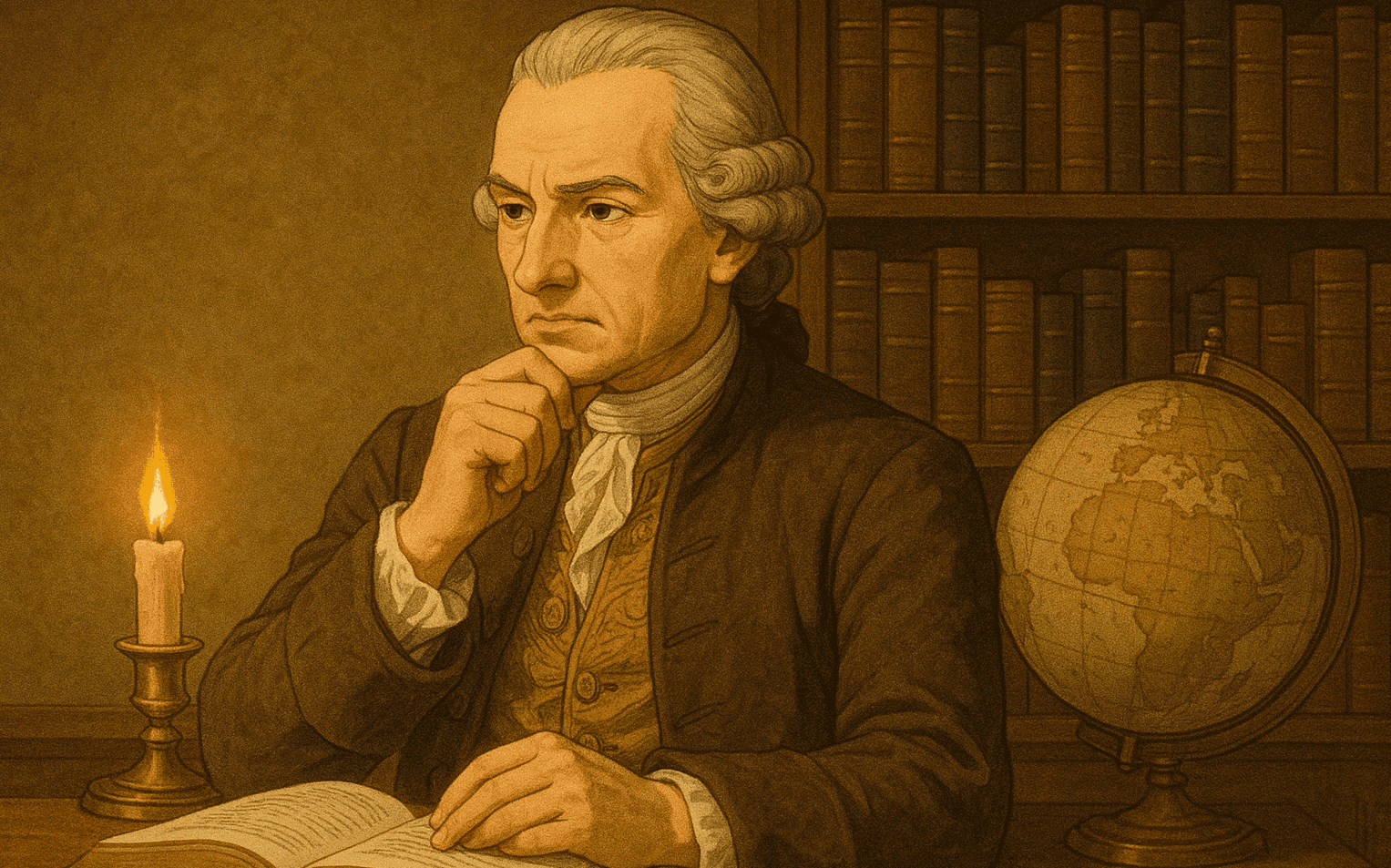
Every time you vote, serve on a jury, read a newspaper editorial, or argue that your employer can't fire you without cause — you're exercising rights that didn't exist before a handful of stubborn thinkers in powdered wigs picked a fight with kings, priests, and the entire feudal order. The Enlightenment wasn't a gentle shift in academic fashion. It was an intellectual insurgency that rewired the operating system of Western civilization between roughly 1680 and 1815, replacing "because God's anointed ruler says so" with "prove it." The ripple effects didn't stay in Europe. They crossed the Atlantic, sparked revolutions on three continents, and embedded themselves so deeply in modern institutions that we barely notice them — the way a fish doesn't notice water.
Here's the proof of how deeply those ideas took hold: the U.S. Constitution, the UN Declaration of Human Rights, the structure of your local city council, the reason a doctor runs a controlled trial before prescribing a new drug, and the economics textbook sitting on your desk all trace their conceptual DNA straight back to arguments that happened in European coffeehouses and salons between 1690 and 1790. If the Renaissance reopened the human mind, the Enlightenment put it to work building systems.
135+ — National constitutions worldwide that reference Enlightenment-era concepts like "natural rights," "separation of powers," or "consent of the governed"
The Spark: Why the Late 1600s, and Why Europe?
The timing wasn't random. Three forces had been building pressure for decades, and they converged in the final quarter of the seventeenth century.
First, the Scientific Revolution had delivered undeniable wins. Isaac Newton's Principia Mathematica (1687) proved that the same mathematics could track a comet's arc and predict the swing of a church bell. If nature obeyed discoverable laws rather than divine whim, maybe society could too. That was the dangerous inference — and thousands of readers drew it.
Second, the wars of religion had exhausted Europe. The Thirty Years' War (1618–1648) killed roughly eight million people, many of them civilians slaughtered over doctrinal disputes so arcane that most combatants couldn't articulate them. The Peace of Westphalia that ended the carnage established a radical idea: states, not churches, hold ultimate authority within their borders. People were ready for a framework that didn't require theological consensus.
Third, the printing press and postal networks had created an information ecosystem that authorities couldn't fully control. Coffeehouses in London, Paris, and Amsterdam put artisans, merchants, ship captains, and pamphleteers at the same table. Journals like the Philosophical Transactions (launched 1665) carried experimental results to provincial schoolmasters who ran informal reading circles. Ideas moved faster than censors could chase them.
The result? A generation of thinkers who believed that careful observation plus reasoned debate could solve problems — not just in physics, but in government, law, economics, and ethics. That conviction became the Enlightenment's engine.
The Philosophical Toolkit: Four Schools That Built the Modern Mind
The Enlightenment wasn't a monolith. It was a loud, contentious argument among brilliant people who agreed on one thing — reason should replace tradition as the ultimate authority — and disagreed on almost everything else. Four philosophical currents dominated the debate, and each one left fingerprints on how we think today.
Empiricism: Trust Your Data, Not Your Assumptions
John Locke launched the empiricist program in An Essay Concerning Human Understanding (1690) with a metaphor that still shows up in psychology textbooks: the mind starts as a tabula rasa, a blank slate. Experience writes on it through sensation and reflection. No innate ideas. No inborn knowledge. Everything you know, you learned by interacting with the world.
The political implications were explosive. If people aren't born with built-in ideas about who should rule them, then authority can't be inherited — it has to be earned and demonstrated. Locke's stance pushed investigators to measure rainfall, tabulate grain prices, and time pendulums before drawing conclusions. That habit of demanding evidence before accepting claims? It started here. Every A/B test a modern tech company runs, every clinical trial a pharmaceutical firm conducts, every quarterly dashboard a CFO reviews — they're all descendants of Locke's insistence that data trumps dogma.
Rationalism: The Power of Pure Logic
René Descartes, Baruch Spinoza, and Gottfried Leibniz took the opposite approach. Where empiricists trusted sensory input, rationalists drilled down on self-evident principles and deductive logic. Descartes' famous cogito ergo sum — "I think, therefore I am" — was an attempt to find one truth immune to doubt and build everything else from there.
The rationalist impulse lives on in mathematics, formal logic, and the legal tradition of deriving specific rules from general principles. When a constitutional court decides a case by reasoning from abstract rights to concrete applications, that's rationalist methodology at work.
Skepticism: The Discipline of Doubt
David Hume was the Enlightenment's most dangerous thinker — dangerous because he turned reason's tools against reason itself. His analysis of cause and effect was devastating: we observe event sequences, Hume argued, but we never observe the binding force between them. The sun has risen every morning of recorded history, but that doesn't logically guarantee tomorrow's sunrise. Regular patterns offer high confidence, not absolute certainty.
Scientists still quote Hume when reminding each other that correlation does not prove causation. Economists invoke him when a stock market rally follows a presidential speech and pundits rush to claim a causal link. His intellectual humility — the recognition that our best knowledge is probabilistic, not certain — remains the bedrock of honest scientific practice.
Kant's Grand Synthesis
Immanuel Kant read Hume, said it "awakened me from my dogmatic slumber," and spent a decade building a framework that tried to rescue knowledge from skeptical collapse. His answer, laid out in the Critique of Pure Reason (1781), was that the mind isn't a blank slate or a deductive machine — it's an active processor that imposes categories like space, time, and causality onto raw experience. We can have genuine knowledge, Kant argued, but only of the world as we experience it, shaped by our cognitive architecture.
Modern cognitive science owes Kant a direct debt. The idea that perception is constructive — that your brain doesn't passively receive reality but actively builds a model of it — runs through everything from visual neuroscience to user interface design.
These four schools weren't enemies — they were sparring partners. Empiricists and rationalists sharpened each other's arguments. Hume's skepticism forced everyone to raise their standards of proof. Kant synthesized the best of both sides. The Enlightenment's real gift wasn't any single philosophy — it was the habit of relentless, structured debate itself.
Science Turns Professional: From Curiosity to Method
Before the Enlightenment, science was a hobby for wealthy amateurs. By 1800, it was becoming a profession with institutions, journals, standardized methods, and career paths. That transition changed everything.
Royal societies and academies sprouted across European capitals. The Royal Society of London (chartered 1662), the French Académie des Sciences (1666), and the Berlin Academy (1700) gave experimenters something they'd never had: an audience of peers who could replicate results, challenge sloppy reasoning, and build on each other's work. Membership lists mixed nobles, artisans, and clergy, united by experiment notebooks and public demonstrations.
The breakthroughs came fast. Newton's laws guided artillery tables and predicted Halley's Comet decades in advance. Antoine Lavoisier's oxygen experiments toppled the phlogiston model and introduced quantitative mass balance — tracking every gram of input and output — which became a direct ancestor of industrial quality control. Carl Linnaeus classified species with binomial labels, giving natural-history museums a universal cataloging system that tech companies would later mimic in database taxonomies. Edward Jenner's smallpox inoculation trials in 1796 proved that data collection on symptom onset could steer public health policy, saving millions of lives.
First major institution dedicated to experimental science. Motto: Nullius in verba — "Take nobody's word for it."
Three laws of motion and universal gravitation, expressed in mathematics. Proved the same rules govern falling apples and orbiting planets.
Standardized biological classification with binomial nomenclature. Still used in every biology class worldwide.
35 volumes cataloguing all human knowledge. Banned multiple times by French authorities. Sold 25,000 copies anyway.
Founded modern chemistry by replacing phlogiston theory with oxygen-based combustion and insisting on quantitative measurement.
First scientifically documented vaccine. Launched the field of immunology and eventually led to smallpox's eradication in 1980.
The shared method — pose a question, isolate variables, publish findings for peer scrutiny — trained observers to distrust hearsay. That habit migrated from laboratories into insurance risk tables, crop-yield estimates, and early actuarial science. By the time the Industrial Revolution arrived, the empirical mindset was already installed in the culture. Factory owners didn't need to be convinced that measurement mattered — they'd grown up in a world where it already did.
Political Theory: The Blueprints Still Running Modern Governments
This is where the Enlightenment gets personal. The political ideas forged between 1689 and 1791 aren't historical curiosities — they're the operating code of almost every democratic government on Earth. If you've ever wondered why the U.S. has three branches of government, why courts can overturn laws, or why your passport says you have inalienable rights, the answers are right here.
Locke: Government by Consent
John Locke's Two Treatises of Government (1689) built the philosophical foundation for modern democracy with one radical claim: rulers don't hold power by divine right. They hold it by the consent of the governed. The people loan their authority to the government for one purpose — to secure life, liberty, and property. If the government fails that job, the people have the right to replace it.
Thomas Jefferson read Locke obsessively. When he sat down to draft the Declaration of Independence in 1776, Locke's fingerprints were everywhere: "We hold these truths to be self-evident, that all men are created equal, that they are endowed by their Creator with certain unalienable Rights, that among these are Life, Liberty and the pursuit of Happiness." That's Locke, almost verbatim, with "property" swapped for "the pursuit of Happiness." The entire American experiment rests on a framework one English philosopher published 87 years earlier.
Montesquieu: Separation of Powers
Charles-Louis de Secondat, Baron de Montesquieu, looked at the English system and drew a structural diagram. His Spirit of the Laws (1748) argued that political liberty requires three separate branches — legislative, executive, and judicial — each checking the others. Concentrate all three in one body, and you get tyranny, regardless of whether that body is a king, a parliament, or a mob.
James Madison devoured Montesquieu while designing the U.S. Constitution. The result? A president who can veto laws but can't make them. A Congress that can make laws but can't enforce them. A Supreme Court that can invalidate both but can't initiate action. That three-way tension was Montesquieu's blueprint, executed with remarkable fidelity. Over 100 national constitutions since then have copied the same basic architecture.
Rousseau: The Social Contract
Jean-Jacques Rousseau took a different route. His Social Contract (1762) argued that legitimate government expresses the general will — the collective interest of the people, not the sum of private interests. Laws gain authority only when citizens participate in making them, either directly or through genuine representatives. Rousseau's ideas fueled the French Revolution's more radical phases and later influenced socialist and communitarian movements that emphasized collective welfare over individual rights.
These three flows aren't just historical trivia. They're the reason your government looks the way it does. Every time a Supreme Court strikes down a law as unconstitutional, that's Montesquieu. Every time a politician claims a "mandate from the people," that's Rousseau. Every time a protest sign reads "No taxation without representation," that's Locke.
Economics: Adam Smith and the Architecture of Modern Markets
The Enlightenment didn't just reshape politics. It built the intellectual foundation of modern economics from scratch.
Adam Smith published The Wealth of Nations in the same year as the Declaration of Independence — 1776 — and it was just as revolutionary. Smith didn't invent capitalism, but he gave it a theoretical framework by examining how supply and demand, specialization, and competition drive productivity and prices under limited government interference.
His famous pin-factory example still appears in economics courses worldwide: ten workers each performing a specialized step in pin manufacturing produce 48,000 pins a day. The same ten workers, each making whole pins from start to finish, produce maybe 200. That's a 240x productivity gain from division of labor alone. The insight didn't stay in factories — it became the organizing principle of every assembly line, every corporate department, and every software development team that splits work into specialized roles.
Smith also introduced the concept of the "invisible hand" — the idea that individuals pursuing their own self-interest, within competitive markets, inadvertently promote the public good. A baker doesn't bake bread out of generosity; she bakes it to earn a living. But the result is that you get bread. Smith wasn't naive about this — he warned repeatedly about monopolies, collusion, and the tendency of merchants to rig markets. Modern antitrust law descends directly from his warnings.
Wealth = gold stockpiled by the nation. Trade is zero-sum: one country's gain is another's loss. Government should control exports, ban imports, grant monopolies, and hoard bullion. Colonies exist to feed the mother country's treasury.
Wealth = productive capacity of a nation's people. Trade benefits both sides through specialization. Government should enforce contracts, protect property, provide public goods, and otherwise stay out of the way. Competition drives innovation and lowers prices.
Two other economic thinkers deserve mention. William Petty coined "political arithmetic" while calculating national income and mortality tables in the 1670s — essentially inventing macroeconomic statistics. Every GDP report, every census, every government economic forecast traces back to his conviction that governance should be quantified, not guessed at.
And François Quesnay, leader of the Physiocrats, created the Tableau Économique (1758) — the first flow diagram of an economy, showing how money circulates between landowners, farmers, and artisans. Although his claim that land was the only source of real value didn't survive scrutiny, the circular-flow model itself became a permanent fixture in every economics classroom. You've probably drawn one.
Free Speech, Tolerance, and the Origin of Modern Rights Debates
Voltaire never actually said "I disapprove of what you say, but I will defend to the death your right to say it." That was a biographer's paraphrase. But the sentiment captures something real about his life's work: a relentless, often vicious campaign against censorship, religious persecution, and judicial corruption.
The case that made Voltaire a household name was the Calas Affair (1762). Jean Calas, a Protestant merchant in Catholic Toulouse, was tortured and executed on a wheel after being falsely convicted of murdering his own son to prevent the boy's conversion to Catholicism. Voltaire investigated, published a devastating pamphlet, and spent three years pressuring the French court system until Calas was posthumously exonerated. It was investigative journalism a century before the term existed.
Voltaire's deeper point went beyond one case: a government that can silence dissent will inevitably abuse its power, because the mechanism that catches abuse — public criticism — has been disabled. That argument runs through every free-speech debate today, from press freedom rankings to social media content moderation policies to university speech codes. The specifics change; the underlying tension Voltaire identified hasn't moved an inch.
Deism offered a theological off-ramp for people who wanted to keep their faith without blocking scientific inquiry. Deists framed the universe as a rational machine set in motion by a creator, then left to run on natural laws rather than miraculous interventions. This stance lowered the temperature of science-religion conflicts: if God built the machine, studying the machine honored God. Benjamin Franklin, Thomas Jefferson, and many other Founders held some version of deist beliefs.
Penal reform emerged from the same impulse. Cesare Beccaria's On Crimes and Punishments (1764) argued against torture and capital punishment with systematic logic: torture produces unreliable confessions (people say whatever stops the pain), and execution eliminates the possibility of rehabilitation. Habsburg Emperor Joseph II curtailed branding irons and breaking wheels after reading Beccaria. Pennsylvania legislators replaced gallows with penitentiary labor. The entire concept of a justice system focused on rehabilitation rather than revenge traces back to this one Italian jurist's 100-page book.
Women, Education, and the Unfinished Revolution
The Enlightenment's most glaring contradiction was this: thinkers who championed universal reason and natural rights routinely excluded half the human race from both.
Women weren't entirely absent from the conversation. The salons of Paris were often run by women — Madame Geoffrin, the Marquise du Châtelet, Julie de Lespinasse — who curated guest lists, moderated debates, funded publications, and circulated drafts through correspondence networks. Émilie du Châtelet translated Newton's Principia into French and corrected a calculation that Newton himself had gotten wrong. These weren't minor contributions.
But the formal arguments came from two women who refused to accept that "all men are created equal" was meant literally. Mary Wollstonecraft's A Vindication of the Rights of Woman (1792) made a case so logically airtight it's almost impossible to refute: if rational capacity is the basis for rights (as every male Enlightenment thinker claimed), and women possess rational capacity (which they demonstrably do), then denying women education and political participation is both logically incoherent and economically wasteful. You're throwing away half the nation's talent.
In France, Olympe de Gouges penned the Declaration of the Rights of Woman and of the Female Citizen (1791), mirroring the men's charter article by article to expose legal gaps. Article 1: "Woman is born free and remains equal to man in rights." Article 10: "Woman has the right to mount the scaffold; she must also have the right to mount the rostrum." De Gouges was guillotined during the Jacobin Terror in 1793 — but her pamphlet outlived her executioners and laid the groundwork for suffrage campaigns that wouldn't bear fruit for another 130 years.
The Enlightenment's universalist language — "all men are created equal," "natural rights," "universal reason" — was written by men who owned slaves, denied women the vote, and classified non-European peoples as inferior. The contradiction wasn't accidental oversight. It was a structural feature. But the language itself proved more powerful than its authors intended: every subsequent liberation movement — abolition, women's suffrage, civil rights, anti-colonialism — seized that language and demanded that its authors' successors actually mean it.
Global Echoes: The Enlightenment Beyond Europe
Textbooks often treat the Enlightenment as a purely European event that other parts of the world passively received. The reality was messier and more interesting.
In Russia, Catherine the Great corresponded with Diderot, bought his personal library when he needed money, and attempted to modernize Russian law codes using Enlightenment principles — while retaining autocratic power. The tension between progressive ideas and authoritarian implementation was real, and it foreshadowed similar contradictions in modernizing governments worldwide.
In the Ottoman Empire, translators rendered European scientific texts into Turkish for the engineering academy at the Imperial Arsenal. The goal was practical — better artillery and navigation — not philosophical transformation. But scientific methods, once imported, don't stay in their designated lane. They reshape thinking patterns.
In Japan, physicians studied Dutch anatomy diagrams under rangaku ("Dutch learning"), refining surgical methods decades before Commodore Perry's fleet arrived. The knowledge entered through a narrow window — the Dutch trading post at Nagasaki — but it proved that Enlightenment science could travel without Enlightenment politics attached.
In West Africa, scholar-states such as Futa Toro blended Quranic education with Lockean ideas of consent, demonstrating that Enlightenment concepts could merge with Islamic jurisprudence rather than replacing it. The synthesis was original, not derivative.
And then there was Haiti. The Haitian Revolution (1791–1804) was the Enlightenment's most radical test case. Enslaved workers in France's richest colony took the Déclaration des droits de l'homme at face value, defeated Napoleon's army, and founded the first Black republic in the Western hemisphere. Leader Toussaint Louverture cited the declaration's clauses while negotiating autonomy. European powers, confronted with the logical consequences of their own rhetoric, responded with economic isolation and diplomatic hostility. Haiti paid the price for taking "universal rights" more seriously than the people who wrote the words.
Critiques, Contradictions, and Blind Spots
Honesty demands acknowledging what the Enlightenment got wrong — not to dismiss the era, but to understand it completely.
The most damaging failure was scientific racism. Johann Friedrich Blumenbach sorted skull collections into racial hierarchies. Georges-Louis Leclerc, Comte de Buffon, ranked human populations on a scale from "civilized" to "savage." These classifications dressed prejudice in empirical clothing and gave pseudo-scientific cover to colonialism, slavery, and — eventually — twentieth-century eugenics. The lesson: the scientific method is a tool, and tools can be weaponized by bad premises.
Indigenous knowledge systems were routinely dismissed as primitive despite sophisticated agricultural practices, astronomical observations, and governance structures across the Americas, Africa, and Oceania. The Haudenosaunee (Iroquois) Confederacy operated a representative government with checks and balances that predated Montesquieu by centuries — but European thinkers rarely acknowledged non-European sources of political thought.
Even within Europe, critics pushed back. Rousseau himself — despite being an Enlightenment thinker — warned that relentless rationalization risked flattening emotion, custom, community bonds, and spiritual depth. The Romantic movement that followed was partly a rebellion against the Enlightenment's coldest tendencies. And medieval scholars had preserved and transmitted much of the classical learning that Enlightenment thinkers claimed to have rediscovered, a debt rarely acknowledged.
Some philosophes championed liberty in print while holding shares in colonial trading companies. Voltaire invested in the slave trade. Locke helped draft the Fundamental Constitutions of Carolina, which upheld slavery. These weren't minor biographical footnotes — they revealed a gap between assertion and practice that subsequent generations would have to confront directly.
From Pamphlets to Parliaments: The Revolutions
Ideas don't change the world by sitting in libraries. They change the world when people act on them. The Enlightenment's political theories got their test runs in three revolutions that collectively remade the global order.
The American Revolution (1775–1783) was the most direct translation of Enlightenment theory into institutional design. Jefferson channeled Locke into the Declaration. Madison channeled Montesquieu into the Constitution. The Bill of Rights (1791) codified protections that traced straight back to Enlightenment arguments about natural rights, religious tolerance, and limits on state power. The framers weren't just influenced by Enlightenment thinkers — they were Enlightenment thinkers, conducting a live experiment in applied political philosophy.
The French Revolution (1789–1799) began with the Déclaration des droits de l'homme et du citoyen, which announced universal rights and popular sovereignty. But France's revolution demonstrated something the American version mostly avoided: how quickly Enlightenment ideals can collapse into terror when institutional guardrails are absent. The Jacobin phase (1793–1794) executed thousands, including many revolutionaries, before exhausting itself. Napoleon inherited the chaos and built a modernized legal code — the Code Napoléon — that spread Enlightenment-derived civil law across Europe, even as he crowned himself emperor.
The Latin American revolutions (1808–1830s) carried Enlightenment arguments across another ocean. Simón Bolívar cited Montesquieu in letters from Jamaica and speeches in Angostura. But Latin American independence leaders also confronted a problem the European theorists hadn't solved: how to build democratic institutions in societies structured by racial hierarchy and concentrated land ownership. The struggles that followed — oligarchy, military coups, populist cycles — are still playing out today.
Imagine you're a delegate at the 1787 Constitutional Convention in Philadelphia. You have a copy of Montesquieu's Spirit of the Laws on your desk. The question before you: how do you prevent any one branch of government from accumulating too much power? Madison's solution — taken almost directly from Montesquieu — was to give each branch a way to check the others. The president vetoes legislation. Congress controls funding and can impeach. The judiciary reviews constitutionality. That system of mutual restraint is why, 237 years later, no American president has successfully seized dictatorial power. The design worked because the theory was sound.
The Enlightenment's Living Legacy: A Flowchart You're Standing In
The direction the user specified for this article was exactly right: the Enlightenment doesn't just connect to modern institutions. It built them. Here's the direct lineage, field by field.
Constitutional government. Locke's consent of the governed + Montesquieu's separation of powers + the English Bill of Rights (1689) = the template used by the U.S. Constitution, the French revolutionary constitutions, and virtually every democratic constitution written since. Board oversight, shareholder votes, and independent audits in corporations mirror the same power-division logic.
Free speech and press freedom. Voltaire's defense of open criticism + the practical experience of censorship's failures = the First Amendment, Article 19 of the UN Declaration, and every press freedom law on the books. When a social media platform debates content moderation, when a journalist invokes shield laws, when a whistleblower goes public — they're operating within a framework Voltaire helped construct.
Modern economics. Smith's Wealth of Nations + Petty's political arithmetic + Quesnay's circular-flow model = the conceptual architecture of free-market economics, GDP measurement, and macroeconomic policy. Every central bank, every trade agreement, every antitrust case works within parameters Smith sketched out.
Evidence-based policy. The empirical method + statistical measurement + peer review = the modern expectation that governments should base policy on data, not intuition. Clinical trials, environmental impact assessments, cost-benefit analyses — all descendants of the Enlightenment insistence that claims require evidence.
Criminal justice reform. Beccaria's arguments against torture + his case for proportional punishment + Enlightenment-era penitentiary design = the rehabilitation-oriented justice systems in most democracies today. The debate between punitive and rehabilitative approaches still tracks the lines Beccaria drew in 1764.
Human rights. Locke's natural rights + the French Déclaration + Wollstonecraft's expansion of "universal" to actually mean universal = the UN Declaration of Human Rights (1948) and the entire international human rights framework. Every rights-based argument in modern politics — from marriage equality to refugee protections — uses Enlightenment-forged tools.
Why This Matters If You're Not a History Major
Here's the practical case for understanding the Enlightenment, stripped of academic obligation.
If you work in any organization with a governance structure — a company, a nonprofit, a student government — you're working inside a Montesquieu derivative. Understanding where those structures came from helps you see why they work, why they sometimes fail, and how to fix them.
If you participate in any public debate about rights, speech, privacy, or government power, you're using Enlightenment-era arguments whether you know it or not. Knowing the original context makes your arguments sharper and helps you spot when others are misusing the same concepts.
If you work in business or economics, Smith's insights about specialization, competition, and market failures aren't just historical — they're the lens through which policy decisions get made today. Understanding Smith helps you understand why your government does what it does with trade policy, antitrust regulation, and tax structure.
If you care about evidence-based decision-making in any field — medicine, technology, education, public policy — you're practicing the Enlightenment's core conviction that data beats tradition. Knowing that history equips you to defend that conviction when it comes under attack, which it regularly does.
The takeaway: The Enlightenment didn't just happen to people who lived in the 1700s. It built the institutions you live inside, the rights you exercise, the economic system you work within, and the standards of proof you apply to claims. You're not studying it from the outside. You're standing in it.
The Enlightenment's contradictions — its blind spots on race, gender, and colonialism — aren't reasons to discard it. They're reasons to do what the Enlightenment itself taught: examine inherited ideas critically, demand evidence, expand the circle of who counts as fully human, and keep arguing. The thinkers of the 1700s didn't finish the project. They handed it to you. The colonial structures they built alongside their philosophical ones created tensions that every subsequent generation has had to address — and those tensions are alive in debates about economic inequality, systemic racism, and global justice happening right now. Understanding where those debates started is the first step toward understanding where they might go.