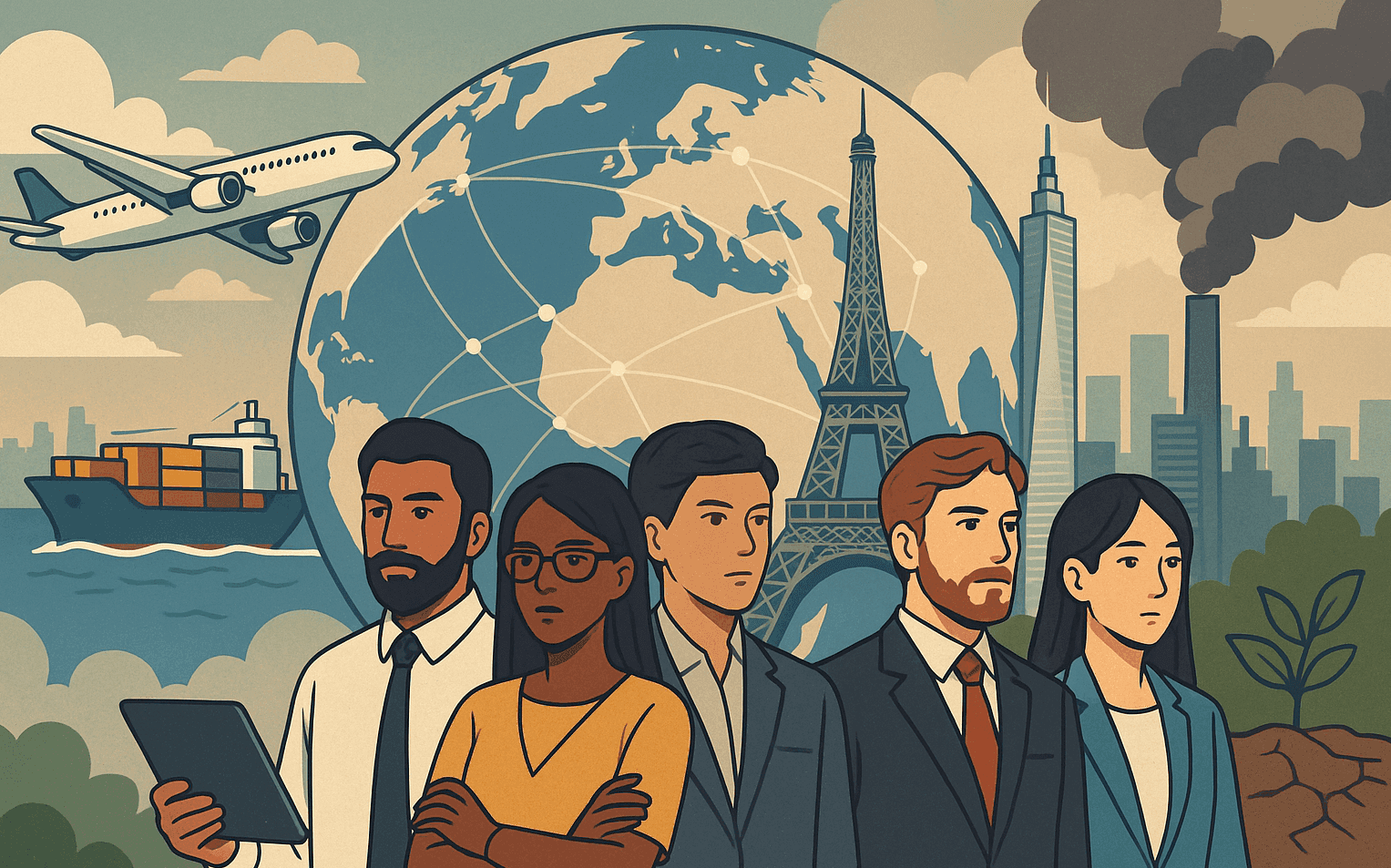
In 1990, roughly 1.9 billion people lived on less than $2.15 a day. By 2019, that number had dropped below 700 million. In the same window, carbon dioxide concentrations climbed from 354 parts per million to 411, global average temperature rose by about 0.5 degrees Celsius, and the world's wealthiest 1 percent captured more new income than the bottom 50 percent combined. Those four data points sit inside the same thirty-year story, and they refuse to be separated. Globalization did not deliver one outcome. It delivered a tangle of outcomes, some miraculous and some alarming, braided so tightly that pulling on one thread yanks all the others.
This article picks up where contemporary history leaves off. Where that piece traced the political events from 1991 to the present, this one zooms out to the structural forces shaping daily life everywhere on Earth right now: the physical and digital infrastructure that moves goods and ideas across borders, the climate pressures that threaten the gains, the artificial intelligence tools rewriting entire job categories, the inequality that fuels populist backlash, and the migration flows that connect aging rich nations to young developing ones. Think of it as the operating system running beneath the headlines.
The Pipes of Globalization: How Things Actually Move
Globalization is often discussed as though it were an ideology. It is not. It is plumbing. Containers, fiber-optic cables, shipping lanes, payment rails, and air routes constitute the physical and digital infrastructure that turns "the world is connected" from slogan into measurable reality. Understanding that plumbing is the difference between reading headlines with vague anxiety and reading them with structural literacy.
Start at the docks. In the early 1960s, loading a cargo ship took days of manual labor, with longshoremen hauling crates of wildly different sizes into holds. Malcolm McLean's standardized steel container changed everything. Today a single crane operator at the Port of Shanghai can move 40 containers per hour, each one a sealed unit that transfers from ship to rail to truck without anyone touching the goods inside. Global container throughput topped 900 million TEUs (twenty-foot equivalent units) in 2023. That number represents the circulatory system of international trade.
Air cargo handles what the sea cannot afford to wait for: pharmaceuticals, microchips, fresh seafood, emergency medical supplies. A smartphone component fabricated Tuesday afternoon in Penang, Malaysia, can reach an assembly plant in Shenzhen, China, by Wednesday morning. The reliability of these links matters more than their speed. A route that delivers in 18 hours 99 percent of the time beats a route that delivers in 12 hours but fails unpredictably once a month, because factories plan around certainty, not hope.
Then there is the digital layer. Submarine fiber-optic cables carry roughly 99 percent of intercontinental data traffic. Not satellites. Cables. Roughly 550 active submarine cables crisscross ocean floors, and a single modern cable can transmit data at speeds exceeding 250 terabits per second. Content delivery networks cache video, software updates, and web pages on servers near users so a teenager in Lagos watching the same tutorial as a student in Toronto experiences comparable load times. Cloud computing turned server rooms into a utility: you rent processing power by the minute, scale up when demand spikes, and shut it down when it fades.
Globalization's infrastructure is not one network but many overlapping networks—maritime, aviation, fiber-optic, financial, and informational—each with its own bottlenecks, failure modes, and governance gaps. When a single container ship blocked the Suez Canal for six days in March 2021, it held up an estimated $9.6 billion in trade per day, revealing just how much modern commerce depends on a handful of narrow passages.
Payment systems form another critical layer. Money crosses borders at light speed through correspondent banking networks, real-time settlement systems, and increasingly through mobile wallets and fintech rails. Remittances alone—money sent home by workers abroad—totaled $656 billion to low- and middle-income countries in 2022, a sum that dwarfs most foreign aid budgets. For families in the Philippines, Mexico, India, and dozens of other nations, that monthly transfer pays school fees, covers medical bills, and seeds small businesses. When transaction fees drop from 7 percent to 3 percent, billions of additional dollars land in the hands of people who spend them locally.
Supply Chains as Choreography—And What Happens When the Music Stops
A modern product is a schedule as much as it is a thing. An iPhone contains components from more than 40 countries. A typical automobile involves about 30,000 parts from hundreds of suppliers across multiple continents. Procurement teams hedge risk by dual-sourcing critical materials. Quality engineers share test results through real-time dashboards. Retailers tune orders to weather patterns, holiday calendars, and social media trends.
This system works beautifully—until it doesn't.
Between 2020 and 2022, the world received an education in supply chain fragility that no textbook could have delivered. A pandemic shut factories and ports. A ship wedged in a canal. Semiconductor shortages idled automobile plants. Energy prices whipsawed. Shipping costs on the Shanghai-to-Los Angeles route surged from roughly $1,500 per container to over $20,000 before settling back down. The lesson was clear: efficiency and resilience are not the same thing. Decades of optimizing for the cheapest possible production had stripped out the buffers—extra inventory, backup suppliers, alternative shipping routes—that absorb shocks.
The response has been a partial rewiring. Companies now talk about "friendshoring" (moving production to allied nations) and "nearshoring" (moving it closer to end markets). The United States passed the CHIPS Act to subsidize domestic semiconductor fabrication. The European Union launched its own chip initiative. India pitched itself as an alternative manufacturing hub. None of this reverses globalization. It restructures it, trading pure cost efficiency for strategic security.
Minimize inventory. Single-source cheapest supplier. Optimize for cost per unit. Accept vulnerability to disruption as a low-probability event. Warehouses stay small. Capital stays liquid.
Build strategic buffers. Dual-source critical inputs. Diversify geography. Accept higher per-unit cost in exchange for continuity. Warehouses expand. Resilience becomes a line item.
Climate Change: The Threat That Rewrites Every Other Plan
Here is the blunt version. Humans have added enough greenhouse gases to the atmosphere to warm the planet by roughly 1.1 degrees Celsius above pre-industrial levels. That single degree has already reshaped insurance markets, agricultural calendars, military planning, and real estate values. The trajectory, without aggressive intervention, points toward 2.5 to 3 degrees by century's end. At those levels, large parts of the tropics become dangerously hot for outdoor labor during peak months, major coastal cities face repeated flooding, and crop yields in critical breadbaskets decline.
This is not a distant forecast. It is already in motion. The 2023 wildfire season in Canada burned over 18 million hectares—an area larger than Greece. Summer 2023 saw ocean surface temperatures shatter records by margins that startled climate scientists who expected gradual change. Coral bleaching events are now occurring roughly every six years instead of every 25. The economic cost of weather-related disasters has been climbing steadily, topping $380 billion globally in 2023.
The energy transition is the central infrastructure project of the 21st century. Solar photovoltaic costs have plunged roughly 89 percent since 2010. Wind turbine costs dropped around 70 percent over the same period. Battery storage costs fell by over 90 percent, making grid-scale storage economically viable for the first time. Electric vehicle sales surged past 14 million units in 2023, capturing about 18 percent of global new car sales. China leads that market, producing more than half the world's EVs.
But here is the complication that rarely makes the optimistic charts. Fossil fuels still supply around 80 percent of the world's primary energy. The gap between "electricity generation" and "total energy" is enormous, because heating, industrial processes, shipping, and aviation have been far harder to electrify. Steel production alone accounts for roughly 7 percent of global CO2 emissions. Cement adds another 8 percent. These are not problems that rooftop solar panels solve. They require new industrial processes—green hydrogen for steelmaking, carbon capture for cement kilns, sustainable aviation fuels—that are still scaling up from pilot to production.
The Industrial Revolution that began in 18th-century Britain ran on coal and reshaped the planet's atmosphere in ways no one anticipated. The question now is whether the clean energy transition can happen fast enough to prevent the worst outcomes. History offers one useful parallel: when nations mobilize resources with wartime urgency, transformation happens at speeds that seemed impossible in peacetime. The United States built 300,000 aircraft in four years during World War II. Whether democracies can summon that intensity for a threat that arrives gradually rather than suddenly is one of the defining tests of this century.
Artificial Intelligence: Tool, Disruptor, and Mirror
In November 2022, OpenAI released ChatGPT. Within two months, 100 million people had used it—the fastest adoption of any consumer technology in history. That moment forced a conversation that AI researchers had been having for years into the mainstream: what happens when machines can write, summarize, translate, generate images, write code, and analyze data at a cost approaching zero?
The honest answer is that nobody fully knows. But the outlines are visible.
AI tools are already embedded in daily workflows. Doctors use AI-assisted imaging to detect tumors earlier. Lawyers use language models to review contracts. Farmers use computer vision to monitor crop health from drone footage. Customer service increasingly runs through AI chatbots that handle routine queries and escalate complex ones. Code assistants generate boilerplate, suggest fixes, and write test cases. Translation tools have reached quality levels that make real-time multilingual communication practical for the first time.
A radiologist in Nairobi reviews chest X-rays with an AI tool trained on millions of images. The tool flags a subtle shadow in the lower left lobe—a pattern consistent with early-stage lung cancer. The radiologist, who might review 60 to 80 scans per shift, confirms the finding and fast-tracks the patient for a CT scan. Without the AI flag, the shadow might have been missed until the next routine screening months later. That is the optimistic case for AI in medicine: not replacing doctors, but giving them sharper instruments. The risk case is an undertrained model deployed without proper validation in a setting where clinicians trust it too much and check it too little.
The labor market effects are the part that keeps economists up at night. Previous waves of automation mostly displaced physical labor—machines replaced muscles on factory floors and farms. AI targets cognitive labor. It can perform tasks that require reading, writing, pattern recognition, and judgment, which were previously considered automation-proof. The World Economic Forum estimated in 2023 that AI and related technologies would displace 83 million jobs globally by 2027 while creating 69 million new ones—a net loss of 14 million, heavily concentrated in clerical, administrative, and routine analytical roles.
That net figure hides enormous churn. The jobs lost and the jobs created will not be in the same places, industries, or skill brackets. A data entry clerk in Manila and a software engineer in San Francisco face entirely different futures. The transition demands massive investment in reskilling—not the vague "learn to code" advice of the 2010s, but structured pathways that connect workers to actual openings in their regions. Countries that build those bridges will adapt. Countries that don't will see populist anger intensify as workers feel abandoned.
Inequality: The Fracture Running Through Everything
Globalization lifted hundreds of millions out of extreme poverty. That is true, documented, and worth celebrating. It is also true that the gains were distributed with breathtaking unevenness. Between 1980 and 2020, the income share captured by the global top 1 percent roughly doubled, while the bottom 50 percent's share stagnated or shrank. In the United States, CEO-to-worker pay ratios climbed from roughly 20:1 in 1965 to over 340:1 by 2023. The median American worker's real wages grew at roughly 0.5 percent per year over the past four decades; the S&P 500 returned an average of about 10 percent per year over the same period, and stock ownership skews overwhelmingly toward the wealthy.
This is not just an American phenomenon. Income inequality widened in most advanced economies and in many developing ones. China's Gini coefficient—the standard measure where 0 means perfect equality and 1 means one person owns everything—rose from about 0.30 in the early 1980s to above 0.46 by the 2010s, even as absolute poverty fell dramatically. India's billionaire wealth grew faster than its GDP for two straight decades.
340:1 — CEO-to-median-worker pay ratio in the U.S. (2023), up from 20:1 in 1965
Why does this matter beyond moral discomfort? Because extreme inequality destabilizes the systems that produce prosperity. When people feel the economy is rigged against them—when they work full-time and cannot afford rent, when they see billionaires pay lower effective tax rates than teachers, when their children face worse prospects than they did—they stop trusting institutions. They vote for candidates who promise to burn the system down. Brexit, the rise of populist movements across Europe, and the political polarization gripping the United States all have multiple causes, but economic globalization's uneven distribution of gains sits near the center of every serious analysis.
The Wealth Gap Is Also a Health Gap, an Education Gap, and a Climate Gap
Inequality compounds across domains. Wealthier families live in neighborhoods with cleaner air, better schools, safer streets, and more green space. Their children have access to tutoring, enrichment activities, and social networks that open doors. They can absorb financial shocks—a medical bill, a car repair, a layoff—without spiraling into debt. Poorer families lack those buffers, and each setback makes the next one more likely.
Climate change amplifies this. The communities least responsible for emissions are often the most exposed to their consequences. A farmer in sub-Saharan Africa contributes negligible carbon but faces crop failures from shifting rainfall. A family in a flood-prone neighborhood of Houston or Jakarta cannot afford to relocate. The wealthy buy air conditioning, water filtration, insurance, and higher ground. The poor endure. This is not a hypothetical scenario—it is the distributional reality of every heat wave, every hurricane, every drought already occurring.
Migration: The Human Side of Global Imbalance
Roughly 281 million people live outside their country of birth—about 3.6 percent of the global population. That number has been rising steadily, driven by economic opportunity, conflict, family reunification, and increasingly by climate pressure. The United Nations estimates that by 2050, climate-related displacement could push 200 million additional people across borders or into new regions within their own countries.
Migration is one of the most emotionally charged topics in politics, which makes it one of the most poorly understood. The rhetoric rarely matches the data.
Economically, immigration tends to be a net positive for receiving countries. Immigrants start businesses at higher rates than native-born citizens in most OECD nations. They fill critical gaps in healthcare, agriculture, construction, and technology. Germany's decision to accept over one million Syrian refugees in 2015 was politically explosive; by 2023, roughly half of working-age arrivals from that cohort were employed and paying taxes. Japan, facing the steepest demographic decline in the developed world, has gradually loosened immigration restrictions it maintained for decades, recognizing that an aging population cannot sustain public services without new workers.
The friction is real, though. Rapid population shifts strain housing, schools, and social services in receiving communities. Cultural anxiety is genuine even when economic data is favorable. Integration takes time, investment, and institutional capacity that many communities lack. The political failure in most wealthy democracies has been the gap between national policy (which benefits from immigration) and local experience (which bears the adjustment costs without adequate support). When governments collect the fiscal benefits of immigration at the national level but leave integration costs to local governments, resentment follows as predictably as dawn.
The mass migrations of the 19th century—Irish fleeing the famine, Italians crossing the Atlantic, Chinese building the American railroad system—reshaped every destination country in ways that took generations to appreciate. The descendants of those waves now form the cultural and economic backbone of the nations their ancestors were told they didn't belong in. Today's migration debates follow nearly identical scripts. The centuries-long pattern of human movement driven by economic pressure and received with hostility is one of history's most consistent rhythms.
Public Health in a Connected World
COVID-19 was the exam. The world passed some parts and failed others spectacularly.
The passed parts: mRNA vaccines moved from genetic sequence to authorized shots in under a year, a scientific achievement that compresses what previously took a decade. Genomic surveillance tracked variants in near-real-time. Telehealth adoption jumped years ahead of projections. International data sharing, while imperfect, enabled researchers on different continents to collaborate at unprecedented speed.
The failed parts: vaccine distribution was grotesquely unequal. By mid-2021, wealthy nations had secured enough doses to vaccinate their populations several times over while many African countries had vaccinated less than 2 percent of their people. Misinformation spread faster than the virus itself, amplified by social media algorithms optimized for engagement rather than accuracy. Public health communication was inconsistent, contradictory, and often politically captured. Trust in institutions, already eroding, took another hit.
The pandemic revealed something that epidemiologists had warned about for years: a pathogen does not care about borders. Air travel means a virus can circle the globe in 36 hours. The only defense is coordination—shared surveillance systems, pre-positioned supplies, manufacturing agreements that activate automatically during emergencies, and communication strategies tested before they are needed. The World Health Organization's pandemic treaty negotiations, grinding through 2024 and 2025, represent an attempt to build that architecture. Whether nations will actually surrender enough sovereignty to make it work remains an open question.
The Digital Public Square: Information, Misinformation, and Attention
About 5.4 billion people use the internet. Roughly 5 billion are on social media platforms. That means the majority of humanity now participates in a shared information environment for the first time in history. The consequences are extraordinary and contradictory.
On one side: a teenager in rural Nigeria can take MIT courses for free. A dissident in a repressive state can document abuses and broadcast them globally. Small businesses can reach customers across the planet without advertising budgets. Niche communities—rare disease patients, minority language speakers, specialized hobbyists—can find each other and organize.
On the other side: algorithms built to maximize engagement systematically promote content that triggers outrage, fear, and tribal loyalty, because those emotions generate clicks. Misinformation about elections, vaccines, and climate science spreads at a scale and speed that fact-checkers cannot match. Deepfake technology makes it increasingly difficult to distinguish real video from fabrication. State-sponsored influence operations target elections in rival countries with surgical precision.
The takeaway: The same technology that democratized information also weaponized it. The printing press sparked both the Reformation and centuries of propaganda wars. Social media is doing the same thing at 10,000 times the speed, and societies have not yet built the institutional immune system to handle it.
The regulatory response is fragmented. The European Union's Digital Services Act requires platforms to be transparent about algorithms and take responsibility for illegal content. Some countries have passed laws requiring platforms to remove flagged content within hours, which critics argue enables censorship. The United States has struggled to regulate platforms at all, caught between First Amendment concerns and bipartisan frustration with tech companies' power. China controls its domestic internet through a comprehensive censorship and surveillance system. India selectively blocks platforms and demands content removal. There is no global consensus, and given different political systems and cultural values, there may never be one.
Cities: Where All These Forces Collide
More than 56 percent of the world's population lives in urban areas, and the United Nations projects that figure will reach 68 percent by 2050. Cities are where globalization, climate change, inequality, migration, and technology converge into lived experience. The quality of urban governance determines whether that convergence produces thriving communities or grinding dysfunction.
Well-managed cities solve enormous problems quietly. Tap water is clean without anyone thinking about it. Buses and trains arrive predictably. Sidewalks accommodate wheelchairs and strollers. Mixed zoning puts homes near workplaces, shops, and clinics, reducing commute times and car dependency. Digital maps show real-time transit arrivals. Building codes mandate energy efficiency without requiring residents to become experts.
Poorly managed cities amplify every problem. Traffic chokes economic productivity. Air pollution shortens lives. Housing costs consume half or more of working families' income. Flooding hits the same neighborhoods repeatedly because drainage systems were designed for a climate that no longer exists. Informal settlements expand to absorb migrants the formal housing market cannot accommodate.
For the first time in human history, more people live in cities than in rural areas.
195 nations commit to limiting warming to well below 2°C. Cities emerge as key implementation units because they control building codes, transit, and land use.
Remote work empties downtown office towers. Cities re-examine density, public space, and the relationship between where people live and where they work.
Cities deploy AI for traffic signal optimization, energy grid management, water system monitoring, and predictive maintenance of bridges and roads.
Food, Water, and the Quiet Crises
Global food production has roughly kept pace with population growth, but distribution remains wildly uneven. Around 735 million people experienced chronic hunger in 2022, while approximately one-third of all food produced globally is lost or wasted before anyone eats it. That is not a production problem. It is a logistics, economics, and governance problem.
Water stress is intensifying. The World Resources Institute estimates that 25 countries—home to a quarter of the world's population—face extremely high water stress annually. Aquifers that took millennia to fill are being pumped dry in decades. The Ogallala Aquifer beneath the American Great Plains, which supports roughly $35 billion in agriculture per year, is declining faster than it recharges. India's groundwater crisis threatens food production for hundreds of millions. The Middle East and North Africa face the most severe water scarcity, a reality that shapes everything from agricultural policy to geopolitical tension.
Climate change compounds water stress through a cruel arithmetic: warmer air holds more moisture, which means when it does rain, it rains harder (causing floods and erosion) but between rain events, droughts last longer. Snow packs that historically acted as natural reservoirs—slowly releasing water through spring and summer—are shrinking, forcing cities and farms to build more artificial storage. The Colorado River, which supplies water to 40 million Americans and irrigates $15 billion in annual crops, has been in a drought crisis for over two decades.
Energy Transition: The Race Between Physics and Politics
The technology to decarbonize electricity generation largely exists. Solar, wind, and battery storage can provide clean power at costs competitive with or below fossil fuels in most markets. The challenge is that electricity generation is only about 20 percent of global greenhouse gas emissions. The remaining 80 percent comes from transportation, heating, industrial processes, agriculture, and land use—sectors where solutions are more expensive, less mature, or politically harder to implement.
Heavy industry presents the hardest cases. Steelmaking requires temperatures above 1,500 degrees Celsius, traditionally achieved by burning coke (processed coal). Green hydrogen—produced by splitting water with renewable electricity—can theoretically replace coke, but as of 2025, green hydrogen costs two to three times more than grey hydrogen made from natural gas. Cement production releases CO2 not just from fuel combustion but from the chemical process itself (calcination), meaning even switching to clean energy does not eliminate emissions entirely. Aviation cannot run on batteries because energy density is too low; sustainable aviation fuels exist but currently account for less than 1 percent of jet fuel consumption.
generate clean
electricity
replaces fossil
fuels where possible
covers hard-to-
electrify sectors
handles residual
emissions
The politics of energy transition are shaped by who wins and who loses. Coal miners, oil workers, petrochemical communities, and the nations whose economies depend on fossil fuel exports face genuine disruption. Saudi Arabia, Russia, and other petrostates have obvious incentives to slow the transition. Domestic politics in coal-dependent regions of the United States, Poland, India, and Australia create legislative friction. A "just transition"—providing economic alternatives for displaced workers and communities—is necessary both morally and strategically, because transitions that ignore the losers produce the political backlash that stalls the transition itself.
Cybersecurity and Digital Trust
As more economic and social activity moves online, the attack surface expands proportionally. Ransomware attacks on hospitals have delayed surgeries. Hacks of water treatment facilities have altered chemical dosing. State-sponsored intrusions have compromised government agencies, defense contractors, and critical infrastructure operators. The global cost of cybercrime is estimated to exceed $10 trillion annually by 2025, which would make it the third-largest economy in the world if it were a country.
The defense toolkit is well understood: multi-factor authentication, role-based access controls, network segmentation, regular patching, tested backups, and incident response plans. The problem is implementation. Most breaches exploit known vulnerabilities that organizations simply have not patched, or social engineering attacks that trick employees into clicking malicious links. The human element remains the weakest point in every security architecture.
Quantum computing introduces a future threat that cryptographers are racing to address. Current encryption standards rely on mathematical problems that classical computers cannot solve in reasonable time. Quantum computers, once sufficiently powerful, could break those standards. The transition to quantum-resistant cryptography is underway—the U.S. National Institute of Standards and Technology published its first post-quantum encryption standards in 2024—but updating the world's digital infrastructure is a project measured in years, not months.
Demography: The Slow Variable That Changes Everything
Demography is the most underrated force in geopolitics. It moves slowly enough to be ignored and powerfully enough to reshape everything.
Japan's population peaked at 128 million in 2008 and has been declining since. Its median age is 49. Italy, South Korea, and much of Eastern Europe face similar trajectories. South Korea's fertility rate fell to 0.72 in 2023—the lowest ever recorded by any country, and less than half the 2.1 replacement level. These societies face shrinking workforces supporting growing retiree populations, straining pension systems, healthcare budgets, and economic dynamism.
Meanwhile, sub-Saharan Africa's population is projected to roughly double by 2050, reaching about 2.1 billion. Nigeria alone is on track to have more people than the entire European Union. The median age across the region is under 20. If those young populations receive adequate education and employment, they represent an enormous engine of economic growth. If they don't, they represent an enormous source of instability and migration pressure.
Migration is the mechanism that connects these two demographic realities. Aging wealthy nations need workers. Young developing nations have surplus labor. The economic logic is straightforward. The political and cultural friction is immense. How the world manages this connection—through legal pathways, integration programs, and equitable burden-sharing, or through walls, detention, and denial—will shape the character of the 21st century more than any technology.
Tradeoffs That Define the Era
Globalization would be simple if every goal aligned. They never do. The honest intellectual work is not choosing between good and bad options but navigating genuine tensions between competing goods.
Single-source supply chains minimize cost. Diversified supply chains survive disruptions. You cannot fully optimize for both. Every organization must decide where on this spectrum it sits—and revisit that decision as conditions change.
Economic growth has been the primary mechanism for poverty reduction. That growth, powered by fossil fuels, is destabilizing the climate. Decoupling growth from emissions is theoretically possible but has never been achieved at global scale.
Privacy versus personalization is another tension without a clean resolution. More data enables better services—medical diagnoses, fraud detection, traffic optimization. It also enables surveillance, manipulation, and catastrophic breaches. Speed versus verification matters in both science and media. A preprint released immediately can save lives during a pandemic; a preprint released without peer review can spread misinformation that kills. Density versus space in urban planning pits climate-efficient compact development against the human desire for privacy and elbow room.
These are not problems to solve. They are tensions to manage. A skilled analyst names the tradeoff clearly, puts numbers on the options, acknowledges uncertainty, and sets review dates to check whether the chosen balance is still working. That skill—holding two competing truths simultaneously without collapsing into false simplicity—is arguably the most important intellectual capacity for navigating the modern world.
Every major historical era covered in this series—from the Cold War's nuclear standoff to the Industrial Revolution's labor upheaval—involved navigating tradeoffs that felt irreconcilable at the time. The societies that adapted were not the ones that found perfect solutions but the ones that built institutions flexible enough to adjust as conditions changed. That pattern holds today.
What to Watch Over the Next Decade
Prediction is humbling work. In 2005, almost nobody anticipated that smartphones would restructure daily life within a decade. In 2019, almost nobody expected a pandemic to shut down global travel within months. Humility about the future, however, does not mean blindness. Several trajectories are visible enough to track.
Grid-scale energy storage is approaching a tipping point. As battery costs continue falling and alternative storage technologies (compressed air, iron-air batteries, gravity storage) mature, the intermittency problem that has limited solar and wind begins to dissolve. Watch for the moment when renewable-plus-storage becomes cheaper than maintaining existing fossil fuel plants in major markets—because after that point, the transition accelerates for economic reasons regardless of political willpower.
AI capabilities will continue expanding faster than governance frameworks can adapt. The gap between what AI can do and what societies have decided AI should do will widen before it narrows. Pay attention to how different countries handle that gap, because the regulatory choices made in the next five years will shape the technology's trajectory for decades.
Demographic pressures will force immigration policy reform in aging economies whether current political leaders want it or not. The math is unyielding: countries with median ages above 45 and fertility rates below 1.5 cannot sustain their pension and healthcare systems without either massive immigration, dramatic productivity gains from automation, or politically devastating benefit cuts. Most will end up with some combination of all three.
Climate adaptation spending will dwarf climate mitigation spending by the 2030s, because even optimistic emission reduction scenarios lock in decades of additional warming from greenhouse gases already in the atmosphere. Seawalls, water recycling systems, heat-resilient crops, urban cooling infrastructure, and wildfire defense will become routine budget items rather than emergency responses.
And finally, the geopolitical order is shifting from the unipolar American dominance of the 1990s toward something messier—not a new Cold War bipolarity between the U.S. and China, but a multipolar landscape where India, the EU, Gulf states, and regional powers all exercise significant influence in different domains. That messiness makes cooperation harder and conflict more likely on the margins, which is why the institutional architecture built after World War II—the UN, WTO, IMF, and WHO—faces its most serious stress test since its creation.
None of these challenges is hopeless. Poverty has fallen, lifespans have lengthened, literacy has spread, and violence has declined over the long arc of history. But none of those gains were automatic. They were built by people who understood the systems around them well enough to push them in better directions. That is the purpose of studying globalization and modern challenges: not to produce anxiety, but to build the structural literacy that makes useful action possible. The world does not need more spectators. It needs more builders who understand the blueprints.