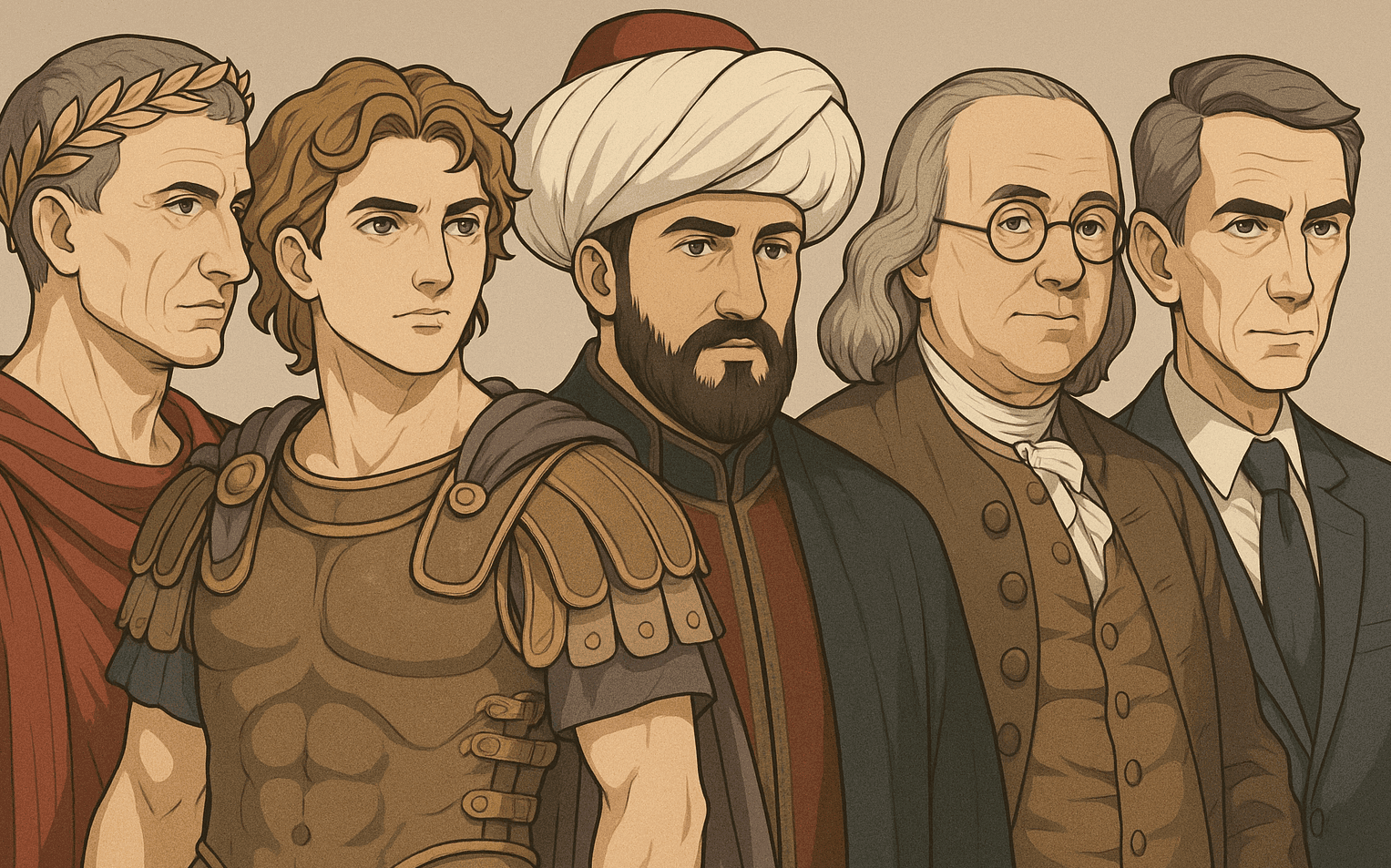
Pick any Fortune 500 CEO, any head of state, any general who turned a losing campaign around. Strip away the title, the era, the costume. Underneath you'll find a decision-making pattern - a repeatable style of reading situations, choosing trades, and convincing other people to follow. Those patterns aren't new. Alexander the Great used one. Ashoka used a completely different one. Caesar picked a third. And the frameworks modern business schools teach - transformational leadership, servant leadership, strategic delegation - showed up centuries before anyone wrote a textbook about them.
That's the real reason historical figures matter. Not because a test asks you to recite their birth years, but because their choices form a library of case studies you can actually reuse. How do you hold a coalition together when resources run thin? How do you govern people who don't share your language or religion? When does boldness pay, and when does it get you assassinated on the Senate floor?
This guide profiles the leaders, inventors, and thinkers whose decisions still echo in boardrooms, laboratories, and legislatures. Each profile pairs narrative with a leadership lens - the specific style or strategic habit that made them effective (or, in some cases, catastrophically wrong). Along the way, you'll see comparison panels that place contrasting leaders side by side so the patterns jump off the page.
Classical Commanders and the Birth of Strategic Leadership
Alexander the Great (356-323 BCE)
Alexander of Macedon ran one of history's most aggressive expansion campaigns - Balkans to the Indus in just over a decade. But speed alone doesn't explain the result. What made Alexander unusual was his ability to combine transformational leadership with brutal logistical precision. He fought at the front of cavalry charges at Issus and Gaugamela, sharing physical risk with his soldiers in a way that built fanatical loyalty. Simultaneously, his quartermasters synchronized marches with harvest cycles and secured grain along river routes so the army never outran its supply.
After conquering a city, Alexander followed a pattern that would later become a management playbook: keep local administrators in place, respect existing customs, and plant new urban centers anchored by Greek-style agoras and garrisons. The result was Hellenistic culture - a fusion of Greek language, geometry, and civic planning that spread across western Asia and lasted centuries after his death at 32.
Alexander practiced leading from the front - a transformational style where the leader's personal risk-taking generates emotional commitment from followers. Modern parallels include founders who take the first sales calls, write the first code, or stand on factory floors during launch week. The danger? It only scales as far as one human body can reach.
His weakness was succession planning. Zero. He left no heir old enough to govern, no written chain of command, and no institutional structure that could survive without his personal charisma. The empire shattered within a generation. It's the oldest lesson in leadership and management: a leader who builds everything around their own presence guarantees collapse the moment they leave the room.
Julius Caesar (100-44 BCE)
Caesar's Gallic War reports read less like propaganda and more like a field manual for bridging rivers, fortifying camps overnight, and navigating the tribal politics of people who didn't want you there. At Alesia, he surrounded the Gallic stronghold with a double ring of earthworks - one belt facing inward to prevent breakout, another facing outward to repel the relief army. It was a logistics puzzle solved with geometry and shovels.
His leadership style was decisive and adaptive. When the Senate ordered him to disband his army, he crossed the Rubicon instead - a calculated bet that speed and momentum would paralyze his opponents before they could coordinate. He was right. He won the civil war, reformed the calendar to a solar standard with leap years (still the foundation of what we use today), expanded citizenship, and centralized administrative power.
Then he ignored the political temperature in the room. On March 15, 44 BCE, senators who felt sidelined stabbed him 23 times. Caesar's arc demonstrates a pattern that repeats endlessly in corporate and political life: the same decisiveness that propels a leader upward can become arrogance that blinds them to growing resentment. Documentation and bold action win campaigns. Listening keeps you alive afterward.
Ashoka the Great (reigned c. 268-232 BCE)
Ashoka conquered most of the Indian subcontinent through conventional warfare - and then made a decision almost no ruler in history has replicated. After the bloody conquest of Kalinga, which reportedly killed over 100,000 people, he publicly renounced military expansion and pivoted to governance through welfare. Stone edicts carved in Prakrit list clinics for people and animals, shade trees planted along roads, judicial reviews to reduce harsh punishments, and inspectors who reported to the court on grain storage, irrigation, and market fairness.
This is servant leadership before the term existed - the idea that a ruler's legitimacy comes from measurable improvements in subjects' daily lives rather than military glory. The Mauryan administrative system tied policy to outcomes in a way that wouldn't look out of place in a modern public service framework.
Cyrus the Great (c. 600-530 BCE)
Cyrus built the Achaemenid Empire across Anatolia, Mesopotamia, and Central Asia using a strategy that modern acquisition-focused companies would recognize: absorb, don't destroy. He kept local laws and ruling elites in place while layering on royal roads, a courier system, and standardized taxation. The Cyrus Cylinder - often exhibited in museums as an early statement of governance principles - framed his legitimacy through proclamations, amnesties, and temple restorations rather than monuments to conquest.
His approach was institutional delegation. Satraps (provincial governors) managed day-to-day operations with significant autonomy, but royal inspectors - the "King's Eyes" - traveled unannounced to audit performance. Think of it as history's first internal audit function. The system scaled across thousands of miles precisely because it didn't require the king's personal attention for every decision.
Style: Transformational, leading from the front
Expansion method: Personal military genius + cultural fusion
Governance: Dependent on personal presence
Succession plan: None - empire fragmented immediately
Modern analogy: Visionary founder who IS the company
Style: Systems-builder, rule through structure
Expansion method: Absorb local systems + layer infrastructure
Governance: Satraps + royal auditors = distributed control
Succession plan: Empire survived him for 200+ years
Modern analogy: CEO who builds processes that outlast them
Conquerors, City-Builders, and the Art of Post-Victory Governance
Genghis Khan (c. 1162-1227)
Temujin stitched feuding steppe clans into the most effective military machine of the medieval world using a principle that still drives the best-run organizations: merit over lineage. Promotions in his army went to the capable, not the well-born. He organized forces into decimal units - groups of ten, a hundred, a thousand, ten thousand - mixing tribal affiliations so loyalty flowed upward to the command structure rather than sideways to old clan ties.
His communication infrastructure was equally radical. The yam relay system moved orders and intelligence faster than any rival could react, covering distances that took weeks on horseback in just days. Signal flags standardized battlefield communication. Mounted archers deployed feigned retreats - an early form of strategic misdirection - that broke enemy formations at range.
After victory, Genghis Khan did something that separates conquerors from mere destroyers: he protected scribes, engineers, and artisans, relocating them to where their skills could scale. It was strategic talent acquisition centuries before any HR department existed. The Mongol Empire's durability owed as much to its knowledge management as to its cavalry.
Timur / Tamerlane (1336-1405)
From Samarkand, Timur combined steppe mobility with siege engineers trained on the latest devices and redirected trade routes to flow through his capital. The Registan complex and Gur-e Amir still stand as evidence of a ruler who understood that cultural prestige and commercial infrastructure reinforce each other. Artisans, architects, and scholars were brought to Samarkand not as prisoners but as investments - their work attracted caravans, and caravans attracted revenue.
Timur's leadership style was transactional at scale: deliver results (build the mosque, route the trade, win the siege) and you were rewarded lavishly. Fail, and consequences were severe. It's a framework that produces spectacular short-term output but struggles with innovation, since fear of punishment discourages experimentation.
Mehmed II, "the Conqueror" (1432-1481)
In 1453, Mehmed brought bronze bombards, a floating bridge, and chained galleys dragged overland to outflank Constantinople's harbor defenses - a combination of engineering, logistics, and lateral thinking that the defenders simply hadn't planned for. But the siege was only half the achievement. What he did next was more impressive.
He reopened the city as Istanbul, repopulated emptied districts with craftsmen and merchants, and reconnected Black Sea grain routes with Mediterranean buyers. His millet system allowed diverse religious communities to manage their own schools, courts, and charitable works while paying taxes to the center. It was a governance framework built on managed pluralism - extracting economic value from diversity rather than trying to stamp it out.
Caesar at Alesia and Mehmed at Constantinople solved different problems with a shared mindset: identify the binding constraint, introduce a tool the opponent hasn't seen before, and keep the timetable moving. Caesar built double earthworks; Mehmed dragged ships over a hill. But both understood that capturing a city is an engineering problem - keeping it alive afterward is a management problem. The same split exists in any product launch: shipping is logistics; retention is operations.
Scholars of the Islamic Golden Age: When Knowledge Was Infrastructure
Al-Khwarizmi (c. 780-c. 850)
His name gave us the word "algorithm." His book Al-Jabr - written at Baghdad's Bayt al-Hikma (House of Wisdom) - outlined systematic procedures for solving equations and introduced Hindu-Arabic numerals to a wider audience. This wasn't abstract theorizing. It was toolbuilding. Without place-value notation and zero, accounting ledgers stay clumsy, astronomical calculations stall, and navigation remains guesswork. With them, you get trigonometry tables, map projections, and eventually actuarial financial mathematics.
Al-Khwarizmi's contribution is a reminder that the most transformative innovations aren't always flashy inventions - sometimes they're better notation systems that let everyone else think more clearly.
Ibn Sina / Avicenna (980-1037)
Born near Bukhara, Ibn Sina wrote the Canon of Medicine - a five-book survey that systematized diagnosis, pharmacology, and anatomy through observation and logic. The Canon served as a university text in multiple languages for centuries. He also argued for experiments and repeatability, the kind of thinking that later scientists formalized into standard laboratory procedure.
What set Ibn Sina apart was his insistence on systematic classification. Rather than treating each illness as a unique mystery, he grouped conditions by symptoms, causes, and treatments - building a taxonomy that allowed physicians to reason by analogy. See a new set of symptoms? Map them against the known categories. It's the same approach modern diagnostic medicine still uses, just with better imaging.
Al-Biruni (973-c. 1050)
A contemporary of Ibn Sina, Al-Biruni measured Earth's radius using mountaintop angles and trigonometry - and came within 1% of the modern accepted value. He produced comparative studies of calendars, religious practices, and cultural systems based on travel and direct interviews. His Kitab al-Hind (Book of India) was field anthropology conducted with rigor that wouldn't arrive in Western academia for another eight centuries.
Al-Farabi, Omar Khayyam, and Ibn Khaldun
Al-Farabi wrote on logic, political philosophy, and music theory, pairing mathematics with tone systems. Omar Khayyam refined solar calendars (his Jalali calendar was more accurate than the Gregorian by some measures) and solved cubic equations by intersecting conic sections. And Ibn Khaldun (1332-1406) wrote the Muqaddimah, proposing that civilizations follow predictable cycles: group solidarity (asabiyyah) rises on the frontier, conquers cities, then declines as comfort erodes discipline. He examined taxation, trade, and education with a systems lens that economists and political scientists still cite.
800+ — years before Western academia formalized field anthropology, Al-Biruni was conducting structured cross-cultural interviews and measurement-based geography
Renaissance Minds: Curiosity as a Competitive Advantage
Leonardo da Vinci (1452-1519)
Leonardo filled thousands of notebook pages with cutaway sketches of muscles, gears, water vortices, and flying machines. He analyzed fluid dynamics, designed military fortifications, and painted the Mona Lisa - treating art and engineering as the same discipline viewed from different angles. His method was simple and replicable: sketch what you think you know, then measure it. When the sketch and the measurement disagree, trust the measurement.
As a project lead, Leonardo was less reliable. He abandoned commissions, missed deadlines, and jumped between interests with a restlessness that modern psychologists might label hyperfocus cycling. The pattern is familiar in creative organizations: the person who generates the most breakthrough ideas is often the worst at finishing deliverables on schedule.
Galileo Galilei (1564-1642) and Isaac Newton (1643-1727)
Galileo tested motion on inclined planes, which let him time events precisely without modern sensors. He pointed telescopes at the Moon and Jupiter and published what he actually saw rather than repeating Aristotelian models. His confrontation with the Church wasn't just about astronomy - it was about the authority of empirical observation versus institutional tradition, a tension that shows up in every industry where data contradicts the boss's intuition.
Newton unified terrestrial and celestial motion with his laws and universal gravitation, then developed calculus to handle rates of change. His Principia turned physics from natural philosophy into predictive engineering. Satellites, bridges, ballistics - the math behind all of them traces back to Newton's framework.
Robert Boyle and Antoine Lavoisier
Boyle used air pumps to quantify the relationship between pressure and volume. Lavoisier provided mass balances that established oxygen's role in combustion and respiration, demolishing the phlogiston theory with careful weighing. Together they established the laboratory version of intellectual honesty: weigh everything, repeat the experiment, publish the numbers even when they contradict your hypothesis.
State-Builders, Strategists, and the Architecture of Power
Niccolo Machiavelli (1469-1527)
Machiavelli stripped governance down to case studies in decision-making. The Prince gets the headlines, but his Discourses on Livy make the deeper argument: republics with citizen militias and rule of law outlast principalities built on one man's cunning. His framework is situational leadership - the idea that different contexts demand different approaches. Sometimes you need to be the lion (overwhelming force). Sometimes the fox (strategic deception). The skill is reading which situation you're in.
Corporate strategists still reference Machiavelli, though usually with a nervous laugh. His point wasn't that leaders should be cruel. It was that leaders who can't accurately assess power dynamics - who mistake their wishes for reality - get removed by someone who can.
Benjamin Franklin (1706-1790)
Printer, scientist, diplomat, city builder, and the closest thing 18th-century America had to a systems architect. Franklin ran a press that spread pamphlets and shaped public opinion. He experimented with electricity using kites and Leyden jars. He charted the Gulf Stream to cut Atlantic sailing times for mail packets. He launched Philadelphia's first lending library, fire brigade, and university. During the Revolution, he served as envoy in Paris, securing the French credit and naval support without which the war was probably unwinnable.
His method was iterative civic infrastructure. Start a local club (the Junto). Pick a practical problem. Pool subscriptions. Test solutions. Publish results. Scale what works. His approach to innovation looks almost identical to modern lean startup methodology - except he did it with printing presses instead of servers.
Core idea: Power is a system - read it accurately or get destroyed
Method: Historical case studies analyzed for repeatable patterns
Weakness: Can shade into cynicism; undervalues moral authority
Modern echo: Competitive strategy frameworks (Porter, game theory)
Core idea: Solve visible problems, build trust, scale the solution
Method: Local experiments, public documentation, coalition-building
Weakness: Requires patience; doesn't work when speed is existential
Modern echo: Lean startup, open-source communities, civic tech
George Washington (1732-1799)
Washington led an underequipped army through freezing winters, devastating defeats, and supply crises that would have broken most commanders. His leadership style was disciplined persistence - not brilliance on the battlefield (he lost more engagements than he won), but the ability to keep an army intact, maintain congressional support, and wait for the right moment to strike. The crossing at Trenton was a tactical masterstroke, but the years of grinding survival that preceded it were the real achievement.
His most consequential decision came after the war. He stepped down after two terms, establishing a norm of voluntary power transfer that held for over a century before becoming law. In a world where every successful general from Caesar to Napoleon seized permanent authority, Washington's restraint was genuinely revolutionary. It's the ultimate case study in knowing when not to lead.
Industry, Electricity, and the Inventors Who Rewired Civilization
James Watt, Michael Faraday, and Thomas Edison
Watt didn't invent the steam engine - he made it efficient. His separate condenser reduced fuel waste dramatically, and his business model charged customers by fuel saved rather than machine price. That's a lesson in value-based pricing that MBA programs still teach. Faraday demonstrated electromagnetic induction - the principle behind every dynamo and transformer on the planet - using handmade coils and magnets in a basement laboratory. Edison built systems, not just gadgets. His Pearl Street Station didn't just generate electricity; it delivered lighting, metering, and billing as an integrated urban service.
Nikola Tesla and Guglielmo Marconi
Tesla championed alternating current when Edison was still insisting on direct current - a dispute sometimes called the "War of Currents" that was really an argument about infrastructure architecture. AC could be stepped up to high voltages for long-distance transmission, then stepped down for household use. DC couldn't. Tesla's polyphase motor and transformer designs won because they scaled better, and the electrical grid you use today is built on his principles.
Marconi linked dots and dashes across the Atlantic with radio, then added ship distress protocols that saved lives. His contribution was less about inventing radio (several people were working on wireless transmission) and more about productizing it - building the business case, the regulatory frameworks, and the operational standards that turned a laboratory curiosity into a global communication network.
Marie Curie and Louis Pasteur
Curie isolated polonium and radium, mapped radiation's behavior, and fielded mobile X-ray units for battlefield surgery during World War I. She won Nobel Prizes in both physics and chemistry - still the only person to have done so. Pasteur connected microbes to disease and created vaccines through attenuation, dismantling the spontaneous generation theory with his famous swan-neck flask experiments. Both embodied a leadership style that modern scientists recognize: relentless empiricism. Follow the data wherever it goes, even when it contradicts established authority or puts your own health at risk.
The Digital Architects: Computation, Information, and the Modern World
Alan Turing (1912-1954)
Turing described an abstract machine that reads symbols on a tape and changes state according to a set of rules - then asked the devastating question: what problems can such machines never solve? That paper, published when he was 24, established the theoretical foundations of computer science. During World War II, he helped design the electromechanical Bombe that cracked Enigma ciphers, arguably shortening the war by years. Afterward, he proposed tests for machine intelligence that still frame debates about AI today.
His leadership was intellectual rather than organizational. Turing didn't build teams or manage budgets particularly well. He advanced human knowledge by asking questions so precisely formulated that they forced entire fields into existence.
Claude Shannon (1916-2001)
Every time you compress a photo, stream a video over a noisy connection, or send an encrypted message, you're using Claude Shannon's blueprint. In 1948, he published "A Mathematical Theory of Communication," transforming messages into probability distributions and defining entropy as the fundamental limit for both compression and reliable transmission. He showed that bits - binary digits stripped of meaning - are the right unit for engineering communication systems.
Shannon also built juggling robots, chess-playing machines, and a motorized unicycle, purely because the problems interested him. His career is the strongest argument for curiosity-driven research - the kind of work that looks like play until it restructures a $4 trillion industry.
Key contribution: Formal model of computation; proved undecidability
Method: Abstract mathematical reasoning applied to foundational questions
Impact style: Set the boundaries of what's possible - and what isn't
Leadership type: Intellectual pioneer; poor organizational manager
Key contribution: Information theory; channel capacity theorem
Method: Applied probability theory to practical communication problems
Impact style: Gave engineers equations they could build products with
Leadership type: Curiosity-driven researcher; worked best alone or in small groups
Grace Hopper and John von Neumann
Hopper built compilers that let programmers write in words rather than raw machine opcodes - a translation layer that democratized software development. Without her work on FLOW-MATIC and its descendant COBOL, programming would have remained a specialist craft rather than becoming the mass profession it is today. Her leadership style was practical advocacy: she didn't just build tools, she campaigned within military and corporate bureaucracies to get them adopted.
Von Neumann described the stored-program architecture that virtually every modern computer still follows, contributed foundational work to game theory, and helped develop the Monte Carlo simulation method used in everything from nuclear physics to financial modeling. His breadth was almost absurd - mathematics, physics, economics, computing, and weapons design, all at world-class level.
Ada Lovelace and Vannevar Bush
Lovelace annotated Charles Babbage's Analytical Engine plans with what historians recognize as the first published algorithm for general computation - Note G, which described how the machine could generate Bernoulli numbers. She also anticipated that computing machines could manipulate symbols beyond pure arithmetic, envisioning applications in music composition and scientific modeling. Vannevar Bush coordinated wartime research for the U.S. government, then wrote "As We May Think" (1945), imagining a personal research library called the Memex - an ancestor of hypertext, web browsers, and the way you're reading this article right now.
Social Reformers: Changing Systems Without Armies
Mohandas Gandhi (1869-1948) and Martin Luther King Jr. (1929-1968)
Both practiced nonviolent resistance, but the strategic mechanics behind their campaigns were anything but passive. Gandhi crafted the Salt March of 1930 as a masterpiece of strategic communication: a 240-mile walk to the sea to make salt - a substance every Indian needed and the British taxed. The action was simple enough for global newspapers to explain in a headline, morally unassailable, and economically threatening to colonial revenue. Behind the symbolism, Gandhi's organization trained marchers in discipline, arranged media coverage, and prepared legal defense teams.
King applied similar principles to the American civil rights movement, framing racial equality as a constitutional claim - not a favor, but a debt. The Montgomery bus boycott succeeded because organizers built a parallel transportation network of carpools before the boycott started, ensuring participants could get to work without giving in. The March on Washington, the Birmingham campaign, and the Selma marches were all choreographed to generate specific legislative outcomes, culminating in the Civil Rights Act of 1964 and the Voting Rights Act of 1965.
Gandhi and King didn't avoid confrontation - they engineered it under conditions that made their opponents' violence visible and morally indefensible. Every march, boycott, and sit-in was preceded by training, logistics planning, and legal preparation. The "spontaneous" nature of the movements was itself a strategic illusion. This is asymmetric leadership: when you can't win through force, you change the arena to one where your strengths matter more.
Mary Wollstonecraft and Emmeline Pankhurst
Wollstonecraft published A Vindication of the Rights of Woman in 1792, arguing that women's apparent intellectual inferiority was the product of denied education, not nature. The argument was structural: change the input (access to education) and the output (civic participation) changes automatically. Pankhurst, a century later, organized suffragette campaigns that escalated from petitions to hunger strikes to property destruction - a deliberate escalation ladder designed to raise the cost of ignoring the movement until Parliament acted. The Representation of the People Act 1918 gave British women over 30 the vote; full equal suffrage followed in 1928.
Medicine, Data, and the Scientific Leaders Who Saved Millions
Florence Nightingale (1820-1910)
Nightingale didn't just nurse wounded soldiers in Crimea. She counted them. Her polar area diagrams - sometimes called "coxcomb charts" - showed Parliament that far more soldiers died of preventable infection than of battlefield wounds. It was one of the earliest uses of data visualization as a policy tool, and it worked. Funding for field hospital sanitation followed. Her statistical methodology influenced public health administration for decades.
Jonas Salk and Tu Youyou
Salk developed the inactivated polio vaccine in the 1950s and then made a choice that shaped public health history: he refused to patent it. "Could you patent the sun?" he asked. The vaccine was distributed widely, and polio cases in the U.S. dropped from 45,000 per year to under 1,000 within a decade. Tu Youyou extracted artemisinin from sweet wormwood using a low-temperature technique inspired by traditional Chinese medical texts, creating a malaria therapy that has saved millions of lives across sub-Saharan Africa and Southeast Asia. She won the Nobel Prize in 2015.
Rosalind Franklin (1920-1958)
Franklin's X-ray diffraction images - particularly the famous Photo 51 - were central to identifying the double-helix structure of DNA. Her crystallographic work required extraordinary precision and patience: months of careful sample preparation for a single usable image. The story of how Watson and Crick saw her data without her knowledge is also a case study in research ethics, credit attribution, and the structural barriers women scientists faced in mid-20th-century institutions.
Engineers of Transport and Space
The Wright Brothers and Amelia Earhart
The Wright brothers built wind tunnels, logged lift coefficients, and iterated propeller designs before leaving the ground at Kitty Hawk in 1903. Their approach was pure engineering methodology: define the variables, test each one in isolation, combine the results. They solved the control problem (wing warping) before the power problem (engine), which is why they flew and their competitors crashed.
Amelia Earhart turned long-distance flights into proof points for aviation reliability, navigation precision, and public interest in flight for everyone - not just barnstormers and military pilots. Her disappearance in 1937 over the Pacific remains one of aviation's enduring mysteries, but her contribution to normalizing air travel was already secure.
Sergei Korolev and Wernher von Braun
One worked in Soviet secrecy, the other in American spotlights, but both solved the same problem: making rockets reliable enough to reach orbit and beyond. Korolev led the R-7, Sputnik, and Vostok programs. Von Braun guided the Saturn V that carried Apollo astronauts to the Moon. Both were systems integrators - their genius wasn't in any single component but in making engines, guidance systems, staging mechanisms, and re-entry shields work together under unforgiving physical constraints.
The leadership challenge in rocketry mirrors any complex multi-team product cycle: hundreds of components from dozens of teams must achieve near-perfect integration, with failure of any single part destroying the whole. Both Korolev and von Braun managed this through obsessive project management discipline and a willingness to test, fail, rebuild, and test again.
The Network View: How One Life Lights the Path for the Next
History's most useful lesson might be that breakthroughs don't happen in isolation. They happen in chains. Each figure in this article solved a problem that became the starting condition for someone else's work, sometimes centuries later.
Systematic equation-solving and Hindu-Arabic numerals spread through Baghdad's House of Wisdom, giving future mathematicians the notation to think clearly.
Systematic diagnosis and clinical observation become a transmissible method rather than individual intuition.
Motion and gravity unified under mathematical laws, turning natural philosophy into predictive engineering.
The first algorithm for a general-purpose computing machine, imagining capabilities beyond arithmetic.
Computation formalized. The boundaries of what machines can and cannot decide are established.
Communication engineering gets its fundamental equations. Bits replace intuition.
Programming shifts from machine code to human-readable languages, democratizing software development.
That chain - from Al-Khwarizmi's notation to Hopper's compiler - spans twelve centuries and at least eight civilizations. Each node depended on the one before it. Al-Khwarizmi's algebra needed Hindu numerals. Newton's calculus needed algebra. Turing's formalization needed calculus. Shannon's information theory needed Turing's framework. Hopper's compiler needed all of them.
The same pattern applies outside mathematics. Pasteur's germ theory built on Lavoisier's chemistry. Nightingale's data visualizations applied statistical methods to clinical outcomes that Pasteur's microbiology explained. Salk's vaccine required both the biological understanding and the public health infrastructure that Nightingale's reforms helped establish.
Extra Profiles: Widening the Range
Charlemagne (c. 742-814)
He regularized weights and measures, supported cathedral schools that preserved classical manuscripts, and sent inspectors (missi dominici) to ensure local counts followed royal policy. The Carolingian Renaissance was less about artistic brilliance and more about administrative standardization - the same force that makes modern supply chains possible.
Tokugawa Ieyasu (1543-1616)
After decades of Japanese civil war, Tokugawa stabilized the country through institutional design rather than continuous conquest. His sankin-kotai system required regional lords (daimyo) to spend alternating years in Edo, keeping potential rebels close to the capital and draining their treasuries on travel and urban residences. It was a brilliantly indirect control mechanism - less dramatic than military occupation, but far cheaper and more sustainable over 250 years of relative peace.
Simon Bolivar (1783-1830)
Bolivar led liberation campaigns across Andes mountain passes to free regions of South America from Spanish colonial rule. His military achievements were remarkable, but his post-war challenge was harder: building functional states from the wreckage of empire. His Carta de Jamaica and constitutional proposals for Gran Colombia attempted to balance regional autonomy with central coordination - a governance problem that South American nations continued wrestling with for the next two centuries.
The takeaway: Historical figures aren't museum exhibits. They're field-tested case studies in decision-making under pressure. The same frameworks that explain why Alexander's empire collapsed and Cyrus's endured - charismatic centralization versus institutional delegation - explain why some startups implode when a founder leaves and others keep growing. The same strategic patience that Gandhi and King deployed against colonial and segregationist systems applies whenever you face an opponent with more raw power but less moral clarity. History isn't a story about the past. It's a pattern library for the present, and every figure in this article left you a tool you can pick up and use.
The profiles here barely scratch the surface. Behind every name on this page stand thousands of collaborators, rivals, students, and critics who shaped what each person could achieve. Washington needed Hamilton's financial architecture. Edison needed teams of machinists and glassblowers. Shannon needed the Bell Labs environment that gave brilliant people room to wander. No leader operates in a vacuum, and the best ones - Cyrus with his satraps, Franklin with his Junto, King with his legal teams - knew it. They built systems of people, not monuments to themselves. That's the pattern worth carrying forward: the figures who endure in memory are the ones who made other people more capable, not just more obedient. If you want your own decisions to compound over time, start there.