Around 3100 BCE, a Sumerian accountant pressed a reed stylus into wet clay and scratched a record of fourteen goats owed to a temple. That tablet still exists. The goats do not. But the impulse behind that moment -- the urge to track, organise, and prove a transaction -- built every civilisation that followed. Forget the romantic image of lone geniuses stacking stones into pyramids. Ancient civilisations rose on something far less glamorous and far more powerful: coordination. The ability to get thousands of strangers to show up, follow a schedule, trust the accounting, and believe the whole effort was worth the sweat.
That skill -- managing collective action at scale -- is the thread that stitches Sumer to Silicon Valley. Every org chart, every supply chain dashboard, every project deadline traces its ancestry to a river valley where someone figured out that surplus grain plus reliable records plus a shared story equals a city.
The four pillars that held up ancient cities -- surplus resources, shared belief, record-keeping, and defence -- still hold up modern organisations. A payroll department tracks surplus time instead of grain. Corporate culture replaces shared ritual. Cloud spreadsheets update the clay tablet. Cybersecurity echoes the watchtower. Strip away the technology and the psychological logic is identical.
Coordination: The Original Management Skill
Before there were CEOs, there were canal overseers. Before quarterly earnings calls, there were harvest tallies. The story of ancient civilisation is, at its core, a story about project management -- and the stakes were existential. Miss a planting window and the city starved. Botch a canal repair and floodwater destroyed the year's crop. Every decision carried consequences measured in human lives, not just revenue.
Consider what Sumer's irrigation system actually required. Hundreds of kilometres of canals had to be dug, maintained, and cleared of silt every season. That meant assigning work crews, scheduling rotations, distributing rations, adjudicating disputes between upstream and downstream farmers, and keeping written records of who had fulfilled their labour obligation. A Mesopotamian overseer around 2400 BCE was juggling resource allocation, labour relations, compliance documentation, and stakeholder management -- the exact job description of a modern operations manager.
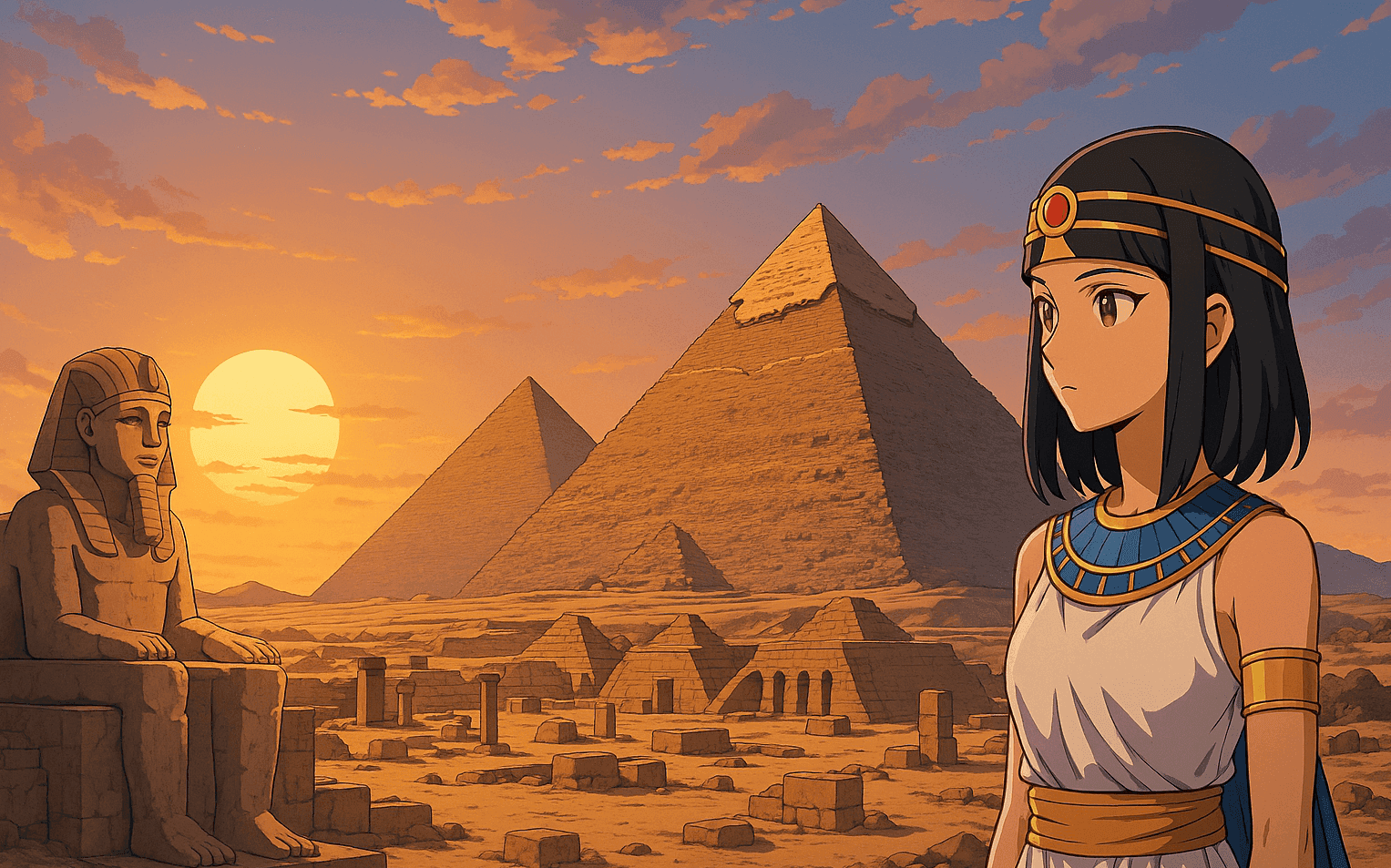
Egypt scaled the same logic to a staggering degree. Building the Great Pyramid at Giza around 2560 BCE required moving roughly 2.3 million stone blocks averaging 2.5 tonnes each over a span of roughly twenty years. Recent archaeological discoveries at the workers' village near Giza reveal that labourers were not enslaved masses but organised crews with names like "Friends of Khufu" and "Drunkards of Menkaure." They received bread, beer, and medical care. Crew performance was tracked. Foremen reported to district supervisors who reported to the vizier. That is a hierarchical org chart, millennia before anyone coined the term.
The Indus Valley took a different approach -- one that looks oddly modern. Mohenjo-Daro and Harappa show almost no evidence of palaces or monumental temples. Instead, they invested in infrastructure: standardised brick sizes (a consistent 4:2:1 ratio), covered drainage running beneath every major street, public granaries, and the Great Bath -- likely used for ritual purification. This was a civilisation that spent its surplus on public works rather than royal display. Some archaeologists call it the world's first middle-class society. Whether or not that label holds, the priorities are unmistakable: sanitation, storage, and standardisation over spectacle.
China's Shang dynasty (roughly 1600-1046 BCE) added another dimension: information warfare. Oracle bone divination was not merely religious theatre. The king controlled access to ancestral spirits, which meant he controlled the calendar, the timing of military campaigns, and the allocation of agricultural effort. Knowledge was power -- literally. The ability to "read" cracks in heated turtle shells and translate them into state policy concentrated authority in the literate elite. Data analytics serving leadership credibility is not a twenty-first-century invention. The Shang perfected it 3,500 years ago.
The takeaway: Every ancient civilisation solved the same core problem -- how to get large numbers of strangers to cooperate reliably. The tools varied (clay tablets, oracle bones, knotted cords, standardised bricks), but the management logic was identical: track resources, assign roles, enforce accountability, and give people a reason to believe.
Mesopotamia: Where Bureaucracy Was Born
Mesopotamia literally means "between the rivers." The Tigris and Euphrates created a fertile crescent of possibilities -- and problems. Unlike the Nile, which flooded with comforting regularity, Mesopotamian rivers were moody. Floods arrived at the wrong time for planting. The water table sat close to the surface, pulling salt upward into topsoil. Every advantage came bundled with a threat.
That volatile environment forced innovation. Sumerian farmers developed canal systems that redirected river water across flat plains, turning marginal scrubland into productive wheat and barley fields. But canals silted up constantly. Maintaining them required coordinated labour on a scale that small family farms could never organise alone. So villages merged into city-states -- Ur, Uruk, Lagash, Eridu -- each governed by a combination of temple priests and secular leaders who could mobilise work gangs during the critical maintenance season.
Writing emerged directly from this administrative need. The earliest cuneiform tablets are not poetry or prayer. They are accounting records: so many bushels of barley, so many jars of beer, so many days of labour owed. The Sumerian word for "scribe" was dubsar -- literally "tablet writer." These were the original data entry specialists, and their output kept the economy functional. Around 2600 BCE, the city of Shuruppak employed scribes who recorded land transactions, inheritance disputes, and even school exercises where student scribes practised multiplication tables. The educational pipeline feeding the bureaucratic machine was already formalised.
Imagine a modern logistics company where every shipment, every warehouse receipt, and every driver assignment was tracked on paper by hand. That was Sumer -- except the paper was wet clay, the warehouse was a temple granary, and the "drivers" were donkey caravans moving copper ingots from the Persian Gulf. The complexity was real. The solutions were ingenious. And the core challenge -- maintaining accurate records across a sprawling supply chain -- is exactly what enterprise resource planning (ERP) software solves today.
Then came law. The Code of Hammurabi, carved onto a basalt stele around 1754 BCE, is often called the first legal code. That is not quite accurate -- earlier Sumerian codes like Ur-Nammu's (circa 2100 BCE) preceded it. But Hammurabi's code is the most complete surviving example, with 282 laws covering property rights, trade disputes, family law, medical malpractice, and construction liability. If a builder erected a house that collapsed and killed the owner, the builder was executed. If it killed the owner's son, the builder's son was executed. Harsh by modern standards, but the underlying principle -- that professionals bear responsibility for the quality of their work -- echoes in every product liability lawsuit filed today.
Mesopotamian mathematics deserves more credit than it usually gets. The base-60 number system developed in Sumer still shapes your daily life: sixty seconds in a minute, sixty minutes in an hour, 360 degrees in a circle. Babylonian mathematicians (inheritors of Sumerian methods) solved quadratic equations on clay tablets a thousand years before Greek geometry entered the picture. Tablet YBC 7289 from the Yale Babylonian Collection shows a square with its diagonal calculated to an accuracy of six decimal places. That is not primitive number-crunching. That is serious mathematical competence.
Egypt: Predictability as a Superpower
Egypt's secret weapon was the Nile's reliability. Each June, snowmelt from the Ethiopian highlands swelled the river. By September, floodwaters had deposited a fresh layer of mineral-rich silt across the valley floor. By October, farmers planted into soil so fertile it barely needed tending. This predictable cycle gave Egypt something Mesopotamia lacked: a stable agricultural calendar that freed enormous quantities of labour for non-farming projects.
And free them it did. The pyramid-building era (roughly 2686-2181 BCE, the Old Kingdom) represents perhaps the most ambitious construction programme in human history relative to available technology. The Great Pyramid alone contains enough stone to build a wall one metre high and half a metre thick stretching from London to Istanbul. Moving that stone required sleds, ramps, levers, copper chisels, and above all, organisation.
2.3 Million — Stone blocks in the Great Pyramid at Giza -- each averaging 2.5 tonnes, assembled over roughly 20 years with zero powered machinery
Recent discoveries have dismantled the old Hollywood image of whip-driven slaves. Papyrus fragments found at Wadi al-Jarf (the oldest known papyri, dating to Khufu's reign) describe a crew leader named Merer who transported limestone blocks by boat from Tura quarries to Giza. His log entries read like a modern shipping manifest: departure times, cargo weights, crew rotations. Workers were organised into competing teams, fed well (cattle bones at the workers' village suggest regular meat rations), and given time off. This was state-sponsored employment on a colossal scale -- a Keynesian stimulus programme 4,500 years before Keynes.
Egyptian medicine ran on systematic observation too. The Edwin Smith Papyrus (circa 1600 BCE, likely copied from a much older text) describes 48 surgical cases with examination, diagnosis, prognosis, and treatment plan. Surgeons sutured wounds, set fractures, and acknowledged their limits -- the willingness to say "this patient cannot be saved" marks a rational mindset that separates medicine from magic.
The everyday writing workhorse was hieratic -- a cursive shorthand scribes used on papyrus for tax records, legal contracts, and personal letters. Literacy rates hovered around 1-3% of the population, making scribes a privileged class. The Satire of the Trades, a Middle Kingdom text, praises the scribe's life while describing every other profession as miserable. It is essentially the oldest known careers pamphlet -- and its argument ("get an education, avoid manual labour") has not changed in four thousand years.
The Indus Valley: Infrastructure Over Ego
The Harappan civilisation (roughly 3300-1300 BCE) sprawled across modern Pakistan and northwest India, covering an area larger than ancient Egypt and Mesopotamia combined. And yet it remains the most mysterious of the major ancient civilisations, because its script -- found on thousands of seal impressions -- has never been deciphered. Without readable texts, we cannot name a single Harappan king, priest, or poet. What we can read, with extraordinary clarity, is their infrastructure.
Mohenjo-Daro's street plan followed a precise north-south, east-west grid. Houses were built from bricks fired to a standard 4:2:1 length-to-width-to-height ratio -- a standardisation so consistent across hundreds of kilometres that it implies centralised quality control or an extremely effective trade guild system. Nearly every house had a private bathroom connected to a street-level drain. Those drains were covered with removable stone slabs for maintenance access. The engineering is so practical it borders on boring, which is exactly the point. The Harappans invested in plumbing, not pyramids.
Massive pyramids, temples, obelisks. Surplus labour directed toward structures glorifying pharaohs and gods. Hierarchical display of power. Individual rulers' names carved into eternity.
Standardised bricks, covered drains, public granaries, the Great Bath. Surplus resources directed toward collective utility. No identifiable royal monuments. Civic engineering over individual glory.
Harappan trade networks stretched from Afghanistan (lapis lazuli) to the Persian Gulf (Mesopotamian texts mention a land called "Meluhha" that most scholars identify as the Indus region). Standardised stone weights in a binary-decimal system let merchants verify quantities without arguing over local measures -- the ancient equivalent of universal product codes. Carnelian beads etched in a technique unique to the Indus have been found in Mesopotamian royal tombs, proving Harappan luxury goods commanded premium prices across the known world.
The civilisation's decline around 1900 BCE remains debated. Climate shift dried the Ghaggar-Hakra river system that fed many eastern settlements. Some cities show overcrowding and deteriorating sanitation in their final phases. When the water supply that supported the system failed, the system failed with it.
China: Writing, Bronze, and the Mandate of Heaven
Chinese civilisation coalesced along the Yellow River's loess plains, where fine wind-blown soil was easy to farm but prone to catastrophic flooding. The river has changed course dramatically at least half a dozen times in recorded history, earning it the name "China's Sorrow." Managing that sorrow required the same hydraulic coordination that shaped Mesopotamia -- dikes, channels, and seasonal labour mobilisation -- but Chinese political philosophy added a distinctive twist: the Mandate of Heaven.
This concept, formalised during the Zhou dynasty (1046-256 BCE) but rooted in earlier Shang thinking, held that heaven granted authority to a just ruler and revoked it from a corrupt one. Natural disasters, famines, and military defeats were read as signs that the mandate had shifted. It was a self-correcting feedback loop built into the political system: perform well and heaven supports you; fail the people and heaven withdraws its favour. Modern democracies achieve something similar through elections, but the Mandate of Heaven operated on a longer and more dramatic timescale.
The Shang dynasty's bronze casting technology was the most sophisticated in the ancient world. Using piece-mould techniques (rather than the lost-wax method common elsewhere), Shang artisans produced ritual vessels of extraordinary intricacy -- wine containers shaped like owls, cooking pots covered in geometric patterns called taotie, and weapons sharp enough to cut bone. Bronze was not merely decorative. It was strategic. Control of tin and copper mines meant control of weapons production, which meant military dominance. The parallel to modern defence supply chains -- rare earth minerals, semiconductor fabrication -- is hard to miss.
Silk production, which the Chinese monopolised for millennia, illustrates how a single trade secret can anchor an entire economic strategy. Sericulture (raising silkworms, harvesting cocoons, reeling thread) required precise temperature control, timing, and mulberry leaf cultivation. The knowledge was guarded so fiercely that legend claims smuggling silkworm eggs out of China was punishable by death. That monopoly generated enormous wealth and eventually created the Silk Road -- a 6,400-kilometre trade network connecting Chang'an to the Mediterranean. Intellectual property protection as an economic strategy? China was running that playbook before Rome existed.
Timeline: Key Innovations That Built the Ancient World
First used for pottery, then adapted for transport. Reduced overland freight costs and enabled heavier cargo movement between river ports and inland settlements.
Evolved from pictographic tokens to abstract wedge marks on clay. Enabled contracts, tax records, and legal codes -- the administrative backbone of urban life.
Sacred script carved on monuments and painted on tomb walls. Hieratic cursive followed for everyday administration on papyrus.
Uniform brick ratios (4:2:1) and binary-decimal stone weights across hundreds of kilometres. Quality control and trade standardisation at civilisational scale.
2.3 million blocks. Twenty years. Zero powered machinery. The largest project management achievement of the ancient world.
Base-60 system, quadratic equations, square root approximations accurate to six decimal places. Still embedded in how we measure time and angles.
282 laws covering property, trade, family, and professional liability. The most complete ancient legal code and a template for written law worldwide.
Piece-mould technology producing ritual vessels and weapons of unmatched intricacy. Bronze control equalled military and political dominance.
22 consonant symbols adapted from Egyptian hieratic. Adopted by Greeks, then Romans. Ancestor of nearly every alphabet used today.
Male citizens voted directly on laws and policy. Jury trials, ostracism votes, and public debate formalised political participation for the first time.
The Americas: Pyramids Without Iron, Empires Without Wheels
Ancient civilisation was not a Eurasian monopoly. Across the Atlantic, cultures built cities, tracked celestial cycles, and managed economies under constraints that make their achievements even more striking. No iron tools. No draft animals suitable for wheeled transport. No contact with the technological traditions of the Old World. Everything was invented independently.
The Olmec (roughly 1500-400 BCE), Mesoamerica's "mother culture," carved colossal basalt heads weighing over 20 tonnes and transported them 80 kilometres without wheeled carts or metal tools. The logistics alone imply labour organisation rivalling Mesopotamian canal projects. Their calendar system and ball game spread to successor cultures including the Maya and Aztec.
The Maya reached intellectual heights that still impress mathematicians. Their Long Count calendar used a base-20 number system that independently invented zero -- centuries before Indian mathematicians formalised it. Maya astronomers calculated Venus's synodic period to within two hours of the modern value. Eclipse predictions enhanced elite authority: when a king announced the sun would darken and it did, his divine credentials were hard to challenge.
In South America, the Inca governed roughly 12 million people across 4,000 kilometres of Andean terrain without alphabetic writing. Instead, they used quipu: knotted cords where position, spacing, colour, and twist direction encoded numerical information. Relay runners called chasqui carried quipu along a road network totalling 40,000 kilometres -- longer than Rome's. Way stations stocked with dried food and replacement cords kept the information flowing. A packet-switching network built from llama wool and human endurance.
Phoenicians, Greeks, and Romans: The Mediterranean Relay
While river-valley civilisations mastered agriculture and administration, Mediterranean cultures perfected something equally transformative: connectivity. The Phoenicians, Greeks, and Romans each amplified the reach of ideas, goods, and governance systems across water rather than along riverbanks -- and the consequences rippled forward through every century that followed.
Phoenician merchants from Tyre and Sidon mastered cedar shipbuilding and established trading colonies from Carthage to Cadiz. Their most lasting export was the alphabet. Around 1050 BCE, the Phoenician script condensed hundreds of cuneiform and hieroglyphic symbols into 22 consonant letters. The Greeks added vowels. The Romans refined letterforms. Every time you read an English sentence or sign a contract, you are using technology that Phoenician traders optimised for speed. They did not invent writing -- they made it portable and commercially practical.
The Greeks took those letters and built a civilisation obsessed with argument. Athenian democracy (from roughly 508 BCE) gave male citizens direct voting power -- not through representatives but through personal attendance at the assembly. The system was deeply flawed (women, slaves, and foreigners excluded), but the principle that political authority derives from collective consent became the load-bearing beam of Western political philosophy.
Greek intellectual output remains staggering. Thucydides invented evidence-based history. Hippocrates separated medicine from religion. Euclid systematised geometry. Archimedes calculated pi. These were products of a culture that rewarded public argumentation and competitive intellectual display. The Renaissance rediscovered their texts. The Enlightenment built on their logic.
Rome absorbed Greek culture and scaled it to imperial dimensions. Eighty thousand kilometres of engineered roads supported year-round wheeled traffic. Roman concrete used volcanic ash to harden underwater -- the Pantheon's dome, poured around 125 CE, remains the world's largest unreinforced concrete dome. Roman law introduced concepts still embedded worldwide: innocent until proven guilty, the right to face your accuser, the distinction between public and private law. And the Roman census was the original big-data governance project.
The Phoenician alphabet became your keyboard. Greek logic became your scientific method. Roman concrete engineering principles inform modern infrastructure. The base-60 Mesopotamian number system sets your clocks. Egyptian surveying geometry sits inside every GPS calculation. Indus Valley standardisation principles underpin every ISO standard and shipping container. Ancient civilisation is not a dead subject -- it is the operating system running beneath modern life.
Trade Networks: Globalisation 1.0
Globalisation did not begin with container ships. It began with donkey caravans, reed boats, and merchants willing to walk for months across terrain that would make a modern logistics manager weep. Ancient trade networks transferred not just goods but ideas, technologies, diseases, and genes across continents.
Mesopotamian texts from the third millennium BCE mention imports of lapis lazuli from Afghanistan, carnelian from the Indus Valley, cedar from Lebanon, and copper from Oman. These required credit arrangements, standardised weights, trusted intermediaries, and dispute resolution -- the full infrastructure of international commerce. Merchant families in Ur maintained multi-generational trading relationships with counterparts thousands of kilometres away.
The Silk Road, formalised during the Han dynasty (206 BCE - 220 CE) but built on older routes, connected Chinese silk production to Roman consumer demand across Central Asia. Middlemen added markups at every stage, so silk that cost a few coins at origin might sell for its weight in gold by the time it reached Rome. The markup structure mirrors modern luxury goods pricing: raw materials are cheap, but exclusivity and transport inflate the final price by orders of magnitude.
Maritime routes were just as significant. Egyptian expeditions to the "Land of Punt" brought back frankincense and myrrh. Phoenician ships reached Britain for tin. Austronesian sailors colonised Madagascar -- 6,000 kilometres from Southeast Asia. The Indian Ocean was crisscrossed by monsoon-riding traders linking South Asia, Arabia, and East Africa in a commercial web that predated European "discovery" by millennia.
From Clay Tablets to Cloud Storage: Enduring Lessons
Data drives authority. Sumerian temple priests tallied sheep owed in tax. Maya astronomers timed corn planting by Venus cycles. Shang kings monopolised oracle bone interpretation. Egyptian scribes controlled the literacy pipeline. In every case, the group that controlled information controlled the civilisation. Today, KPI dashboards shape marketing budgets and algorithmic feeds shape elections. The medium changes; the power dynamic does not.
Infrastructure outlives rulers. The Great Bath at Mohenjo-Daro, the qanat tunnels of Persia, and Roman aqueducts kept serving populations long after specific dynasties vanished. Current mayors still cut ribbons on subway lines laid by predecessors three administrations ago. Choosing equipment that survives organisational turnover is a lesson project managers repeat whenever they debate proprietary versus open-source software.
Standardisation multiplies trade. Indus seals, Egyptian cubits, Chinese bronze weight sets, Phoenician alphabet letters, and Roman coin denominations all solved the same bottleneck: how do strangers close a deal quickly without arguing over units? ISO codes, container sizes, and USB plugs continue the pattern. Each cut haggling overhead so producers can focus on volume and quality.
Surplus + Records + Shared Story + Defence = Civilisation. Whether the surplus is grain or server capacity, the records are clay or cloud, the story is divine mandate or corporate mission, and the defence is a wall or a firewall -- the formula holds. Every startup that scales past fifty employees reinvents these four pillars, usually without realising they are following a 5,000-year-old playbook.
Shared stories reduce friction. Myths of Osiris, Marduk, the Mandate of Heaven, or Viracocha validated tax collection because they framed the state as a caretaker appointed by cosmic order. Modern businesses rely less on divine appointment, but company narratives about mission and stakeholder value still push staff to accept late nights before product launch. Remove the story and extrinsic rewards must rise sharply to preserve motivation -- a cost line every CFO tracks.
Geography is opportunity and hazard in equal measure. Rivers made soil fertile yet invited floods. Mountain strongholds offered defence yet hindered grain shipments. Silk Road oases enabled commerce yet attracted bandits. Digital terrain follows the same rule: high-speed fibre grants cloud startups access to customers worldwide, while cyberattacks threaten the same paths. Strategy still begins with an honest map.
Failure modes repeat. Ecological stress felled the Classic Maya in parts of the Yucatan. Salinisation starved Sumerian wheat fields (by 2000 BCE, Sumer's barley yields had dropped roughly 40% from their peak). The Ghaggar-Hakra river system dried up and Harappan cities emptied. Plague weakened Rome. In every case, the civilisation had outgrown the carrying capacity of its environment or failed to adapt to a changing one. Excess resource extraction, pandemic risk, and soil degradation headline global business reports twenty centuries later. The warning is persistent: technology improves, but biological and physical limits still apply.
What Ancient Civilisations Teach Modern Leaders
Strip the subject to its bones and ancient history delivers a management curriculum that no business school has surpassed. It just uses different case studies.
Mesopotamian irrigation teaches systems thinking -- understanding that upstream decisions create downstream consequences, that maintenance is cheaper than crisis repair, and that shared infrastructure requires shared governance. Every modern debate about internet regulation, water rights, or electrical grid investment runs on the same logic.
Egyptian pyramid construction teaches programme management -- breaking an impossibly large goal into measurable phases, feeding and housing your workforce, tracking progress in writing, and maintaining motivation through team identity and fair compensation. The Giza workers' village is the oldest evidence of an employer investing in worker welfare to boost productivity. HR departments, take note.
Harappan urban planning teaches design thinking -- prioritising user needs (sanitation, drainage, storage) over prestige display, standardising components for interoperability, and building maintenance access into the original design. Every UX designer who argues for "boring but functional" over "flashy but fragile" is channelling Mohenjo-Daro's city planners.
Chinese oracle bone divination teaches information asymmetry -- whoever controls the data interpretation controls the narrative. The Shang king did not just ask the ancestors for advice; he monopolised the right to interpret their answers. Modern parallels are uncomfortable but instructive: algorithm designers, credit rating agencies, and intelligence services all wield authority through exclusive access to data interpretation frameworks.
Phoenician trade teaches platform economics -- creating a standard (the alphabet) that everyone adopts, then profiting from the network effects as communication costs plummet and trade volume explodes. The Phoenicians did not conquer territory. They built the protocol layer that other civilisations used, and they positioned themselves as indispensable intermediaries. That is the playbook of every modern platform company.
History is not a subject you study to pass an exam and forget. It is a pattern library. The civilisations covered here -- Sumerian, Egyptian, Harappan, Chinese, Olmec, Maya, Inca, Phoenician, Greek, Roman -- each solved the fundamental problem of large-scale human cooperation in a slightly different way. Some prioritised monumental display. Others invested in infrastructure. Some centralised authority in a god-king. Others distributed it across assemblies. Some guarded their trade secrets for millennia. Others broadcast their innovations freely.
Every one of those strategic choices has a modern equivalent. Every one of their failure modes is still active. And every one of their successes offers a template worth studying -- not because the past predicts the future in any mechanical sense, but because the constraints of human psychology, ecology, and group coordination change far more slowly than our technology does. The Sumerian canal overseer and the Silicon Valley product manager face the same core question: how do you get a large group of people, most of whom have never met, to cooperate reliably toward a goal none of them could achieve alone?
The ancient world answered that question. We are still refining their answers.