On a September morning in 1983, Soviet Lieutenant Colonel Stanislav Petrov watched his console light up with five incoming American nuclear missiles. Every protocol told him to report immediately so Moscow could launch a counterstrike. He had roughly twenty minutes before impact. He picked up the phone, paused, and told his superiors it was a false alarm. He was guessing. He happened to be right -- a satellite had confused sunlight reflecting off clouds for rocket exhaust. If Petrov had followed the rulebook, a retaliatory salvo could have killed a hundred million people before lunch. That is how thin the margin was. For forty-five years, two nations pointed enough warheads at each other to end civilization multiple times over, and the whole arrangement held together through a combination of game theory, bureaucratic caution, espionage, bluffing, and -- more than anyone wants to admit -- sheer luck.
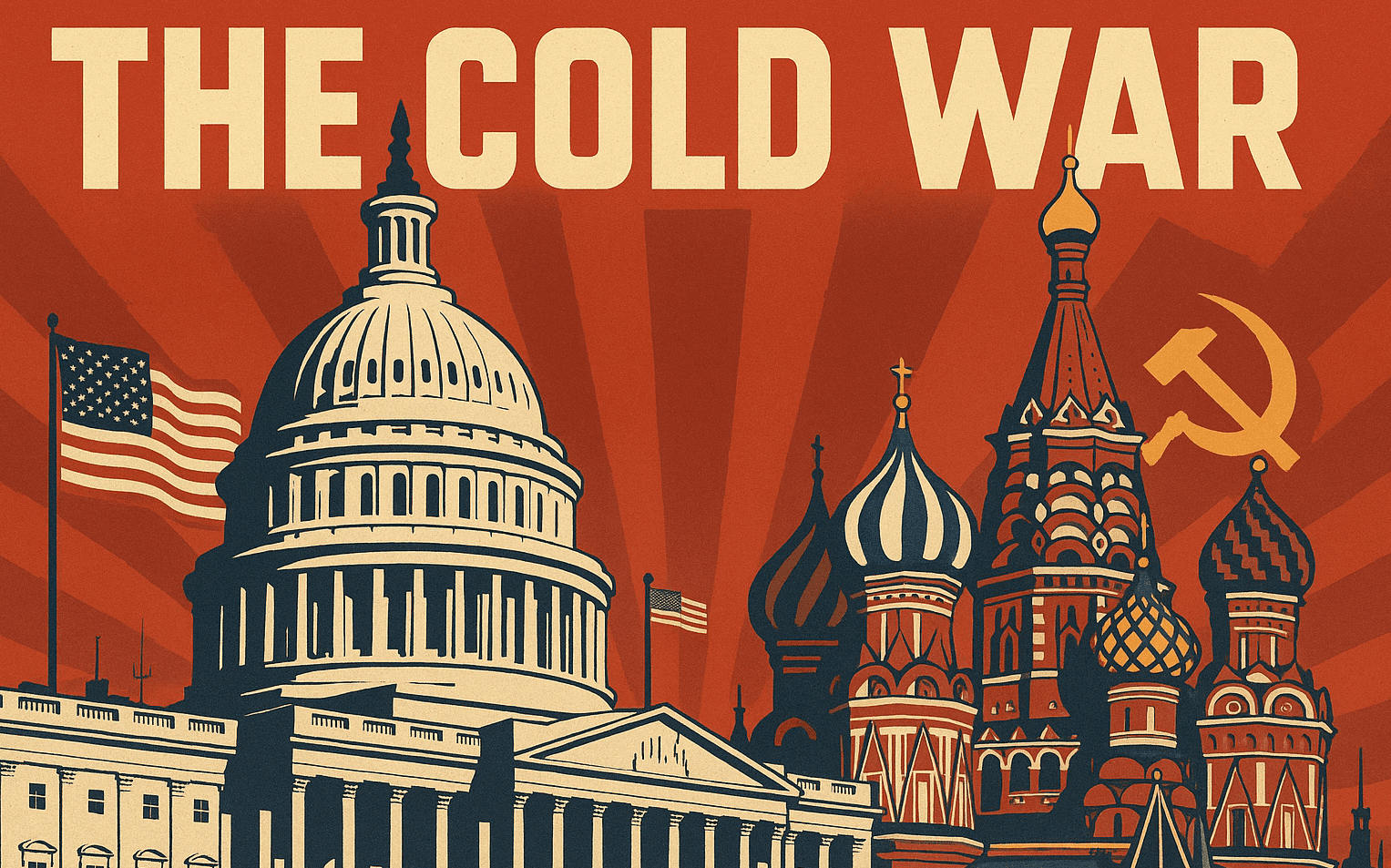
The Cold War was never a single conflict. It was an ideological operating system that ran underneath every major event from 1947 to 1991 -- every election in Latin America, every famine relief decision in Africa, every satellite launch, every Olympic boycott. Two superpowers, each convinced that the other's model of organizing society would destroy freedom or equality (depending on which side you asked), waged a global competition that reshaped economies, created technologies you use every day, and drew lines on maps that still cause wars.
The Split Nobody Planned
The wartime alliance that defeated Nazi Germany collapsed with breathtaking speed. The United States and the Soviet Union had nothing in common except a shared enemy, and once that enemy signed an unconditional surrender in May 1945, the friction became impossible to ignore. Washington championed elected governments, private enterprise, and open trade. Moscow demanded a security buffer of loyal states along its western border -- understandable, given that 27 million Soviet citizens had just died in a war that invaded from the west. Both sides read history as proof that the other posed an existential threat.
The United States held two decisive cards in 1945: atomic weapons and an industrial base untouched by bombing. The Soviet Union held the world's largest standing army and physical control of Eastern Europe from the Baltic to the Balkans. Winston Churchill's March 1946 speech in Fulton, Missouri gave the split a name. An "iron curtain," he said, had fallen across the continent. The phrase stuck because it described something people could already see.
Political: Multi-party democracy, constitutional limits on power, independent judiciary, free press
Economic: Private ownership, market pricing, profit motive as the engine of innovation, consumer choice
Assumption: Individual freedom produces collective prosperity. Markets self-correct. Government should referee, not play.
Political: One-party state, centralized authority, state-run media, ideological conformity enforced
Economic: State ownership, central planning, output quotas set by ministries, employment guaranteed but wages fixed
Assumption: Collective ownership eliminates exploitation. The state allocates resources rationally. Profit is parasitic.
Key moves in the late 1940s made the split permanent. The Marshall Plan (1948) poured $13.3 billion -- about $170 billion in today's dollars -- into sixteen Western European nations. Dollars, machinery, and food rebuilt factories, stabilized currencies, and created customers for American exports. It was simultaneously generous and strategically brilliant: a devastated Europe was vulnerable to communist parties that polled well in France and Italy. Moscow rejected the offer and forbade its satellite states from accepting. That same year, the Truman Doctrine pledged support for governments resisting communist pressure in Greece and Turkey. By 1949, two German states existed. NATO bound the United States to Western Europe. And the Soviet Union tested its own atomic bomb, four years ahead of CIA estimates.
The game was on.
Berlin: The City That Became a Symbol
Berlin sat over a hundred miles inside the Soviet occupation zone, which made it the most vulnerable pressure point in the Western position. When the Western sectors introduced a new currency in June 1948 -- a prerequisite for economic recovery that Moscow hadn't approved -- Stalin closed every road and rail line into the city.
Western planners faced an ugly choice: push an armored convoy through the blockade (risking a shooting war) or feed two million people by air (a logistical impossibility, according to most experts). They chose the impossible option. For eleven months, British and American pilots landed cargo planes at Tempelhof and Gatow every ninety seconds at peak, day and night, through winter fog and crosswinds. Coal. Flour. Medicine. Even candy -- pilot Gail Halvorsen started dropping chocolate bars on tiny parachutes, earning the nickname "Candy Bomber." By the spring of 1949, the airlift was delivering more tonnage than the roads had ever carried. Stalin quietly lifted the blockade.
2.3M tons — Total cargo delivered during the Berlin Airlift (June 1948 - May 1949) across 278,000 flights
The lesson was profound and practical: logistics can defeat intimidation when planners match tonnage to schedules and maintain discipline under stress. But Berlin's role as Cold War flashpoint was far from over. By the late 1950s, East Germany was hemorrhaging talent. Doctors, engineers, teachers -- anyone with portable skills walked into West Berlin and never came back. Between 1949 and 1961, roughly 3.5 million East Germans left. In August 1961, construction crews appeared overnight and strung barbed wire across the city. Within days, concrete panels and watchtowers replaced the wire. Families split in hours. A woman waving to her sister across a barrier that would stand for twenty-eight years. The Berlin Wall became the Cold War's starkest physical symbol.
MAD: Game Theory with Nuclear Warheads
Here is where the Cold War stops sounding like history and starts sounding like a problem set from a graduate seminar in fiscal policy -- except the stakes were extinction.
Fission bombs gave way to thermonuclear devices by the mid-1950s. A single hydrogen bomb carried more destructive power than every explosive used in all of World War II combined. Intercontinental ballistic missiles arrived soon after, and both sides built what strategists called a nuclear triad: land-based missiles in hardened silos, submarine-launched missiles that could hide in the ocean depths, and bombers that could loiter and turn back if called off. Early-warning radars, spy satellites, and "dead hand" automated systems tried to ensure that no surprise first strike could eliminate the ability to retaliate.
The logic was perverse but internally consistent. If Country A launches first, Country B's surviving forces destroy Country A's cities and industry. Both sides lose everything. Therefore, neither side launches. Analysts called this Mutually Assured Destruction -- MAD -- and the acronym was no accident. The entire framework depended on each side believing the other was willing to commit collective suicide rather than lose.
MAD is essentially the Prisoner's Dilemma scaled to civilization. In game theory, two rational actors choosing purely self-interested strategies can produce the worst possible outcome for both. The "solution" to the nuclear version was to make defection (launching first) so catastrophically costly that cooperation (not launching) became the only rational choice -- even between enemies who trusted each other about as far as they could throw a Minuteman III missile.
The arithmetic was staggering. At peak, the United States held roughly 31,000 nuclear warheads. The Soviet Union held about 40,000. Combined, that was enough to destroy every city on Earth multiple times. The redundancy was the point -- you needed so many that even after absorbing a first strike, enough survived to end the attacker's civilization.
But hardware is only half the story. Mistakes nearly triggered the unthinkable more than once. In 1961, a B-52 broke apart over Goldsboro, North Carolina, dropping two hydrogen bombs. One went through five of its six arming stages. A single low-voltage switch prevented detonation. In 1983 -- the same year Petrov caught the false alarm -- NATO ran a war game called Able Archer 83 so realistic that Soviet intelligence briefly believed it was cover for an actual first strike. Aircraft were loaded with nuclear weapons in response before calmer heads prevailed.
The lesson? Deterrence works until it doesn't. And "until it doesn't" is a genuinely terrifying qualifier when the failure mode is the end of civilization.
Proxy Wars: Where the Cold War Turned Hot
The superpowers never fired directly at each other. They didn't need to. They had proxies.
Korea (1950-1953). After Japan's surrender, occupation lines split the Korean peninsula at the 38th parallel. On June 25, 1950, North Korean forces crossed south. A United Nations command led by the United States pushed them back to the Yalu River -- the Chinese border. China responded by sending 300,000 troops across that river, driving UN forces south in some of the most brutal winter fighting since Stalingrad. The front stabilized near the original dividing line. An armistice in July 1953 established a demilitarized zone. No peace treaty was ever signed. Technically, the war is still on. The conflict proved that the Cold War could produce massive conventional battles -- 2.5 million dead, including 36,000 Americans -- without anyone pressing the nuclear button.
Vietnam (1955-1975). France lost its Indochina colony at Dien Bien Phu in 1954. A temporary partition at the 17th parallel hardened into a permanent split. The United States escalated from a handful of advisors to over 500,000 combat troops after 1964, bombing North Vietnam with more tonnage than all of World War II. None of it produced a stable South Vietnamese government. The war killed roughly 58,000 Americans and between 1.5 and 3 million Vietnamese. Antiwar protests convulsed American society, redefined how media covered conflict, and seeded a generation-long skepticism about military intervention that influenced contemporary policy debates.
Afghanistan (1979-1989). The Soviet Union invaded in December 1979 to prop up a failing Marxist government. Washington, Islamabad, and Riyadh funded mujahideen fighters, supplied Stinger missiles that neutralized Soviet air superiority, and turned the conflict into Moscow's Vietnam. After a decade of guerrilla warfare and roughly 15,000 Soviet dead, the Red Army withdrew. The war accelerated Soviet economic decline and left Afghanistan shattered -- setting the stage for the Taliban and eventually the September 11 attacks.
Every major proxy war followed the same grim template: a local dispute (colonial independence, border conflict, ideological rivalry) got amplified by superpower funding and weapons. Local actors gained military capacity far beyond what their own economies could support. The superpowers avoided direct confrontation but paid in money, credibility, and -- when things went wrong -- blowback that showed up years later in unexpected places.
The Cuban Missile Crisis: Thirteen Days on the Edge
October 1962. Fidel Castro's government, aligned with Moscow since the Bay of Pigs fiasco, agreed to host Soviet nuclear missiles ninety miles from Florida. U-2 reconnaissance aircraft photographed the construction sites. President Kennedy convened an executive committee that debated options ranging from diplomatic protest to a full-scale invasion. He chose a naval quarantine -- a blockade by another name, since "blockade" was technically an act of war.
For thirteen days, Soviet cargo ships steamed toward the quarantine line while the world held its breath. Back-channel negotiations, some conducted through journalists and a Soviet intelligence officer named Aleksandr Feklisov, hammered out a deal: Moscow would remove the missiles. Washington would publicly pledge not to invade Cuba and privately agree to withdraw obsolete Jupiter missiles from Turkey. A direct communications hotline -- the famous "red phone," which was actually a teletype -- was installed between the White House and the Kremlin to prevent future misunderstandings.
The crisis changed something fundamental in how both sides thought about their rivalry. Before Cuba, each side occasionally entertained the notion that nuclear war was winnable. After Cuba, the consensus shifted: nuclear war was unsurvivable. That shift made arms control politically possible for the first time.
The Space Race: Innovation Under Competitive Pressure
Nothing captures the Cold War's strange mixture of terror and inspiration quite like the space race. The same rockets that could deliver nuclear warheads to Moscow or Washington could also carry humans into orbit. And both sides understood that whichever nation mastered space would demonstrate technological supremacy to the entire watching world.
The Soviet Union launches the first artificial satellite. A polished sphere the size of a beach ball circles Earth every 96 minutes, beeping on a frequency any ham radio operator could pick up. The psychological shock in the United States is enormous -- Congress floods funding into science education and creates NASA.
Yuri Gagarin becomes the first human in space. Kennedy responds by committing the United States to landing a man on the Moon before the decade ends -- a goal with no existing technology to achieve it.
John Glenn becomes the first American to orbit Earth, partially closing the perception gap. The Mercury program proves NASA can compete.
Alexei Leonov floats outside his capsule for twelve minutes. Ed White follows for the U.S. three months later. Each milestone ratchets competitive pressure higher.
Neil Armstrong and Buzz Aldrin walk on the Moon. An estimated 600 million people watch live. The United States wins the most visible contest of the Cold War. The Soviet lunar program, plagued by rocket failures, never makes it.
American and Soviet spacecraft dock in orbit. Astronauts and cosmonauts shake hands. A symbolic end to the space race, though competition continues in other domains.
The space race was a business strategy lesson disguised as a geopolitical contest. NASA's peak budget consumed 4.4% of all federal spending -- roughly $50 billion a year in current dollars. That investment didn't just produce Moon rocks. The technologies developed for Apollo cascaded into civilian life: integrated circuits that became the foundation of modern computing, water purification systems, medical telemetry, freeze-dried food, and the materials science behind everything from scratch-resistant lenses to fireproof gear for firefighters.
The Soviet program made breakthroughs too. Their space station program (Salyut, then Mir) pioneered long-duration spaceflight decades before the International Space Station. Their rocket engines were so efficient that American companies purchased them for commercial launches well into the 2000s. Competition drove innovation on both sides at a pace that peacetime research budgets almost certainly would not have matched.
Espionage: The Shadow War
Spies, defectors, and covert operations ran through the entire Cold War like a parallel nervous system. This was not James Bond. It was bureaucratic, paranoid, morally compromised, and occasionally decisive.
Washington backed coups in Iran (1953) and Guatemala (1954), betting that friendly authoritarian regimes beat governments that might drift toward Moscow. Moscow funded communist parties and "liberation fronts" from Angola to El Salvador. Both sides ran embassies wired with listening devices, submarines that tapped undersea cables, and satellites that could photograph missile sites from orbit.
The human drama was real. Klaus Fuchs passed atomic bomb designs to Moscow, accelerating the Soviet weapon by years. Kim Philby, a senior British intelligence officer, secretly worked for the KGB for decades before defecting in 1963. Oleg Penkovsky, a Soviet military intelligence colonel, passed missile data to the CIA and MI6 that proved critical during the Cuban crisis -- he was executed for it. Espionage drove budgets, tightened security clearances, fueled domestic paranoia (McCarthyism in the U.S., purges in the USSR), and occasionally changed the course of events.
The Non-Aligned World and Decolonization
Not everyone wanted to pick a side. Newly independent states across Asia, Africa, and the Middle East refused to join either bloc, forming the Non-Aligned Movement at conferences in Bandung (1955) and Belgrade (1961). Leaders like India's Nehru, Egypt's Nasser, Yugoslavia's Tito, and Indonesia's Sukarno argued for a third path: accept aid from both superpowers, play them against each other, and maintain sovereignty.
The strategy was clever. It was also fragile. Decolonization intersected with Cold War rivalry at every turn. When Nasser nationalized the Suez Canal in 1956, Britain, France, and Israel attacked. Both Washington and Moscow -- for entirely different reasons -- opposed the invasion. The intervention collapsed, and the old European colonial powers lost whatever credibility they had left across the developing world. In the Congo after 1960, a chaotic independence was immediately complicated by secession, assassinations, and superpower meddling. In Algeria, an eight-year war of independence against France produced over a million casualties and nearly toppled the French government.
The Cold War didn't cause decolonization -- that was driven by local nationalism and the moral bankruptcy of empire. But the Cold War determined which side armed which rebel movement, which dictator got propped up, and which newly independent nation got economic aid. The consequences of those choices are still visible in the political maps, debt structures, and alliance patterns of the Global South today.
Comparing the Economic Systems
The Cold War was ultimately an argument about economics. Which system produces more wealth? Which distributes it more fairly? Which adapts faster? The answers turned out to be more complicated than either side's propaganda suggested, but the final scoreboard was decisive.
Strengths: Price signals directed resources efficiently. Competition drove innovation. Consumer demand shaped production. Flexible labor markets allowed rapid reallocation.
Weaknesses: Inequality, boom-bust cycles, externalities like pollution and financial crises. Social safety nets came slowly and unevenly.
GDP per capita (1990): ~$23,200
Strengths: Could mobilize massive resources for specific goals (heavy industry, military, space). Full employment. Free education and healthcare (variable quality).
Weaknesses: No price signals meant chronic misallocation. No consumer feedback loop. Innovation stifled by bureaucracy. Agriculture perpetually underperformed.
GDP per capita (1990): ~$6,900
The Soviet model delivered impressive GDP growth in the 1930s through 1960s, particularly in heavy industry and military production. It turned a largely agrarian nation into a nuclear-armed industrial power in a single generation. But the model broke down when economies became too complex for central planners to manage. A steel mill is relatively simple to plan from the top down. A consumer electronics industry where products evolve every eighteen months is not. By the 1980s, Soviet citizens joked about their economy: "We pretend to work, they pretend to pay us."
The American system had its own problems -- grinding poverty amid abundance, healthcare tied to employment, periodic financial panics. But it adapted. It absorbed shocks. When the 1970s oil crisis hammered the economy, painful restructuring eventually produced efficiency gains. When Japan's manufacturing challenged American dominance, firms responded with automation and innovation. The system's self-correcting mechanisms, messy and often cruel, kept producing growth over the long run.
Détente: Managing the Rivalry
After the Cuban Missile Crisis, both sides slowly accepted that coexistence was preferable to extinction. The result was détente -- a period of managed rivalry that traded absolute hostility for negotiated limits.
The 1963 Limited Test Ban Treaty ended atmospheric nuclear testing. The 1968 Non-Proliferation Treaty tried to prevent new nations from acquiring nuclear weapons. SALT I in 1972 capped certain missile categories and, through the ABM Treaty, limited missile defense systems to one site per country -- preserving the MAD framework by ensuring neither side could shield itself from retaliation. The 1975 Helsinki Final Act confirmed European borders and included language on human rights and free movement that dissidents behind the Iron Curtain later wielded as a political weapon.
Détente expanded trade. American grain shipments fed Soviet cities. Technology transfers flowed both ways. Leaders met for summits and photo opportunities. But the rivalry never stopped. Proxy wars continued in Africa, Latin America, and the Middle East. Hawks in both capitals viewed the other side's compliance as temporary and tactical. Détente didn't end the Cold War. It kept it from ending the world.
The Global South as Battleground
For billions of people in Africa, Latin America, the Middle East, and Southeast Asia, the Cold War was not an abstract geopolitical chess match. It was the force that determined whether their country got schools or death squads, dams or drone strikes, development loans or destabilization campaigns.
Africa. When Portugal's colonial empire collapsed in 1974-75, civil wars in Angola and Mozambique became proxy theaters. Cuban combat troops, South African armored units, Soviet aircraft, and Western advisors all operated simultaneously. Ethiopia and Somalia fought over the Ogaden region in 1977-78, with Moscow switching clients mid-conflict in one of the Cold War's more cynical pivots.
Latin America. In Chile, the CIA-backed 1973 coup overthrew Salvador Allende and installed Augusto Pinochet, who murdered thousands while implementing free-market reforms that American economists had designed. In Central America, Nicaragua's Sandinista revolution (1979) and the El Salvador civil war drew covert funding and proxy fighters throughout the 1980s. Human rights reports documenting torture and civilian massacres raised the political cost of these operations and contributed to congressional restrictions on covert action.
The Middle East. The 1973 Arab-Israeli war triggered an oil embargo that quadrupled fuel prices virtually overnight, demonstrating how Cold War alliances could create global economic shockwaves. Washington brokered the 1978 Camp David Accords between Egypt and Israel -- a genuine diplomatic achievement that also realigned the Middle East's Cold War dynamics. The 1979 Iranian Revolution toppled a key American ally and created a theocratic state that opposed both superpowers. That same year, the Soviet invasion of Afghanistan began the chain of events that would, over the next decade, accelerate Moscow's decline.
China: The Third Player
No account of the Cold War makes sense without China. Initially a Soviet ally, Beijing broke with Moscow by the late 1950s over doctrinal disputes, border territory, and the question of who led the global communist movement. Armed clashes along the Ussuri River in 1969 brought the two communist giants close to open war.
Richard Nixon's 1972 visit to Beijing -- orchestrated by Henry Kissinger through months of secret diplomacy -- was one of the Cold War's most consequential pivot points. By engaging China, Washington gained leverage against Moscow and fundamentally reshaped the strategic triangle. After Mao's death in 1976, Deng Xiaoping launched market-oriented reforms under continued Communist Party control. Special Economic Zones attracted foreign factories and capital. The results, across two generations, produced the most dramatic economic expansion in human history and created the manufacturing base that now produces a large share of the world's consumer goods.
China's trajectory also posed an awkward question for Cold War ideologues on both sides: what do you call a one-party communist state that runs a market economy and becomes the world's largest trading nation? The Cold War's clean ideological categories -- capitalism versus communism, freedom versus tyranny -- turned out to be less stable than either side believed.
Why the Soviet System Stalled
By the late 1970s, the structural failures of the Soviet economy were becoming impossible to hide. Central planners chronically misread consumer demand. Agricultural output depended on weather and subsidies rather than innovation. Oil exports masked the depth of industrial problems -- when prices were high, hard currency flowed in and papered over inefficiencies; when prices dropped, the system lurched toward crisis.
Imagine running a company where every product decision -- what to manufacture, how many, at what price, where to ship them -- is made by a committee that meets once a year, uses data that's six months old, and punishes anyone who reports bad news. No customer feedback. No competitor pressure. No ability to reallocate resources when demand shifts. That was the Soviet economic planning system, applied to a continent-spanning nation. It worked tolerably well for building steel mills and tanks. It was catastrophically ill-suited for an information economy.
Polish workers formed the independent trade union Solidarity in 1980 after strikes at the Gdańsk shipyards -- the first independent labor movement in the Soviet bloc. Martial law suppressed it but couldn't solve the underlying shortages. In the Soviet Union itself, a gerontocracy of aging leaders presided over stagnation. Three general secretaries died in office between 1982 and 1985. The war in Afghanistan drained budgets and morale. The Chernobyl nuclear disaster in 1986 -- and the government's initial attempt to cover it up -- became a symbol of a system that couldn't even tell the truth about a reactor melting down.
Mikhail Gorbachev took power in 1985 and launched two reforms: glasnost (openness) and perestroika (restructuring). Newspapers started printing scandals that had been suppressed for decades. Enterprises gained limited autonomy. The intention was to save the system by reforming it. The effect was to reveal how broken it was. Once people could speak freely about problems, they discovered that the problems were worse than anyone had publicly admitted -- and that reforming a command economy without dismantling it was like trying to renovate a building while it's collapsing.
The Endgame: 1989 and the Unraveling
The Reagan administration ratcheted up pressure in the 1980s. Defense budgets surged. The Strategic Defense Initiative -- a proposed missile defense system critics dubbed "Star Wars" -- was scientifically dubious but strategically effective: it forced Moscow to contemplate expensive countermeasures at a time when the economy was already gasping. NATO deployed Pershing II and cruise missiles in Western Europe, triggering massive peace protests but also demonstrating alliance resolve.
Then, remarkably, talks produced results. The 1987 Intermediate-Range Nuclear Forces Treaty eliminated an entire class of missiles and introduced intrusive on-site inspections that would have been unthinkable a decade earlier. Strategic arms negotiations capped launchers and warheads. Something was shifting.
Hungary removes the barbed wire fence on its Austrian border. East German "tourists" begin walking through to the West.
Thousands march every Monday in Leipzig carrying candles. "Wir sind das Volk" -- We are the people. Gorbachev signals Moscow will not intervene.
A confused press conference about new travel rules sends East Berliners to test the checkpoints. Guards, without clear orders, open the gates. People pour through. Strangers embrace. Sledgehammers appear. The Wall is open.
Two German states become one. The Warsaw Pact begins to dissolve. Free elections sweep Eastern Europe.
Hardliners attempt to overthrow Gorbachev. Boris Yeltsin stands on a tank outside the Russian parliament. The coup collapses in three days.
Gorbachev resigns. The hammer-and-sickle flag comes down over the Kremlin. Fifteen independent republics emerge. The Cold War is over.
The speed of the collapse stunned everyone, including the people causing it. No shots were fired (with the tragic exception of Romania). No nuclear weapons were used. The most heavily armed confrontation in human history ended with candles, marches, and bureaucratic press conferences that accidentally opened borders. Nuclear warheads in Ukraine, Belarus, and Kazakhstan were eventually transferred to Russia under negotiated agreements -- a proliferation nightmare that was narrowly averted through diplomacy.
The Cold War's Living Legacy
The Cold War ended in 1991 as a named rivalry. Its consequences did not end.
NATO didn't dissolve -- it expanded, absorbing former Warsaw Pact members and even former Soviet republics. Russia under Yeltsin cratered through a decade of oligarch-driven privatization, hyperinflation, and collapsing life expectancy. China continued its economic ascent, becoming the world's largest manufacturer and second-largest economy. The European Union deepened integration and introduced a common currency. Yugoslavia disintegrated into ethnic wars that produced the worst atrocities in Europe since 1945.
Nuclear arsenals shrank but didn't disappear -- roughly 12,500 warheads remain globally. Intelligence agencies didn't close. Defense industries pivoted from mass-producing tanks to precision-guided weapons and networked surveillance. The internet, born as ARPANET -- a Cold War project designed to maintain communications after a nuclear attack -- became the defining technology of the 21st century, reshaping commerce, politics, media, and human relationships in ways no Cold War planner imagined.
The patterns the Cold War established still shape geopolitics. Great power competition between the U.S. and China follows eerily similar dynamics: technological rivalry, competing economic models, proxy influence in developing nations, military buildups, and a shared terror of direct conflict. The World War I lesson about alliance systems creating uncontrollable escalation -- the lesson that the Cold War's architects desperately tried to learn from -- remains as relevant as ever.
What the Cold War Actually Teaches
Strip away the ideology and the propaganda, and the Cold War is a forty-five-year case study in a handful of principles that apply well beyond geopolitics.
Systems that can't self-correct eventually collapse. The Soviet Union didn't lose because communism is inherently evil or because capitalism is inherently virtuous. It lost because its feedback mechanisms were broken. When no one can report bad news, bad news accumulates. When prices don't reflect reality, resources get wasted. When innovation requires permission from a committee, it doesn't happen. Any organization -- a country, a company, a team -- that suppresses honest feedback is building the same trap. The market economy's advantage wasn't moral superiority; it was error correction.
Deterrence has limits. MAD prevented nuclear war. It did not prevent conventional wars, proxy wars, coups, famines, or the deaths of millions in conflicts from Korea to Angola. The existence of a catastrophic deterrent at the top of the escalation ladder did not prevent violence at every rung below it. In business, in diplomacy, in life -- the existence of a worst-case-scenario punishment rarely eliminates all bad behavior. It just changes its form.
Competition drives innovation -- but at a cost. The space race produced the technologies that underpin modern civilization. It also consumed resources that could have built hospitals and schools. The arms race produced materials science breakthroughs and computing advances. It also produced 70,000 nuclear warheads. The Industrial Revolution posed the same tradeoff, and every subsequent technological competition has repeated it. The question is never whether competition produces innovation. It always does. The question is whether you can capture the benefits without the catastrophic downside.
Communication infrastructure saves lives. The hotline after Cuba. The arms control verification regimes. The Helsinki process. Every mechanism that allowed adversaries to talk, verify, and de-escalate reduced the probability of accidental catastrophe. The Cold War's closest calls -- Petrov's false alarm, Able Archer, the Cuban Missile Crisis itself -- were resolved because someone picked up a phone, or trusted their judgment over a machine, or chose to verify before retaliating. In any high-stakes environment, build your communication channels before you need them.
The takeaway: The Cold War was the most dangerous period in human history -- not because of any single crisis, but because a single miscalculation at any point across forty-five years could have ended civilization. It teaches that ideological certainty is dangerous, that economic systems must adapt or die, that competition produces both innovation and destruction, and that the most important infrastructure in any conflict is the channel that lets adversaries talk before they shoot.