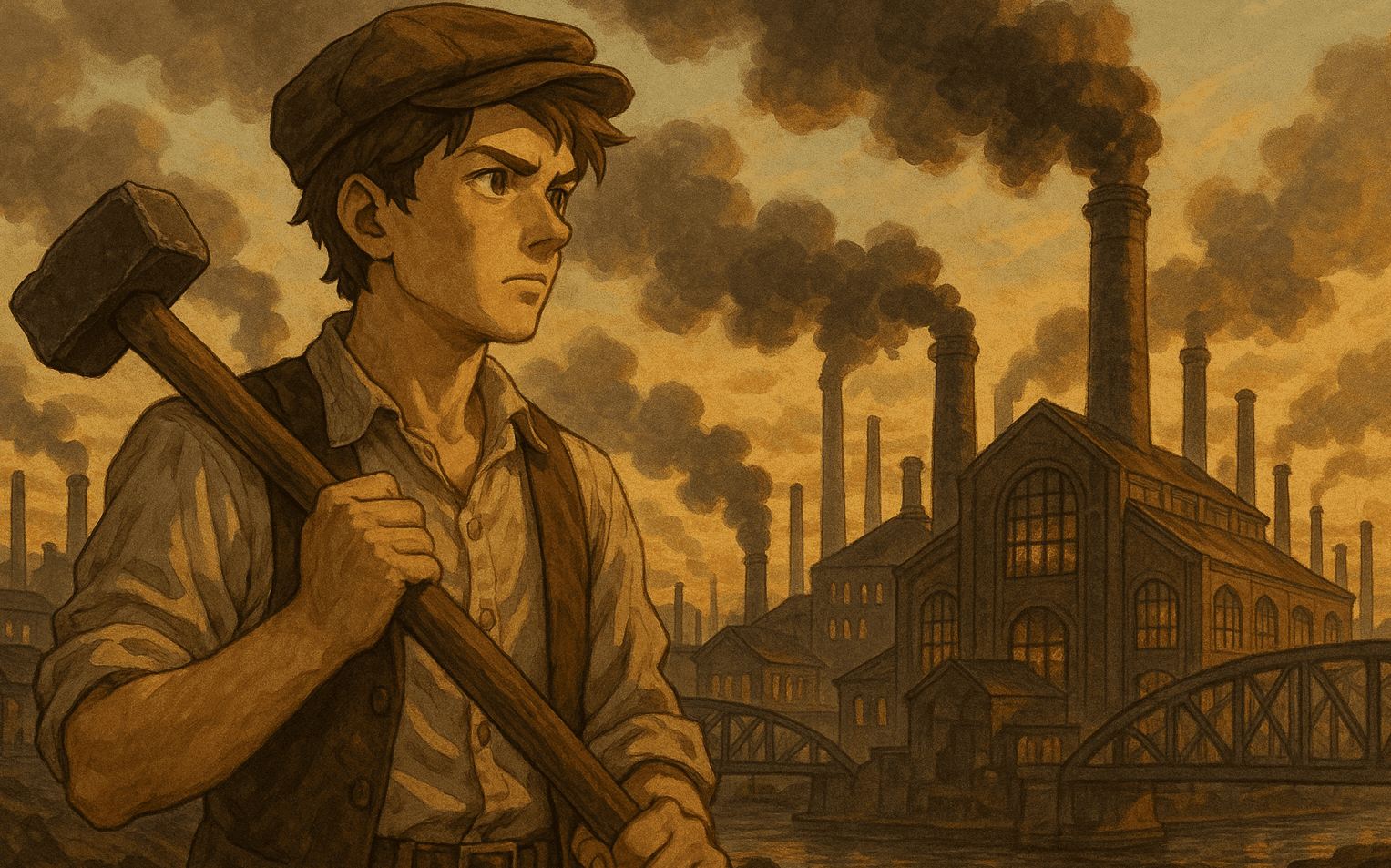
In 1830, a nine-year-old girl named Sarah Gooder testified before a British Parliamentary commission that she worked in a coal mine from four in the morning until five at night. Her job was opening and closing ventilation doors in total darkness. She told the investigators she sometimes sang to keep from being afraid, but mostly she just sat alone in the dark. That testimony, along with hundreds like it, eventually produced the laws we now take for granted every time we clock in somewhere with safety rails, overtime pay, and a minimum hiring age. The Industrial Revolution built the modern world. It also broke a lot of people building it.
What happened in Britain between roughly 1760 and 1840 - then radiated across Europe, North America, and eventually the entire planet - was not just an economic shift. It was a species-level rewiring of how human beings organize work, move goods, accumulate wealth, and relate to machines. Every tech disruption since - electrification, the automobile, the internet, artificial intelligence - follows a pattern the Industrial Revolution established first: a new technology unlocks productivity, entrepreneurs race to exploit it, workers scramble to adapt, governments lag behind, and society eventually negotiates new rules. Recognizing that pattern is one of the most useful things history can teach you.
New technology arrives. Productivity surges. Old jobs vanish. New jobs emerge but demand different skills. Wealth concentrates. Workers organize. Governments intervene - usually a generation too late. Society stabilizes under new rules. Then the next technology arrives, and the cycle restarts. The Industrial Revolution was round one. We are living through round five or six.
Why Britain? The Ingredients That Lined Up
Plenty of places had coal. China had blast furnaces centuries before Abraham Darby fired his at Coalbrookdale. The Ottoman Empire sat on trade routes that should have made capital accumulation easy. So why did industrialization ignite in a damp island off the northwest coast of Europe?
Because it was never about one ingredient. It was about a dozen of them sitting in the same room at the same time.
Britain's geological luck was real - shallow coal seams near navigable rivers meant you could haul fuel from pit to smelting shed by barge instead of ox cart. Iron ore deposits clustered near those same seams, slashing transport costs once furnaces switched from scarce charcoal to plentiful coke. But geology alone explains nothing. What made Britain different was the institutional scaffolding wrapped around those rocks.
Private property law let landowners lease mineral rights without begging a monarch for permission. The Bank of England (1694) anchored a network of country banks that issued bills of exchange - essentially IOUs that let entrepreneurs fund risky experiments without gold reserves. Patent law gave inventors a temporary monopoly, so a clever mechanic could profit from a better spinning frame instead of watching a richer man copy it. Insurance clubs spread fire risk across investors, encouraging expansion instead of caution.
And then there was the labor pool. Enclosure acts had pushed rural families off common land for decades, creating a mobile workforce walking toward whatever paid wages. When the mills opened, the workers were already on their way.
The Machines That Changed Everything
Key inventors typically carried toolmaker habits picked up in workshops attached to water mills or clock shops. These were not ivory-tower theorists. They were tinkerers with calloused hands who understood gears, tolerances, and friction at a fingertip level.
Abraham Darby's coke-fired blast furnace at Coalbrookdale (1709) produced pig iron cheaply enough for rails, pots, machine frames, and eventually bridges. John Kay's flying shuttle (1733) doubled the speed of hand looms - but then spun thread could not keep pace with woven cloth, creating a bottleneck that screamed for a solution. James Hargreaves answered with the spinning jenny. Richard Arkwright followed with the water frame, then did something even more consequential than inventing a machine: he clustered dozens of machines in a multi-storey brick building at Cromford, powered by a single waterwheel, and hired workers to tend them on shifts.
That was the factory. Not a machine. A system. Arkwright did not just mechanize spinning. He mechanized the organization of work. Cottage weavers had set their own hours, worked alongside family, and sold cloth at their own pace. Arkwright's workers showed up when a bell rang, operated machines they did not own, produced output they did not sell, and went home when another bell rang. If that sounds like your job, now you know where the template came from.
Cheap pig iron replaces charcoal-smelted metal, unlocking mass production of machine parts and structural components.
Weaving speed doubles, creating a thread bottleneck that drives spinning innovation for the next forty years.
A single worker can now operate eight spindles simultaneously, then sixteen, then over a hundred.
Steam engine fuel costs drop ~70%. Factories no longer need rivers. Industrial geography is rewritten.
The first true factory - centralized power, shift work, wage labor. The modern workplace is born.
The first public railway to use steam locomotives. Goods and people move at speeds that redefine distance.
Mass-produced steel transforms construction, shipping, and warfare. Skyscrapers and battleships follow within decades.
Electric power reaches commercial customers. The second industrial revolution begins.
Steam Power: Unchaining Factories from Rivers
Waterpower was powerful but geographically tyrannical. If you wanted to run a mill, you needed a river with a reliable flow, which meant your factory sat in a valley whether or not that valley had workers, roads, or customers nearby. Thomas Newcomen's atmospheric engine (1712) was the first crack in that constraint. It was a fuel hog - burning coal at appalling rates just to pump water out of mine shafts - but it proved a radical concept: boiling water could move metal parts without a flowing stream.
James Watt's separate condenser, patented in 1769, was the breakthrough that made steam practical for factories. By condensing steam in a separate chamber instead of inside the cylinder itself, Watt cut fuel consumption by roughly seventy percent. Suddenly, an engine could power spinning frames, lathes, brewery pumps, and rolling mills in the middle of a city, during a drought, on a hilltop, anywhere.
Matthew Boulton, Watt's business partner, deserves more fame than he gets. His Soho Foundry in Birmingham integrated casting, boring, sales, and parts supply under one management structure - an early template for what we would now call operations and process optimization. Boulton handled marketing, credit terms, and installation logistics while Watt handled engineering. Their partnership is one of history's best examples of complementary skill sets building something neither person could have built alone.
Inside mills, time itself changed. Arkwright ordered clocks on every floor and bells at dawn, meal breaks, and dusk. Power shafts spun overhead with leather belts hissing past worker shoulders. Supervisors recorded output in tally books, setting piece rates that rewarded speed. Before factories, most humans lived by sun time - you worked when it was light, rested when it was dark, and seasons shaped your rhythm. After factories, you lived by clock time. The abstract notion that "time is money" was not a metaphor before the Industrial Revolution. It became literal the moment a factory owner calculated that an idle spindle for ten minutes cost him a measurable number of shillings.
Child Labor and the Origin of Worker Protections
Here is a fact that should sit uncomfortably in any discussion of industrial progress: children as young as five worked in British factories and mines during the early Industrial Revolution. Not occasionally. Routinely. Mill owners preferred children for certain tasks - their small fingers could reach between spinning machinery to reattach broken threads, and they could crawl into mine tunnels too narrow for adults. They were also cheap. A child earned perhaps a shilling a week when an adult man earned ten.
The exploitation was not hidden. It was defended. Factory owners argued that idle children would fall into vice, that working families needed every penny, that restricting child labor would make British textiles too expensive to compete with foreign producers. Some of those arguments sound disturbingly familiar today whenever someone pushes back against raising labor standards in developing economies.
What changed the conversation was evidence. Parliamentary commissions in the 1830s and 1840s collected testimony from children, parents, overseers, and physicians. The reports were devastating. Children described fourteen-hour shifts, beatings for falling asleep at machines, fingers crushed in carding drums, and permanent spinal deformities from crouching in mine passages. Michael Sadler's Select Committee report (1832) and the Ashley Commission on mines (1842) made conditions impossible to ignore.
Legislation followed - slowly, imperfectly, but with a trajectory that points directly to the labor protections you benefit from today.
Children under nine banned from textile mills. Children nine to thirteen limited to eight hours per day. First factory inspectors appointed - four of them for the entire country.
Women and all children under ten banned from underground work. Triggered by the Ashley Commission's report, which included illustrations of half-naked children pulling coal carts on all fours.
Maximum ten-hour workday for women and children in textile factories. Factory owners predicted economic collapse. Profits actually rose because rested workers made fewer costly mistakes.
Consolidated earlier piecemeal laws into a comprehensive code. Minimum working age raised to ten. Required fencing around dangerous machinery - the ancestor of every safety guard you see today.
Today's workplace safety regulations, minimum wage laws, and child labor bans are direct descendants of these Victorian-era fights. The lineage is unbroken.
The pattern here matters beyond historical trivia. Every major technology creates a period where existing laws do not cover the new working conditions. Gig economy workers in the 2020s - delivery drivers classified as independent contractors, content moderators exposed to traumatic material - are living in the same regulatory gap that factory children occupied in the 1830s. The question is never whether protections will arrive. It is how many people get ground up before they do.
Cities Explode: Urbanization and Its Consequences
Steam freed factories from river valleys, but it chained workers to factory neighborhoods. Rural families walked or rode carts toward mill districts where wages, though low, beat the unpredictable earnings of seasonal farm work. Manchester's population surged from roughly 30,000 in 1773 to over 300,000 by 1851 - a tenfold increase in a single lifetime. Birmingham, Leeds, Glasgow, and Liverpool followed similar arcs. Nothing in human history had prepared cities for that kind of growth.
Rows of back-to-back brick terraces sprang up within months, thrown together by speculative builders who optimized for rent income, not sanitation. Entire families shared single rooms. Communal privies overflowed into open gutters. Clean water was a luxury. Cholera, typhus, and tuberculosis ripped through these neighborhoods with brutal regularity.
But density also forced innovation. Physician John Snow's famous mapping of cholera deaths around the Broad Street pump in London (1854) demonstrated that disease could be traced, measured, and prevented through data - not prayer, not moral reform, not miasma theory. Municipal boards eventually ordered iron pipes and sand-filtered reservoirs, channeling the same industrial ironworking skills that built machines into public health infrastructure. The sewers that Joseph Bazalgette engineered beneath London after the Great Stink of 1858 were among the most consequential construction projects of the century. They did not just solve a smell problem. They cut waterborne disease mortality by orders of magnitude.
Crowded cities also created something unexpected: mass culture. Sunday crowds packed music halls. Serialized novels by Charles Dickens traveled on rail coaches to clerks in distant towns. Cheap paper - its price slashed by steam-driven rotary presses and wood-pulp chemistry - made newspapers affordable for working families. Literacy climbed for pragmatic reasons on both sides: factory owners wanted workers who could read machine manuals, and reformers hoped education would build civic virtue. Both got what they wanted, plus something neither anticipated - a reading public with opinions and the means to spread them.
Transport: Canals, Rails, and the Death of Distance
Raw cotton landed at Liverpool docks, sailed through canals to inland mills, became cloth, then traveled back to port for export. The Bridgewater Canal (1761) slashed coal costs in Manchester by half, proving that capital-heavy infrastructure paid back fast when traffic volume was guaranteed. Engineers lined ditches with puddle clay and built aqueducts over valleys - using arch mathematics that Renaissance builders had revived from Roman engineering.
Railways made canals look quaint. George Stephenson's Rocket averaged thirty-seven kilometers per hour at the Rainhill Trials in 1829, stunning crowds who considered a galloping horse the speed ceiling. By 1850, over 10,000 kilometers of rail connected every major British industrial city. Perishable goods could reach distant markets before rotting. Workers could commute - the very concept of a "commuter" was invented by railways, originally meaning someone who exchanged daily tickets for a cheaper season pass.
Here is a detail that rarely makes the highlight reel but changed civilization: time standardization. Before railways, every town set clocks by local noon. Bristol ran ten minutes behind London. Exeter ran fourteen behind. Fine when the fastest thing between towns was a horse. Catastrophic when trains needed timetables. In 1847, railway companies adopted Greenwich Mean Time, synchronizing watches from Penzance to Aberdeen. Global time zones followed. The next time your phone's clock matches everyone else's, that chain of causation runs back to a Victorian scheduling problem.
On oceans, iron-hulled steamships like Brunel's SS Great Britain (1843) cut trans-Atlantic crossings to under two weeks. The Suez Canal (1869) shortened London-to-Calcutta voyages by over 6,000 kilometers. Refrigerated cargo holds enabled meat exports from Argentina and New Zealand - connecting ranchers on distant pampas to London butcher stalls. The global supply chain was born.
The Second Wave: Steel, Chemicals, and Electricity
By the 1850s, textiles and steam no longer dominated the frontier. Henry Bessemer's converter (1856) and the Siemens-Martin open-hearth process (1860s) produced steel in volumes that would have seemed hallucinatory to earlier ironworkers. Steel rails lasted years instead of months. Steel bridges spanned rivers that had stopped earlier engineers cold. Steel-framed buildings began climbing above crowded city streets - the skyscraper was not an architectural whim but a direct consequence of affordable structural steel and the elevator.
Chemical engineering, especially in Germany's Rhine-Ruhr zone, turned industrial waste into gold. Coal tar - previously flared off as a nuisance - yielded synthetic dyes when chemists learned to manipulate its molecular structure. William Perkin's accidental synthesis of mauveine in 1856 turned fashion palettes from muted earth tones to vivid purples and magentas, launching a global dye race. That race soon produced aspirin, photographic film chemicals, and fertilizer precursors. Companies like BASF and Bayer built sprawling research laboratories where scientists linked molecular diagrams to pilot-plant output - bridging theory with commercial scale in a model that pharmaceutical companies still follow.
Electric dynamos converted mechanical rotation into current, and the world changed again. Thomas Edison's Pearl Street Station lit parts of lower Manhattan in 1882. Nikola Tesla and George Westinghouse backed alternating current for long-distance transmission, winning the "War of Currents" because AC could travel hundreds of kilometers where Edison's DC faded after a few blocks. Electric streetcars freed suburbs from horse-stable stench. Factory owners swapped overhead belt-shaft systems for individual electric motors on each machine, which meant you could rearrange a factory floor without rebuilding the entire power-transmission architecture. That flexibility - reconfiguring production layout on the fly - was a productivity revolution hidden inside an energy revolution.
The Numbers: Before and After
Abstract claims about "transformation" mean nothing without scale. Here is what the Industrial Revolution actually did to measurable economic indicators.
Notice the tension baked into those numbers. GDP tripled. Exports exploded. And half the children in industrial cities died before their fifth birthday. Real wages eventually rose, but "eventually" meant three generations of workers who lived worse than their grandparents had on farms. The labor market gains were real - they were also brutally delayed. That lag between aggregate prosperity and individual wellbeing is the central moral drama of every industrialization story, then and now.
Finance, Corporations, and the Architecture of Modern Business
Building a factory with steam engines, iron frames, and hundreds of workers cost far more than any single family could bankroll. The answer was the joint-stock company - a legal structure that let multiple investors pool capital while limiting each person's liability to what they had invested. If the venture failed, you lost your shares but not your house. That simple legal innovation unlocked risk-taking at a scale that individual proprietorships never could.
The London Stock Exchange and New York's Wall Street channeled savings into railway bonds, mining shares, and industrial ventures. Speculation boomed alongside genuine investment. Railway manias in the 1840s saw fortunes made and lost in months, foreshadowing dot-com bubbles and crypto cycles with eerie precision.
Inside firms, new management structures emerged because they had to. A workshop with twelve employees can be run by one owner barking orders. A steel mill with 3,000 workers cannot. Andrew Carnegie's steel empire used cost accounting to compare each furnace's yield per ton of coke, firing managers whose numbers lagged. William Lever at Port Sunlight tracked soap-barrel output against advertising spend, pioneering what we would now call marketing analytics. Frederick Winslow Taylor, slightly later, stood with a stopwatch timing how long it took a man to shovel pig iron, launching "scientific management" - the ancestor of every efficiency consultant and productivity app you have ever encountered.
Patent offices in London (reorganized 1852), Paris (revamped 1791), and Washington, D.C. (reorganized 1836) created searchable archives of inventions. Alexander Graham Bell guarded telephone circuitry and collected royalties that funded laboratories for newer designs. The tensions between patent protection and open innovation that dominate today's debates about software, pharmaceuticals, and AI models? Those arguments started in the nineteenth century over sewing-machine needles and interchangeable rifle parts.
Carnegie used cost-per-ton spreadsheets to benchmark furnace performance in the 1870s. Amazon uses real-time data dashboards to benchmark warehouse throughput in the 2020s. The technology changed. The management logic did not.
Global Spread and the Latecomer Playbook
Industrialization did not stay British for long. Belgium adopted spinning frames within a decade, exploiting rich coal deposits at Mons. The United States leaped ahead in interchangeable parts - Eli Whitney's firearms contract for the U.S. Army (1798) pushed precision so that any lock plate fit any barrel, a concept that later powered assembly lines from Henry Ford's Model T to modern semiconductor fabs.
Japan's Meiji leaders, after watching Western gunboats force open their ports, decided the only defense against industrial powers was becoming one. They dispatched missions to Manchester and Pittsburgh, ordered railway kits and lathes, and built mills at Osaka and shipyards at Yokosuka. Within forty years, Japan defeated Russia in a naval war - proving that industrialization was transferable if the institutional commitment existed. Russia took a different route: Finance minister Sergei Witte invited French loans to build the Trans-Siberian Railway, but the approach left rural peasants untouched, setting up contradictions that fed the 1917 revolution.
Colonies occupied a harsher position. They supplied raw materials - cotton from Egypt, jute from Bengal, rubber from the Congo - and absorbed finished European goods. This arrangement locked colonial economies into resource extraction while profits flowed to London, Paris, and Brussels. Those asymmetries cast shadows visible today in trade imbalances and development gaps economists still wrestle with.
Advantage: Organic growth from domestic innovation. Strong patent systems and capital markets. First-mover profits in global trade.
Cost: Decades of unregulated labor exploitation before reform. Severe environmental damage to rivers, air, and forests.
Advantage: Could skip failed experiments and adopt best-practice technology. State coordination accelerated infrastructure. Some (Germany, Japan) leapfrogged in chemicals and steel.
Cost: Heavy reliance on foreign capital or state debt. Social disruption compressed into shorter timescales, increasing political instability.
Labor Fights Back: Unions, Strikes, and the Birth of Workers' Rights
The people operating the machines did not accept their conditions quietly. Resistance took many forms, from spontaneous riots to sophisticated political movements that reshaped democracies.
The Luddites (1811-1816) are often mocked as anti-technology cranks, but that reputation is unfair. Handloom weavers in Yorkshire and Nottinghamshire smashed stocking frames not because they feared machines in principle but because specific machines, operated by unskilled workers at lower wages, were destroying their livelihoods with no transition plan. They were not wrong about the economic threat. They were wrong about the solution - but their anger pointed at a real problem that governments ignored for decades.
Chartists petitioned Parliament for universal male suffrage in the 1830s and 1840s, explicitly linking political voice to shop-floor bargaining power. If workers could vote, they could elect representatives who would pass labor laws. The logic was sound. It took until 1918 for all British men to get the vote and 1928 for women - but the Chartist argument that economic justice required political representation became a foundational principle of democratic labor movements worldwide.
Trade unions emerged despite hostile courts. The Tolpuddle Martyrs - six farm laborers from Dorset - were transported to a penal colony in 1834 for the crime of forming a "friendly society" (essentially a union). The public backlash was so fierce that the government pardoned them within two years. Union membership grew steadily after that, though legal recognition came in fits and starts.
Karl Marx and Friedrich Engels analyzed the whole system in The Communist Manifesto (1848), arguing that the conflict between capital owners and wage laborers was the engine driving history forward. You do not have to agree with Marx's prescriptions to recognize that his diagnosis - that industrial capitalism generated enormous wealth and enormous inequality simultaneously - was accurate. Governments responded piecemeal. Bismarck's Germany introduced accident insurance (1884) and old-age pensions (1889) not out of compassion but to undercut socialist parties by giving workers just enough to stay loyal. Those programs became the template for welfare states across Europe and eventually the world.
In the United States, the Haymarket affair in Chicago (1886) and the Pullman Strike (1894) highlighted tensions between craft unions, immigrant workers, and railway barons. The eight-hour workday - now so normal it feels like a law of nature - was the central demand. It took decades of strikes, court battles, and political organizing before it became standard. Nothing about your current working conditions was inevitable. All of it was fought for.
The takeaway: Every workplace protection you benefit from - minimum wage, overtime pay, safety regulations, the weekend itself - traces back to organized workers in the Industrial Revolution who risked imprisonment, deportation, and violence to demand that productivity gains be shared rather than hoarded. The fight was never about rejecting progress. It was about making sure progress did not leave most people behind.
Environmental Costs and the Seeds of Public Health
Coal smoke hazed industrial skylines so thickly that midday in Manchester sometimes looked like twilight. Rivers turned colors - the Irwell ran purple from dye runoff, the Thames reeked so badly during the Great Stink of 1858 that Parliament hung lime-soaked curtains in its windows. Benjamin Disraeli called it "a Stygian pool reeking with ineffable and unbearable horror."
Yet the environmental crisis drove innovation that saved millions of lives. Bazalgette's intercepting sewers, mentioned earlier, channeled waste away from water intake pipes and cut cholera mortality dramatically. Smokeless coke ovens reduced visible soot (though they increased sulfur emissions - an early lesson in how solving one pollution problem can create another). Conservationist George Perkins Marsh warned in Man and Nature (1864) that unchecked resource extraction was destroying watersheds and topsoil. His writing influenced forest preservation acts in the United States and reforestation drives in colonial India.
The uncomfortable truth is that industrialization made the modern environmental crisis possible. Burning coal at industrial scale pumped carbon dioxide into the atmosphere at rates that natural systems could not absorb. The climate conversation happening right now is, in a very direct sense, a conversation about consequences set in motion 250 years ago. Understanding that lineage matters - not for blame, but for recognizing that the pattern of "extract, profit, deal with consequences later" is not a modern invention. It is the Industrial Revolution's shadow, and it has not gone away.
The Template: Why Every Tech Revolution Since Follows the Same Script
Step back far enough and the Industrial Revolution reveals a pattern so consistent that it functions almost like a script for technological disruption.
Phase 1 - Invention: A new technology makes something dramatically cheaper or faster. Steam engines. Electricity. Microprocessors. Large language models.
Phase 2 - Exploitation: Entrepreneurs race to deploy the technology. Early adopters accumulate outsized profits. New business models emerge. Older industries start dying.
Phase 3 - Displacement: Workers in legacy industries lose livelihoods. New jobs appear but require different skills. A mismatch gap opens between the jobs disappearing and the jobs being created.
Phase 4 - Concentration: Wealth pools in the hands of those who own the new technology or control its chokepoints. Inequality spikes. Social tension rises.
Phase 5 - Regulation: After sufficient public outrage, governments pass laws to redistribute gains, protect workers, and set safety standards. These laws always arrive later than they should.
Phase 6 - Stabilization: Society adapts. New institutions, norms, and expectations form around the technology. Average living standards eventually rise. And then the next technology arrives.
The Industrial Revolution ran this script with steam and textiles. Electrification ran it with power grids and appliances. The automobile ran it with highways and suburbs. The internet ran it with e-commerce and social media. Artificial intelligence is running it right now.
Recognizing the pattern does not let you predict every detail, but it does tell you where to look. When a new technology emerges, the smart questions are not "will this change things?" (yes, obviously) but "who captures the gains?", "who bears the costs?", and "how long before the rules catch up?" Those are the same questions that mattered when a child sat alone in a coal mine in 1830, and they are the same questions that matter when a gig worker has no health insurance in 2026.
What the Industrial Revolution Still Teaches
The specific machines are museum pieces now. Nobody is building a spinning jenny or laying wrought-iron rail. But the underlying dynamics - the interplay between technology, capital, labor, regulation, and environment - have not changed in structure, only in speed.
Systems thinking was born in these factories. Spinning, weaving, dyeing, and shipping formed an interlocked chain where a bottleneck in one stage rippled through every other. Modern supply-chain managers still map value streams to spot exactly these kinds of dependencies. When a container ship blocked the Suez Canal in 2021 and global trade stuttered, the logic was identical to what happened when a waterwheel broke at a Lancashire mill in 1790.
Cost accounting was invented because factory owners needed to know which furnace, which shift, which product line was profitable and which was bleeding money. That practice evolved into the financial dashboards, KPIs, and performance metrics that every modern business runs on.
Workplace safety regulation started with fenced gears on Victorian looms and evolved into OSHA standards, machine-vision shutdown systems, and ergonomic desk assessments. The principle has not changed: when a new production method creates new dangers, society eventually demands protective rules.
Infrastructure as economic catalyst was proven by canals and railways and reproven by highways, fiber optic cables, and 5G networks. The specific pipes change. The principle - that connectivity creates markets - does not.
Environmental debt was incurred for the first time at industrial scale during this period. We are still paying it. Every carbon credit, every emission regulation, every climate summit is a downstream consequence of decisions made when factory owners decided that dumping soot into the sky was cheaper than filtering it.
The Industrial Revolution is not a chapter in a history book you close and shelve. It is the operating system running underneath modern civilization - upgraded many times, patched repeatedly, but never replaced. Understanding it does not just make you better at history. It makes you better at reading the world you are living in right now. The factories may have changed. The script has not.