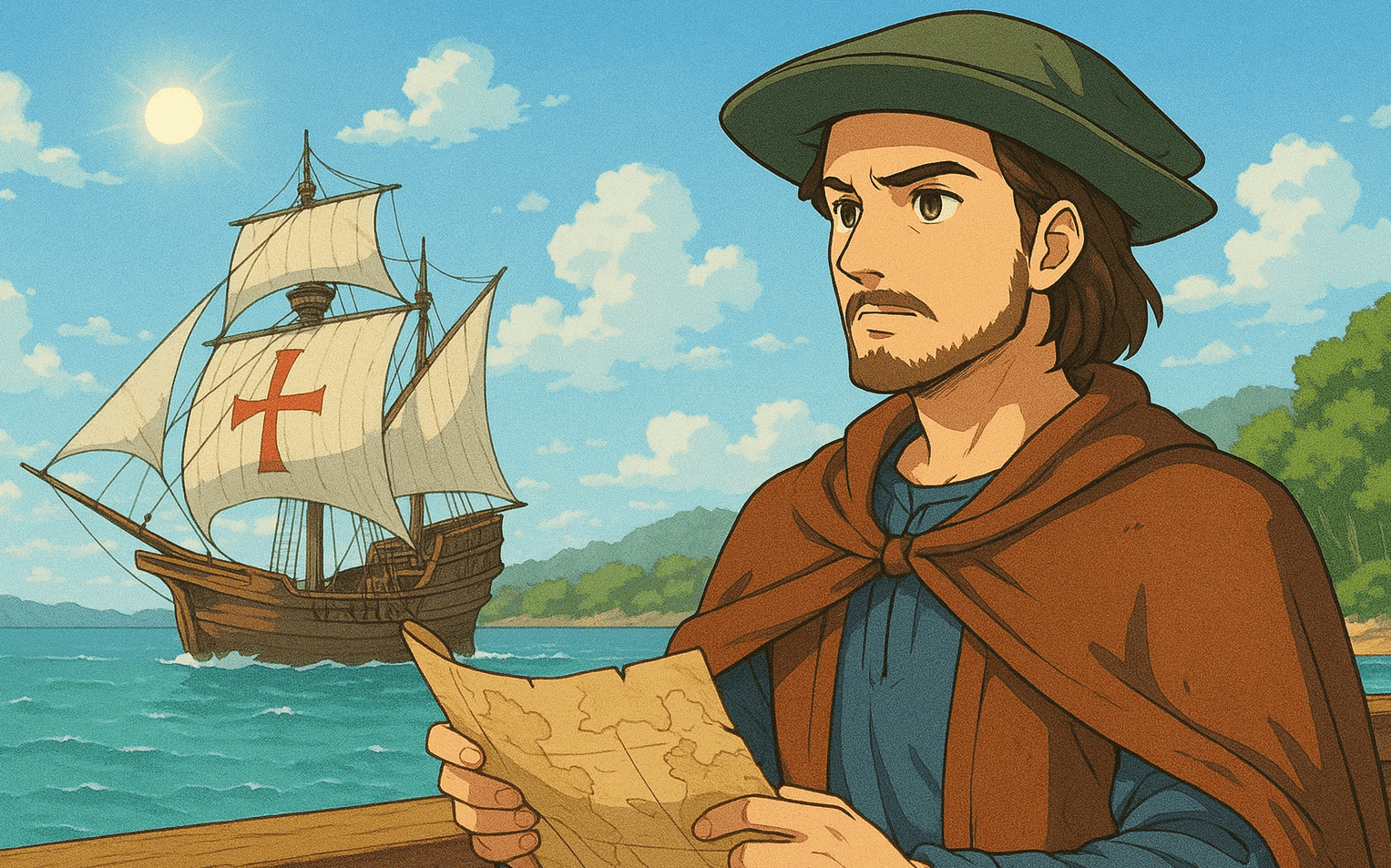
The Spice That Launched a Thousand Ships
A single peppercorn in 1450 Venice was worth more by weight than silver. That ratio sounds absurd until you realize pepper did something silver couldn't: it made rotting meat edible in an age before refrigeration. Cloves masked the taste of spoiled fish. Cinnamon turned stale bread into something a merchant's wife would actually serve to guests. These weren't luxury indulgences -- they were caloric survival tools dressed up as status symbols. And the markups were staggering. A sack of pepper purchased in Calicut for two ducats could sell in Antwerp for thirty. That 1,400% margin is what pulled European sailors into open ocean, rewired global trade networks, and -- within a single century -- connected four continents in a web of exchange that would reshape diets, demographics, and power structures for the next five hundred years.
But here's the part textbooks often rush past: exploration wasn't a noble quest for knowledge. It was a business plan. Every caravel that left Lisbon carried investors expecting returns. Every fort planted on a foreign coastline existed to protect a revenue stream. The age of exploration was, at its roots, the age of venture capital -- with all the brilliance, brutality, and unintended consequences that phrase implies.
Why Europe Went to Sea: Ottoman Tolls and the Spice Bottleneck
For centuries, Asian spices reached Europe through a relay chain of middlemen. Pepper grew on India's Malabar Coast, passed through Arab dhow traders in the Indian Ocean, crossed overland via camel caravans to Levantine ports, then moved onto Venetian galleys bound for Mediterranean markets. Each hand that touched the cargo added a markup. By the time a sack of cloves reached a London merchant, it had been taxed, tolled, and resold six or seven times.
When the Ottoman Empire consolidated control over eastern Mediterranean chokepoints after the fall of Constantinople in 1453, those tolls got worse. Not catastrophically worse -- the Ottomans were shrewd enough to keep trade flowing rather than strangling it entirely -- but enough to make ambitious merchants in Lisbon and Seville ask a pointed question: What if we cut out every middleman at once?
That question drove everything that followed.
The age of exploration wasn't triggered by curiosity about the unknown. It was triggered by frustration with known costs. European merchants understood exactly where spices came from and exactly how much the supply chain marked them up. Exploration was a margin optimization strategy -- the fifteenth-century equivalent of a company building its own logistics network to bypass expensive third-party distributors.
Portugal had a geographic head start. Perched on the Atlantic edge of Iberia, its sailors had been probing the African coast for decades. Prince Henry -- often called "the Navigator" despite never personally sailing beyond sight of shore -- ran something resembling a government R&D lab at Sagres. He assembled cartographers, mathematicians, and shipwrights. He dispatched annual expeditions that pushed incrementally farther south, each voyage mapping another stretch of African coastline. It was iterative, methodical, and expensive. Henry died in 1460 without seeing the program's payoff, but the institutional knowledge he built survived him.
Three technologies made deep-ocean sailing survivable. The caravel, a light ship with lateen sails, could tack against headwinds rather than waiting for favorable breezes -- critical when you're fighting the trade winds off West Africa. The magnetic compass gave pilots a fixed bearing under overcast skies, which sounds basic now but was revolutionary for sailors who'd previously relied on visible stars. And improved astrolabes, refined by Jewish astronomer Abraham Zacuto, let navigators calculate latitude to within one degree. Together, these tools turned ocean crossing from suicide mission to calculated risk.
The Race Around Africa and Across the Atlantic
Bartolomeu Dias reached the southern tip of Africa and proved ships could survive the passage. He named it the Cape of Storms; the Portuguese crown rebranded it the Cape of Good Hope -- an early lesson in optimistic marketing.
Backed by Castile, Cristoforo Colombo crossed the Atlantic using maps that dramatically underestimated Earth's circumference. He reached the Bahamas believing he'd skirted Asia. He went to his grave still convinced of it.
Spain and Portugal drew an imaginary line 370 leagues west of Cape Verde, dividing the non-European world between them. No one asked the people already living in those "divided" lands.
Vasco da Gama arrived at Calicut and tried to trade woolen cloth and honey for pepper. Local merchants weren't impressed. They wanted silver. Portugal returned with bullion -- and warships.
Magellan's fleet of 270 men set out from Spain. Only 18 returned, on one surviving ship, completing the first trip around the planet. Magellan himself died in the Philippines -- Juan Sebastian Elcano finished the job.
Cortes and his Indigenous allies toppled the Mexica capital -- a city larger than any in Europe at the time. Smallpox killed more defenders than Spanish steel.
Pizarro captured Inca emperor Atahualpa. The ransom -- a room filled with gold -- remains one of the largest single wealth transfers in recorded history.
Portugal's Indian Ocean Strategy
Portugal's approach was commercial, not territorial. They didn't want to conquer India; they wanted to control the shipping lanes. Vasco da Gama's arrival at Calicut in 1498 was more business trip than invasion -- at least initially. The problem was that Indian merchants didn't particularly need what Portugal was selling. European woolen cloth? Calicut had cotton. Honey? They had sugar. What Indian merchants wanted was silver, and Portugal had to go get it.
What Portugal did have was naval firepower. Armed caravels with cannon could outgun the dhows and junks that dominated Indian Ocean trade. Within twenty years, Portugal had established fortified trading posts -- feitorias -- at Goa, Malacca, Hormuz, and Mombasa. These weren't colonies in the later sense. They were armed warehouses. Fortified nodes in a logistics network designed to funnel Asian goods toward Lisbon while skimming tariffs from everyone else's shipping. Think of them as the fifteenth-century version of controlling a critical internet exchange point: you don't need to own the whole network if you control the bottlenecks.
Spain's Westward Gamble
Castile took a different bet. Columbus sailed west expecting to hit Asia and instead stumbled into something no European mapmaker had accounted for. The initial reaction in Spain was disappointment -- these islands had no pepper, no silk, no porcelain. What they had was gold ornaments on Indigenous bodies, which was enough to justify a second voyage.
The real windfall came a generation later. Hernan Cortes reached the Mexica (Aztec) capital of Tenochtitlan in 1519 and found a city of roughly 200,000 people -- larger than London, Paris, or Seville at the time. Aqueducts, causeways, botanical gardens, a central market where 60,000 people traded daily. Cortes conquered it in two years, aided by three decisive advantages: alliances with Indigenous groups who resented Mexica tribute demands, steel weapons and horses that Mesoamerican armies had never faced, and -- most devastatingly -- smallpox, which killed somewhere between 40% and 90% of the Indigenous population within a generation.
Francisco Pizarro repeated the pattern against the Inca Empire in 1533, capturing Emperor Atahualpa and extracting a ransom of roughly 6,000 kilograms of gold and 12,000 kilograms of silver. Then he executed Atahualpa anyway. The silver mines at Potosi, discovered in 1545 in present-day Bolivia, became the engine of Spanish imperial finance. At its peak, Potosi was producing roughly 60% of the world's silver output, extracted by Indigenous forced labor under a system called the mita that worked miners to death in underground shafts filled with mercury vapor.
~56 Million — Estimated Indigenous population decline in the Americas between 1492 and 1600 -- roughly 90% of the pre-contact population -- driven primarily by epidemic disease, forced labor, and warfare
That number deserves a pause. Fifty-six million people. It represents the single largest demographic collapse in recorded human history. Entire languages, agricultural systems, astronomical traditions, and governance structures vanished within decades. When we talk about the "age of exploration," this catastrophe isn't a footnote. It's the central story.
The Columbian Exchange: The First Globalization
Historian Alfred Crosby coined the term "Columbian Exchange" in 1972 to describe something that hadn't been adequately named: the massive, bidirectional transfer of plants, animals, diseases, technologies, and people between the Eastern and Western Hemispheres after 1492. It was, by any honest accounting, the most consequential ecological event since the end of the last Ice Age. And unlike the Ice Age, it happened in decades rather than millennia.
The exchange wasn't symmetrical. The Americas sent crops that would eventually feed billions. The Eastern Hemisphere sent diseases that killed tens of millions. Understanding this asymmetry is the key to understanding why the modern world looks the way it does.
| Item | Direction | Impact |
|---|---|---|
| Potatoes | Americas → Europe | Doubled caloric yield per acre in northern Europe; fueled population boom; Irish dependency on potato monoculture led to the 1845 famine and mass emigration |
| Maize (Corn) | Americas → Africa/Europe/Asia | Became a staple crop across Africa and southern Europe; supported population growth in regions where wheat struggled |
| Tomatoes | Americas → Europe | Initially feared as poisonous in northern Europe; became the foundation of Italian and Spanish cuisines within two centuries |
| Tobacco | Americas → Global | Created one of history's most profitable (and deadly) cash crop industries; Virginia's entire colonial economy depended on it |
| Cacao | Americas → Europe | Transformed from a Mesoamerican ceremonial drink into Europe's chocolate industry; sugar addiction followed |
| Sugar Cane | Asia → Americas | Drove the entire Caribbean plantation system; primary economic reason for the Atlantic slave trade |
| Wheat | Europe → Americas | Replaced Indigenous crops across temperate zones; became the staple grain of settler agriculture from Kansas to Argentina |
| Horses | Europe → Americas | Transformed Plains Indigenous cultures; enabled new hunting and warfare strategies; became the symbol of the American West |
| Cattle / Pigs | Europe → Americas | Feral populations destroyed Indigenous agricultural land; ranching reshaped the Pampas, Great Plains, and Mexican highlands |
| Smallpox | Europe → Americas | Killed an estimated 90% of Indigenous Americans who had no prior immunity; deadlier than any army |
| Malaria | Africa → Americas | Thrived in tropical American lowlands; made Caribbean and southern colonies deadly for European settlers, increasing demand for enslaved Africans who carried partial immunity |
| Syphilis | Americas → Europe (debated) | Appeared in Europe after 1493; ravaged armies and urban populations for centuries before antibiotics |
| Silver | Americas → Global | Flooded European and Asian markets; caused the Price Revolution in Europe (~400% inflation over 150 years); became China's de facto currency |
| Quinine | Americas → Global | Extracted from Andean cinchona bark; made European survival in tropical climates possible; enabled later 19th-century colonization of Africa |
Crops That Changed Everything
The potato is probably the single most underappreciated force in European history. Before American crops arrived, northern European agriculture was a caloric gamble. Wheat needs decent soil and a long growing season. Rye survives cold but yields less. The potato, domesticated in the Andes over thousands of years, thrived in the cool, damp soils of Ireland, Scandinavia, and Russia. It produced two to three times more calories per acre than grain. A family with a small plot and a supply of potatoes could survive. That simple agricultural fact powered a population explosion across northern Europe that provided the labor force for the Industrial Revolution.
Maize followed a similar trajectory, particularly in Africa and southern Europe. It grew faster than local grains, tolerated poorer soil, and offered flexible planting windows. African farmers adopted it rapidly, and within a century, maize had become a staple across much of the continent. The irony cuts deep: a crop from the Americas helped grow African populations that European slavers then forcibly transported back across the Atlantic.
Tomatoes, cacao, vanilla, chili peppers, rubber, tobacco -- the list of American-origin products that reshaped Old World economies, cuisines, and cultures is genuinely staggering. Modern Italian food without tomatoes? Unimaginable. Thai cuisine without chili peppers? Unrecognizable. The Swiss chocolate industry, worth over $5 billion annually? Built on a bean that Mesoamerican civilizations cultivated for millennia.
Microbes: The Invisible Conquerors
Disease was the deadliest export of the Columbian Exchange, and the devastation was almost entirely one-directional. Eurasian populations had spent thousands of years co-evolving with domesticated animals -- cattle, pigs, chickens, horses -- and the diseases that jumped from those animals to humans. Smallpox, measles, influenza, typhus, and plague all have zoonotic origins. European bodies carried antibodies shaped by centuries of exposure. Indigenous Americans had none.
The result was biological catastrophe on a scale that defies easy comprehension. Hispaniola's Taino population dropped from an estimated 250,000 in 1492 to fewer than 500 by 1548. Mexico's population fell from roughly 25 million to 1 million within a century. The Inca Empire, already fractured by civil war when Pizarro arrived, lost perhaps 90% of its people to successive waves of epidemic disease.
Epidemic disease wasn't just an unfortunate byproduct of contact -- it became a strategic reality that European colonizers recognized and, in documented cases, deliberately exploited. The famous (and debated) case of British officers distributing smallpox-contaminated blankets during Pontiac's War in 1763 is the most cited example, but the broader pattern is clear: colonizers understood that disease weakened Indigenous resistance, and they structured their military and settlement strategies around that knowledge.
Why didn't the exchange work in reverse? Why didn't American diseases devastate Europe? The short answer: population density and animal domestication. Eurasian civilizations had large, dense urban populations living alongside domesticated animals for millennia -- perfect conditions for breeding epidemic diseases. The Americas had fewer domesticated animal species (llamas and guinea pigs, primarily), and many Indigenous societies were less densely packed. They had their own diseases, but none with the pandemic potential of smallpox or measles.
The Atlantic Slave Trade: Commerce Built on Human Suffering
The plantation economy that emerged in the Americas created an almost infinite demand for labor. Sugar, tobacco, rice, indigo, cotton -- these crops required backbreaking, year-round work in brutal tropical conditions. Indigenous populations, devastated by disease, couldn't supply enough workers. European indentured servants died at appalling rates in Caribbean heat. Plantation owners turned to Africa.
Between roughly 1500 and 1870, an estimated 12.5 million Africans were forcibly transported across the Atlantic. About 10.7 million survived the crossing. The rest -- nearly two million people -- died in the cramped, disease-ridden holds of slave ships during a voyage called the Middle Passage that lasted anywhere from six weeks to three months.
Estimated distribution of enslaved Africans transported across the Atlantic, 1500-1870. Source: Trans-Atlantic Slave Trade Database.
That last number surprises most Americans. Only about 3% of all enslaved Africans went to what became the United States. Brazil and the Caribbean absorbed the vast majority. The reason? Mortality. Sugar plantations killed workers so fast that the enslaved population couldn't sustain itself through natural reproduction. Planters simply bought replacements. In contrast, enslaved populations in North America grew through births -- which is why, by 1860, the U.S. had four million enslaved people despite importing a fraction of the Atlantic total.
The Triangular Trade
The economic logic was brutally efficient. European ships carried manufactured goods -- textiles, iron bars, guns, alcohol -- to West African ports. African intermediaries, including powerful states like the Kingdom of Dahomey and the Oyo Empire, captured or purchased people from rival groups and sold them to European traders. Ships then crossed the Atlantic, sold their human cargo in American port cities, loaded up with sugar, rum, tobacco, and cotton, and sailed back to Europe. Three legs. Three sets of profits. Each leg subsidizing the next.
Coastal African states weren't passive victims in this system. Dahomey built its military and political power partly on the slave trade, raiding inland communities to supply European demand. The Kingdom of Kongo initially tried to regulate and then halt Portuguese slave purchasing within its borders -- King Afonso I wrote anguished letters to the Portuguese crown in the 1520s protesting the trade's destabilizing effects -- but was ultimately unable to stop it. The trade reshaped African political geography, militarized entire regions, and drained the continent of millions of working-age adults over four centuries.
Olaudah Equiano, kidnapped from present-day Nigeria as a child and enslaved for years before purchasing his freedom, published his autobiography in 1789. His account of the Middle Passage -- the stench, the chains, the bodies thrown overboard -- became a key text in the British abolitionist movement. Equiano understood, decades before modern economists formalized the idea, that systems built on coerced labor eventually rot from within. His writing helped shift public opinion toward abolition, showing that first-person testimony can be more powerful than any policy paper.
Corporate Colonialism: When Companies Became Empires
The Dutch and English took the Portuguese model and financialized it. Rather than having monarchs directly fund expeditions, they invented the joint-stock company -- arguably the most consequential financial innovation of the seventeenth century. Here's how it worked: thousands of investors bought shares in a chartered company, spreading the enormous risk of an ocean voyage across a broad base. If the fleet sank, no single investor was ruined. If it returned loaded with pepper, everyone profited proportionally.
The Dutch East India Company (VOC), founded in 1602, was the world's first publicly traded corporation. It issued shares on the Amsterdam stock exchange, paid dividends, and -- at its peak -- was valued at roughly $7.9 trillion in inflation-adjusted dollars. More than Apple, Amazon, and Google combined. It also had its own army, its own navy, the power to sign treaties, mint currency, and establish colonies. Calling it a "company" understates the reality. It was a state wrapped in a corporate charter.
Peak valuation: ~$7.9 trillion (adjusted)
Employees: ~50,000 at peak
Territory: Indonesia, Sri Lanka, South Africa, Taiwan
Powers: Could wage war, negotiate treaties, mint coins, establish colonies
Model: Monopoly on Asian spice trade via Amsterdam exchange
Peak valuation: ~$1.1 trillion (adjusted)
Employees: ~260,000 (including private army)
Territory: India, parts of Southeast Asia, China trade
Powers: Governed entire Indian subcontinent, maintained standing army larger than most European nations
Model: Textile and tea trade via London exchange
The English East India Company (EIC), chartered in 1600, followed a similar trajectory but ended up controlling something far larger: the Indian subcontinent. What started as a trading operation in Surat and Madras gradually became a governing authority. By the mid-1700s, the EIC had its own army of 260,000 soldiers -- twice the size of the British Army itself. It collected taxes, administered justice, and determined the fates of millions of people who had no say in its corporate decisions. If you want to understand modern anxieties about trade and corporate power, the EIC is where that story starts.
The VOC pursued a more focused strategy: monopolize specific commodities by controlling the supply at its source. In the Banda Islands, the sole global source of nutmeg, the VOC under Governor-General Jan Pieterszoon Coen orchestrated the massacre or deportation of nearly the entire Indigenous population in 1621, replacing them with plantations worked by enslaved laborers. The profit motive, stripped of any restraining ethic, produced genocide. This wasn't an aberration of the system. It was the system working exactly as designed.
Silver: The Blood Currency of Global Trade
If spices pulled Europeans across oceans, silver kept the entire system running. And no place on Earth produced silver like Potosi.
Discovered in 1545 in present-day Bolivia, the Cerro Rico -- "Rich Mountain" -- of Potosi contained the largest silver deposit anyone had ever seen. Within decades, the city that grew around it had a population of 160,000, making it one of the largest cities in the world. Larger than London. Larger than Paris. A city at 4,000 meters altitude, perched on a barren Andean plateau, existing solely because of what lay inside the mountain.
The human cost was monstrous. Spain's mita system conscripted Indigenous men -- some as young as 14 -- to work underground shifts that lasted days at a stretch. Miners inhaled mercury vapor during the amalgamation process, a slow poisoning that destroyed their nervous systems. Estimates suggest that eight million Indigenous and African workers died in Potosi's mines between 1545 and 1825. The Spanish called the mountain "the mouth that eats men."
Where did all that silver go? Much of it ended up in China. The Ming Dynasty required tax payments in silver by weight, creating insatiable demand. Manila galleons carried up to two million pesos of silver annually across the Pacific from Acapulco to the Philippines, where Chinese merchants exchanged it for silk, porcelain, and lacquerware. This was the first truly global trade circuit: American silver, mined by Indigenous labor, shipped across two oceans, exchanged for Asian luxury goods, sold in European and American markets. The modern concept of a globally integrated economy didn't start with container ships. It started with silver bars in the holds of wooden galleons.
The flood of silver into European markets had a side effect that economists still study: the Price Revolution. Between roughly 1500 and 1650, prices across Europe rose by about 400%. Wages didn't keep pace. The purchasing power of working people eroded steadily for over a century. Landlords and merchants who held goods or property prospered. Workers who earned fixed wages got poorer. Sound familiar? The relationship between money supply expansion and inflation that central bankers debate today was first demonstrated, at continental scale, by Spanish silver flooding sixteenth-century markets.
Colonization in North America: Three Models, One Pattern
Not all colonization looked the same. The French, English, and Dutch each brought distinct strategies to North America -- different enough in method that it's worth examining them separately, similar enough in outcome that the comparison is instructive.
France: The Fur Trade Network
Samuel de Champlain planted Quebec's first palisades along the St. Lawrence River in 1608 and immediately did something the English and Spanish generally didn't: he built genuine alliances with Indigenous nations, particularly the Huron-Wendat Confederacy. French colonists were relatively few in number -- New France never exceeded about 70,000 settlers -- and they needed Indigenous partners to run the fur trade that justified the colony's existence.
Beaver pelts drove the entire economy. European felt-makers needed beaver underfur to produce fashionable hats, and North American beaver populations were enormous. French coureurs des bois (unlicensed fur traders) learned Indigenous languages, married into Indigenous families, and adopted canoe-based travel networks that covered thousands of miles of interior waterways. The result was a colony that was economically dependent on Indigenous expertise and politically intertwined with Indigenous governance -- a relationship based more on reciprocity than raw domination, at least initially.
England: Land and Labor
English colonization was fundamentally about land. Jamestown (1607) nearly collapsed until colonists discovered that Virginia's soil grew excellent tobacco. Within a decade, tobacco was Virginia's sole export, its currency, and the reason the colony imported its first enslaved Africans in 1619. The Chesapeake model was simple and devastating: clear forest, plant cash crops, import labor (first indentured servants, then enslaved Africans), exhaust the soil, move west, repeat.
New England's Puritan settlements operated differently -- communal farming, town meetings, religious governance -- but the outcome for Indigenous peoples was the same. Land seizures, broken treaties, and epidemic disease displaced the Wampanoag, Narragansett, and Pequot nations within a generation. King Philip's War (1675-1678) was, proportionally, the deadliest conflict in American history -- roughly 30% of the English population and a higher percentage of the Indigenous population died.
Netherlands: The Trading Post
The Dutch West India Company purchased Manhattan in 1626 for trade goods worth about 60 guilders -- a transaction that says more about Indigenous and European land concepts than about pricing. Lenape leaders likely understood the deal as a shared-use agreement, not a permanent sale. The Dutch didn't care about the distinction. They wanted a port at the mouth of the Hudson River to anchor their fur trade, and New Amsterdam became exactly that: a commercial hub that attracted settlers from dozens of nationalities.
When the English seized it in 1664 and renamed it New York, the Dutch merchant culture didn't disappear. It survived in the city's tolerant commercial ethos, its property laws, and -- eventually -- its financial institutions. The New York Stock Exchange traces a direct cultural lineage back to Dutch trading practices on the tip of Manhattan.
The takeaway: French, English, and Dutch colonization used different methods but produced the same structural result: Indigenous displacement, resource extraction for European markets, and the creation of hybrid societies whose internal tensions -- over land, labor, and sovereignty -- would define North American politics for centuries. The differences in method matter for understanding how distinct colonial cultures developed. The similarity in outcome matters for understanding who bore the costs.
The Caribbean Sugar Machine
Sugar was the oil of the colonial era. And the Caribbean was its Persian Gulf.
Barbados, Jamaica, Saint-Domingue (Haiti), Martinique, and Guadeloupe became the most profitable territories in the colonial world -- and the most brutal. Sugar cultivation required year-round labor of extraordinary intensity: clearing land, planting cane, harvesting with machetes in scorching heat, crushing stalks through vertical three-roller mills within hours of cutting (before fermentation ruined the juice), boiling the extracted liquid in copper kettles at temperatures that could take off a limb if you stumbled.
The labor was performed almost entirely by enslaved Africans, under conditions so lethal that the average life expectancy for an enslaved field worker on a Barbados sugar plantation was seven years after arrival. Planters treated this as a cost calculation: it was cheaper to work people to death and buy replacements than to improve conditions enough for the enslaved population to sustain itself. That arithmetic -- human life reduced to a depreciation schedule -- is the moral core of what the plantation system was.
Saint-Domingue (present-day Haiti) was the crown jewel of French colonial wealth. By the 1780s, this single colony produced more sugar and coffee than all of Britain's Caribbean possessions combined. It also had the most horrifying mortality rates. The Haitian Revolution, which began in 1791 when enslaved people rose against their captors, was the inevitable result of a system that treated human beings as disposable machinery. The revolution succeeded -- Haiti declared independence in 1804, becoming the first free Black republic in the Western Hemisphere -- but France demanded compensation for "lost property" (meaning lost enslaved people), saddling Haiti with a debt it didn't fully repay until 1947. The economic effects of that extortion are still visible in Haiti's poverty today.
Mission Networks and Cultural Collision
Alongside merchants and soldiers came missionaries. Jesuit, Franciscan, Dominican, and Augustinian orders established mission chains from Baja California to Paraguay, from the Philippines to the Congo. Their stated goal was saving souls. Their practical function was more complex: missions served as forward outposts of colonial authority, cultural transformation engines that aimed to replace Indigenous languages, religions, and social structures with European ones.
The Jesuit missions in Paraguay -- the reducciones -- are a fascinating case study in this complexity. Jesuits gathered Guarani communities into planned settlements with stone churches, communal farms, workshops, and schools. They protected Guarani people from Portuguese slave raiders. They taught European music, agriculture, and craftsmanship. They also systematically dismantled Guarani religious practices, governance structures, and cultural autonomy. Was this protection or cultural erasure? The honest answer is both, simultaneously -- and that ambiguity runs through the entire history of colonial missionary work.
Knowledge flowed in unexpected directions. Jesuit reports on South American plants introduced quinine (from cinchona bark) to European medicine, providing the first effective treatment for malaria. This botanical knowledge, originally held by Quechua healers in the Andes, eventually enabled European colonization of tropical Africa in the nineteenth century -- a bitterly ironic chain of cause and effect. Indigenous knowledge, extracted by colonial agents, was used to fuel further colonization.
On the other side, Tisquantum (known to most Americans as "Squanto") taught English settlers at Plymouth how to cultivate maize using fish as fertilizer in 1621. He could do this because he'd already been to Europe -- kidnapped by English sailors years earlier, enslaved in Spain, escaped to England, and eventually returned home to find his entire village wiped out by epidemic disease. His biography alone captures the entanglement of knowledge exchange, violence, and survival that characterized the colonial encounter.
Resistance and Adaptation: Indigenous Responses
Portraying Indigenous peoples solely as victims of European expansion is both inaccurate and patronizing. Across the Americas, Africa, and Asia, local populations resisted, adapted, negotiated, and sometimes turned European presence to their own advantage -- even as the overall power dynamics tilted against them.
The Mapuche of southern Chile fought Spanish colonizers to a standstill for over three centuries. They adopted European horses and firearms, adapted their guerrilla tactics accordingly, and maintained an independent territory that Spain never conquered. The Maroons of Jamaica and Suriname -- communities of escaped enslaved people -- built autonomous settlements in mountainous interiors and fought colonial forces so effectively that the British signed formal treaties recognizing their freedom.
In the fur trade, Haudenosaunee (Iroquois) Confederacy leaders played French and English interests against each other with sophisticated diplomatic skill, maintaining autonomy through strategic alliance-shifting for over a century. In Southeast Asia, the Kingdom of Siam (Thailand) navigated between French and British colonial ambitions without ever being colonized -- the only Southeast Asian nation to maintain continuous independence.
Imagine you're an Indigenous leader in 1620, watching European ships arrive with trade goods your people want -- metal tools, textiles, firearms. You know these newcomers carry diseases that have devastated neighboring nations. You know they want land. But you also know that refusing to trade means your rivals will get those firearms first. This is the strategic dilemma that dozens of Indigenous leaders actually faced: engage with a dangerous partner or be outcompeted by neighbors who do. It's the same logic that modern small nations face when negotiating trade deals with economic superpowers. The power asymmetry is real, but the weaker party isn't helpless -- they're making calculated decisions under severe constraints.
These stories of resistance matter because they complicate the narrative. Colonization wasn't a one-way steamroller. It was a series of negotiations, conflicts, adaptations, and compromises in which Indigenous peoples were active participants with their own strategies and their own agency. The outcomes were devastatingly unequal -- disease, technology, and sheer demographic weight overwhelmed even the most effective resistance in most cases -- but reducing hundreds of distinct peoples to a collective "they were conquered" erases the complexity of what actually happened.
The Legacy: How 1500 Still Shapes Today
The period from 1400 to 1800 didn't just change the world. It built the world we currently inhabit. The patterns established during the age of exploration and colonization are still operating -- in different forms, with different actors, but following recognizably similar logic.
Economic Structures
The global division between wealthy nations and developing nations maps almost perfectly onto the colonial division between colonizers and colonized. Countries that were exploited for raw materials during the colonial era -- extracting silver, sugar, rubber, cotton -- tend to still export raw commodities today, while former colonial powers tend to dominate manufacturing and finance. This isn't coincidence. Colonial extraction systematically prevented colonized regions from developing their own manufacturing, financial institutions, and educated workforces. The pattern was locked in over centuries and has proven extraordinarily resistant to change.
Haiti's story is emblematic. The wealthiest colony in the Caribbean in 1790. The poorest nation in the Western Hemisphere today. Between the extortionate debt France imposed after the revolution, repeated U.S. military interventions in the twentieth century, and systematic international economic marginalization, Haiti's poverty isn't a mystery -- it's a direct inheritance of colonial-era extraction and post-colonial punishment for daring to revolt.
Cultural and Demographic Legacies
The languages spoken across the Americas, Africa, and Southeast Asia -- Spanish, Portuguese, English, French, Dutch -- are colonial artifacts. The racial categories that organize social hierarchies in Brazil, the United States, South Africa, and beyond were invented by colonial administrators to sort populations for labor extraction. The Christianity practiced by roughly 2.4 billion people worldwide spread largely through colonial-era missionary networks. Even the food on your plate is a Columbian Exchange artifact: your morning coffee (Ethiopian origin, grown in Brazil), your lunchtime tomato sauce (Mesoamerican origin, perfected in Italy), your evening chocolate (Aztec origin, manufactured in Switzerland).
Legal and Political Frameworks
The concept of corporate personhood -- the idea that a company can hold rights, sign contracts, and be treated as a legal entity -- was prototyped by charter companies like the VOC and EIC. Modern debates about whether corporations have too much political power are direct descendants of seventeenth-century debates about whether the East India Company had become a state unto itself. (Spoiler: it had.)
International law itself was shaped by colonial-era questions. Who has the right to claim "empty" land? (The doctrine of terra nullius was used to justify seizing territory from peoples whose land-use patterns didn't match European agricultural norms.) Who counts as a sovereign nation? (European colonial powers reserved that status for themselves and denied it to everyone else for centuries.) These frameworks are still being contested -- in Indigenous land rights cases, in disputes over Arctic sovereignty, in debates about who should control resources on the Moon and Mars.
In 1602, the VOC raised capital from thousands of investors to fund risky ocean voyages, used armed force to secure trade monopolies, extracted resources from distant territories, and operated with minimal government oversight. In 2024, some of the world's largest tech companies raise capital from millions of investors to fund risky technology ventures, use market dominance to secure near-monopolies in data and advertising, extract value from global user bases, and operate with minimal government oversight. The scale has changed. The structure hasn't.
What This Period Actually Teaches Us
Strip away the romanticized version -- the brave explorers, the discovery narratives, the march of progress -- and the age of exploration reveals a set of patterns that still operate in global economics and politics:
Profit motives drive expansion. Every expedition that left a European port carried investors expecting returns. The language of discovery masked the reality of market-making. Modern corporate expansion into developing markets follows the same playbook: find an underexploited resource, build infrastructure to extract it, manage the local population as either labor or obstacle.
Technology advantages are temporary but devastating. European naval cannon, steel armor, and horses provided short-term military dominance that enabled long-term structural control. The advantage wasn't permanent -- Indigenous peoples adopted European technologies within decades -- but the window of dominance was long enough to establish political and economic systems that persisted for centuries.
Ecological disruption has economic consequences. The Columbian Exchange reshuffled the planet's biology in ways that are still unfolding. Invasive species, monoculture agriculture, and the destruction of biodiversity during this period created vulnerabilities -- the Irish Potato Famine being the most dramatic example -- that echo in modern debates about agricultural diversity and food system resilience.
Systems built on coerced labor are profitable but unstable. The plantation economy generated enormous wealth for a small elite and devastation for everyone else. It also produced constant resistance -- slave revolts, maroon communities, abolitionist movements -- that eventually destroyed the system. Modern supply chains that depend on exploitative labor in distant countries face the same structural tension, just at a slower burn.
Financial innovation follows risk. Joint-stock companies, futures contracts, insurance markets, stock exchanges -- all were invented or perfected to manage the extreme uncertainty of colonial trade. The same principle operates today: the riskier the venture (space mining, deep-sea drilling, cryptocurrency), the more creative the financial engineering around it.
The wooden ships are gone. The canvas sails are museum pieces. But the logistical logic, the financial instruments, the geopolitical power structures, and the cultural legacies of the age of exploration are embedded so deeply in the modern world that most people don't even notice them. Understanding this period isn't about memorizing dates and routes. It's about recognizing the infrastructure -- physical, financial, legal, cultural -- that still shapes who has power, who doesn't, and why.