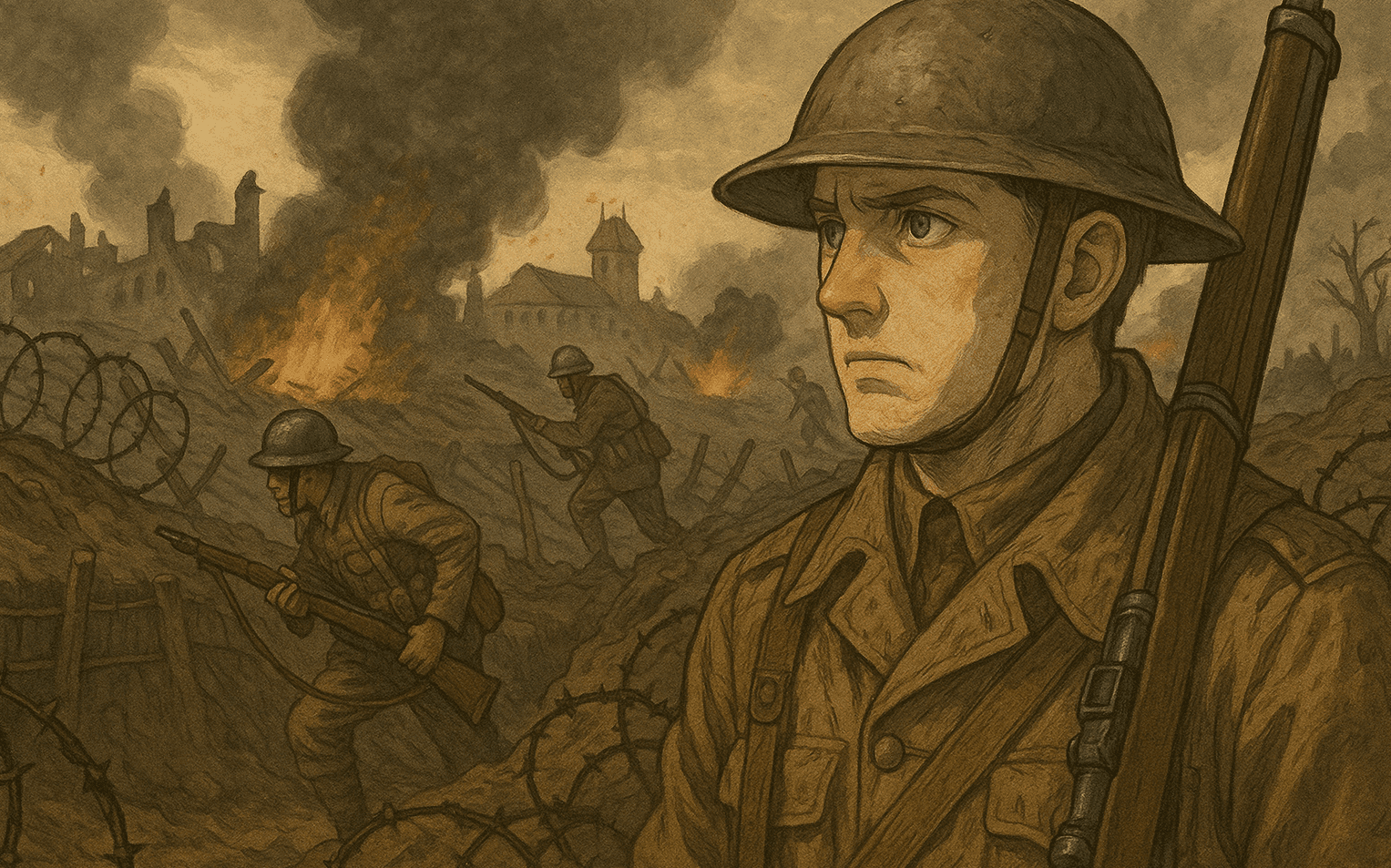
The war that was supposed to end all wars lasted four years and created the conditions for an even worse one. Between 1914 and 1918, roughly 20 million people died, four empires collapsed, and an entire generation of Europeans discovered that industrial technology could kill on a scale nobody had seriously imagined. The aftermath — a punitive peace treaty, economic chaos, shattered borders, and a pandemic that killed more people than the fighting itself — didn't settle anything. It loaded the spring for 1939.
That's the brutal summary. But World War I deserves more than a summary, because the patterns it reveals keep showing up. Alliance systems that spread local crises into global catastrophes? That's systemic risk, and modern financial markets run on the same wiring. A peace settlement designed to punish rather than stabilize? That's a negotiation failure you can still study in MBA programs. The mobilization of entire economies for a single goal? Governments used the same playbook in 2020 during COVID. Understanding this war isn't just history. It's pattern recognition for the modern world.
~20M — Total deaths (military and civilian) during World War I — roughly equal to the entire population of Romania at the time
Alliance Systems: How Local Risk Became Global Catastrophe
Europe in 1900 looked stable on the surface. Trade flowed. Banks lent across borders. Royals from different countries attended each other's weddings. Beneath that surface, two alliance networks had hardened into something dangerously rigid. The Triple Alliance bound Germany, Austria-Hungary, and Italy. The Triple Entente connected France, Russia, and Britain. Each pact carried obligations. If one member went to war, the others were expected to follow.
Think of it like co-signed loans. When everything's calm, mutual guarantees feel like smart insurance. But when one party defaults, the obligation drags everyone else down. That is exactly what happened in July 1914. A political assassination in a Balkan city activated a chain of commitments that nobody could stop once the first link pulled.
Colonial friction added accelerant. Germany tested French control of Morocco in 1905 and again in 1911 — both crises ended with diplomatic fixes, but each one tightened the alliances and raised suspicion. In the Balkans, small states fought the Ottoman Empire in 1912 and 1913, then fought each other over the spoils. Every local dispute reinforced the idea that the next crisis might be the one where diplomacy failed.
Alliance systems before 1914 operated like interconnected banks before the 2008 financial crisis. Each individual connection seemed manageable. But when one node failed, the obligations cascaded through the entire network faster than anyone could intervene. The lesson hasn't changed: tightly coupled systems with hidden interdependencies amplify shocks instead of absorbing them. Analysts who study modern trade networks still use this era as a cautionary example.
The Arms Race and Industrial War Planning
Industrial power stoked military planning until the two became almost indistinguishable. German steel firms like Krupp turned out heavy guns by the thousands. British yards at Portsmouth and on the Tyne launched dreadnoughts that outclassed everything afloat. France extended conscription and fixed a three-year service law in 1913. Russia poured money into railway lines that could move troops from the interior to the German border.
Railways deserve special attention, because they weren't just infrastructure. They were war plans printed in iron. Every mobilization schedule told generals exactly how many hours they needed to move regiments from barracks to frontiers. The Schlieffen Plan, Germany's strategy for a two-front war, was essentially a railway timetable with bullets. Once those trains rolled, stopping them required a kind of political courage that didn't exist in the summer of 1914.
National feeling ran hot in every capital. Students in Prague waved Czech flags against Vienna. Serbs sang about breaking free from Habsburg rule. Pan-German and Pan-Slavic clubs published maps that shaded whole regions as "rightfully ours," even when local towns spoke three or four languages. Newspaper editors sold papers with splashy headlines about honor, betrayal, and destiny. The fuse was short, and millions of people were excited to see it lit.
The July Crisis: Thirty-Seven Days From Assassination to World War
On 28 June 1914, a nineteen-year-old Bosnian Serb named Gavrilo Princip shot Archduke Franz Ferdinand and his wife Sophie on a street in Sarajevo. Princip belonged to a youth cell with links to Black Hand operatives from Serbia. The assassination itself was almost accidental — an earlier bomb attempt had failed, and Princip stumbled on the Archduke's car only because the driver made a wrong turn.
But accidental triggers can fire loaded systems. Vienna blamed Belgrade and delivered an ultimatum with 48-hour terms that deliberately cut into Serbian sovereignty. Germany signaled a "blank check" of unconditional support to its Austrian ally. Russia declared it would back Serbia. France declared it would back Russia. Britain watched, hoped for mediation, and quietly checked its navy was ready.
Thirty-seven days after the shots, the whole structure collapsed. Austria-Hungary declared war on Serbia on 28 July. Russia mobilized. Germany declared war on Russia, then on France, and marched through neutral Belgium to outflank French border forts. Britain entered on 4 August after Belgium's neutrality was violated. A regional grudge became a continental catastrophe in just over five weeks.
Gavrilo Princip kills Archduke Franz Ferdinand of Austria-Hungary, triggering the July Crisis.
Vienna issues deliberately humiliating demands. Serbia accepts most terms but not all. Austria rejects the reply.
Shelling of Belgrade begins. Russia starts general mobilization in response.
Berlin activates the Schlieffen Plan. German troops cross into Luxembourg and Belgium.
Violation of Belgian neutrality triggers Britain's entry. The war is now continental.
The Ottoman Empire aligns with the Central Powers. Japan joins the Entente. The war goes global.
1914: Speed, Shock, and the Line That Froze
Germany tried to execute the Schlieffen concept by swinging through Belgium into northern France, aiming to knock Paris out of the war before Russia could fully mobilize in the east. The advance was fast — terrifyingly fast — but it outran its own supply wagons. Horses pulling artillery couldn't keep pace with infantry marching twenty miles a day. At the Marne in early September, French taxis famously ferried troops to plug gaps near Paris. General Joffre counterattacked. The German right wing bent back.
Then came the Race to the Sea. Both sides threw divisions northward, each trying to outflank the other before the English Channel stopped them. Neither succeeded. By November, a continuous line of trenches stretched from the Swiss border to the North Sea — roughly 440 miles of earthworks that would barely move for the next three years.
On the Eastern Front, events moved faster but killed just as freely. Russian armies invaded East Prussia, where Hindenburg and Ludendorff smashed them at Tannenberg and the Masurian Lakes in battles that cost Russia over 100,000 prisoners. Austria-Hungary struggled badly in Galicia against Russia and in the mountains against Serbia. The pattern that would dominate the entire war revealed itself early: railways could move men quickly to a front, but firepower could stop them cold once they arrived.
Trench Warfare and the Technology of Mass Killing
The Western Front became an earthwork maze of parapets, duckboards, dugouts, barbed wire, and deep shelters designed to keep soldiers alive under constant shelling. Between the opposing trenches lay no-man's-land — a cratered wasteland where machine guns turned every square meter into a killing zone. An infantry attack meant climbing over the parapet, walking into interlocking fields of fire, and hoping artillery had actually destroyed the wire and strongpoints ahead. Usually, it hadn't.
Machine guns did the most visible killing, but artillery was the prime cause of casualties throughout the war. Shells killed, wounded, and broke men psychologically. Gas shells appeared in 1915 when Germany released chlorine at Ypres. Both sides escalated to phosgene and mustard gas. Every morning, soldiers checked the wind.
Aircraft started as scouts. Observation crews mapped enemy batteries and called fall-of-shot corrections by radio. When each side tried to blind the other's eyes, dogfights escalated. Names like Fokker, Sopwith, and Nieuport marked factory lines turning out fighters by the hundred. Tanks entered on the Somme in 1916 — slow, unreliable, terrifying. Early models broke down constantly, yet they proved that tracked armor could cross trenches and smash wire. The concept would mature over the next two decades into the weapon that defined the next world war.
Under the waterline, U-boats attacked cargo heading to Britain. Germany's 1917 resumption of unrestricted submarine warfare was a calculated gamble: starve Britain before American convoys could scale up. British and American escorts did scale up. Depth charges, hydrophones, and codebreakers in Room 40 cut the sinking rate. The gamble failed — and it dragged the United States into the war.
Quick, decisive campaigns lasting weeks. Cavalry charges breaking enemy lines. Wars of movement settled by Christmas. The Franco-Prussian War of 1870 had lasted six months; leaders assumed the next one would be similar or shorter.
Four years of attritional trench warfare. Machine guns, artillery barrages, poison gas, and barbed wire created a stalemate that no offensive could break until late 1918. Casualties numbered in the millions per year.
The War Goes Global
This was not a European war that happened to spill overseas. It was a global conflict from the start, fought across four continents and every ocean.
The Ottoman Empire joined the Central Powers late in 1914 after two German warships reached Constantinople and pushed the decision. The Straits closed to Russian grain exports and arms imports — a crushing blow to the Entente's eastern partner. In 1915, Britain and France tried to force the Dardanelles by sea and then by land, landing at Gallipoli with ANZAC forces from Australia and New Zealand. Terrain, disease, and fierce Turkish defense led by Mustafa Kemal stopped the advance cold. The evacuation in early 1916 was orderly — but the campaign had failed completely.
In Mesopotamia, British forces pushed toward Baghdad, suffered a humiliating disaster at Kut where an entire division surrendered, then regrouped and took the city in 1917. In the Hejaz, Sharif Hussein's Arab revolt, supported by British gold and advisors including T. E. Lawrence, attacked Ottoman rail lines and outposts, easing pressure on the Suez Canal and tying down Turkish garrison troops.
Across sub-Saharan Africa, colonial units fought for ports and wireless stations. German commander Paul von Lettow-Vorbeck led a mobile campaign in East Africa that tied down forces many times his own size until after the armistice in Europe — one of history's most effective guerrilla operations.
Indian troops served in Flanders and the Middle East. West African carriers hauled supplies along roads that barely existed. The human cost in the colonies was staggering, and the experience planted expectations that would reshape the postwar world.
Home Fronts and the Invention of Total War
Previous wars had armies. This one had populations. Every country involved mobilized its entire economy, its labor force, its food supply, and its information systems for the single purpose of outproducing the enemy. The concept of total war — the idea that the distinction between military and civilian spheres essentially disappears — was born in these years.
Governments rationed bread, coal, and meat. Women filled jobs in munitions factories, transport depots, and hospitals. Posters sold war bonds and urged silence about troop movements. Censors scanned letters and newspapers. Churches rang bells for the fallen every week. Labor disputes didn't vanish — they were managed under wartime boards that tried to balance wage demands with shell output.
States learned brutal lessons in logistics. Britain created a Ministry of Munitions under David Lloyd George in 1915 after artillery shell shortages nearly lost the war. Germany imposed the Hindenburg Program in 1916 to raise output through compulsory service in key industries. Both sides slashed luxury production and redirected copper, steel, and chemicals toward shells and rails.
Germany's "turnip winter" of 1916–1917 shows what happens when a wartime economy gets the basics wrong. The British naval blockade cut off food imports. Poor harvests combined with labor shortages (farmers were at the front) and mismanaged rationing. Potato crops failed. Germans survived on turnips, which had previously been considered animal feed. Malnutrition weakened civilians and soldiers alike, contributing to the social unrest that would eventually topple the Kaiser. The lesson: wars aren't just won with bullets. They're won — and lost — with calories, supply chains, and inflation management.
1916: Verdun, the Somme, and the Death of Optimism
If any year killed the belief that this war would end soon, it was 1916.
Verdun became a grinder by design. German planners under Falkenhayn wanted to force France to defend a symbolically important fortress complex and "bleed the French army white" in the process. For ten months, forts, ravines, and villages changed hands under constant shelling so intense that the landscape itself was rearranged. French troops rotated through the sector on a system called the noria, so that most soldiers who served on the Western Front could later say they had "done" Verdun. Combined casualties approached 700,000.
The Somme opened on 1 July as an Allied attempt to relieve pressure on Verdun. The first day was the worst in British military history — nearly 20,000 killed and 40,000 wounded in a single day, many cut down in the first minutes as they walked into machine gun fire that a week-long bombardment had failed to suppress. Yet the battle dragged on for five months. Tanks made their debut in September. Small gains, tank trials, and relentless attrition chewed both armies down to bone.
By winter 1916, every capital had learned the same lesson. Short wars were a fantasy. Production schedules had replaced dreams of quick decisions. The question was no longer how to win — it was how long each side could endure.
1917: The Year Everything Shifted
Two shocks restructured the entire war in 1917, and their consequences lasted the rest of the century.
Revolution in Russia
Wartime shortages, military defeats, and bread lines toppled Tsar Nicholas II in February. A Provisional Government tried to keep Russia in the war while managing domestic chaos — a fatal combination. By October, Lenin and the Bolsheviks seized power with promises of "peace, land, and bread." The Treaty of Brest-Litovsk in March 1918 pulled Russia out of the war at an enormous territorial cost: Finland, the Baltic states, Poland, Ukraine, and parts of the Caucasus were all stripped away.
For Germany, Russia's exit freed dozens of divisions for the Western Front. For the world, the Bolshevik Revolution created an ideological rival to liberal capitalism that would define global politics until 1991 and shape the Cold War that followed the next world conflict.
The United States Enters
Across the Atlantic, German submarine attacks on neutral shipping had been pushing American opinion for two years. The sinking of the Lusitania in 1915 killed 1,198 people, including 128 Americans. But the final push came from the Zimmermann Telegram — a German diplomatic cable proposing a military alliance with Mexico against the United States, offering to return Texas, New Mexico, and Arizona as incentives. British codebreakers intercepted and leaked it. Public fury was immediate.
Congress declared war in April 1917. The American Expeditionary Forces arrived in strength during 1918, adding not just manpower but the psychological weight of a fresh, enormous industrial economy entering the fight. For Germany, the clock was now ticking.
1918: Spring Gambles and the Hundred Days
With Russia out, Germany transferred divisions west and launched five massive spring offensives using stormtrooper tactics — small, fast infiltration units that bypassed strongpoints to hit artillery and command posts. The attacks advanced further than anything had moved on the Western Front since 1914. Paris came under fire from long-range guns. For a few weeks, it looked like Germany might actually win.
It couldn't sustain the pace. Each advance outran its logistics. Troops who overran Allied supply depots stopped to eat and drink supplies they hadn't seen in years — white bread, tinned meat, real coffee. Morale cracked not from defeat but from discovering how well-fed the enemy was while Germans starved.
In July, the tide turned at the Second Battle of the Marne. At Amiens in August, coordinated armor, aircraft, rolling barrages, and fresh American divisions drove the German line backward in what Ludendorff called "the black day of the German Army." The Hundred Days Offensive — a series of Allied attacks from August to November — pushed Germany back relentlessly.
At home, hunger and strikes undermined what was left of German resolve. The navy mutinied at Kiel in late October. Austria-Hungary fragmented as Czechs, Slovaks, South Slavs, Poles, and others declared national councils and broke away. On 11 November 1918, Germany accepted an armistice that demanded evacuation of all occupied territory, surrender of heavy weapons, and Allied control of the Rhine's left bank.
The guns stopped at 11:00 AM. Soldiers on both sides reported that the silence was the strangest sound they had ever heard.
Four Empires Fall: The Map Redrawn
By late 1918, four dynasties that had ruled for centuries were gone. The Hohenzollerns in Berlin fell with the armistice. The Habsburg monarchy shattered into half a dozen new states. The Romanovs had died by firing squad in a basement in Yekaterinburg months earlier. The Ottoman Empire signed its own armistice and soon faced occupation of its key ports.
New borders redrew the map of Europe and the Middle East in ways that still define both regions. Poland returned after a century of partition. Czechoslovakia formed from Bohemia, Moravia, and parts of Hungary. The Kingdom of Serbs, Croats, and Slovenes (later Yugoslavia) assembled South Slav regions formerly tied to Vienna and Budapest. Finland, Estonia, Latvia, and Lithuania emerged as independent states from the wreckage of the Russian Empire.
The seeds of future conflict were already planted. Borders rarely matched ethnic or linguistic realities. German-speaking populations ended up in Czechoslovakia and Poland. Hungarian speakers found themselves in Romania. Every new state contained minorities who felt they'd been assigned to the wrong country. These grievances would provide ready-made fuel for the next generation of demagogues.
The Treaty of Versailles: A Case Study in Punitive Negotiation
The Paris Peace Conference of 1919 might be the most studied negotiation failure in history — and for good reason. The men who gathered at Versailles had a chance to build a durable peace. What they built instead was a fragile truce that collapsed within twenty years.
The "Big Four" leaders each brought different priorities to the table. Woodrow Wilson pushed his Fourteen Points: open agreements, national self-determination, free trade, and a League of Nations to prevent future wars. He was an idealist negotiating with men who had just buried a generation. Georges Clemenceau wanted security — permanent guarantees that Germany could never invade France again, no matter what. David Lloyd George tried to balance continental stability against British imperial interests. Vittorio Orlando wanted Italy's promised territorial gains fulfilled.
The resulting treaty was a compromise that satisfied nobody and infuriated Germany.
The treaty limited Germany's army to 100,000 men, stripped all its colonies, returned Alsace-Lorraine to France, and assigned reparations to be set by a later commission (eventually fixed at 132 billion gold marks, roughly $33 billion in 1921 dollars — an astronomical sum). Most damaging psychologically was Article 231, the "War Guilt Clause," which forced Germany to accept sole responsibility for causing the war. Germans across the political spectrum called it a Diktat — a dictated peace they'd had no real role in negotiating.
Other treaties redrew Central Europe and the Balkans. Saint-Germain dealt with Austria. Trianon dealt with Hungary (which lost two-thirds of its prewar territory — a trauma that still echoes in Hungarian politics). Neuilly dealt with Bulgaria. Sevres attempted to settle the Ottoman case, but Turkish resistance under Mustafa Kemal forced a revised peace at Lausanne in 1923.
The conference also created the League of Nations and a mandates system for former German colonies and Ottoman provinces. These territories didn't become independent. They became Class A, B, or C mandates under British, French, Japanese, or other oversight, with the stated purpose of "preparing them for self-rule." In practice, this often looked like empire wearing a new hat. The United States, whose president had proposed the League, refused to join it — the Senate rejected the treaty. The institution designed to prevent the next war was born without its most powerful potential member.
The Pandemic Within the War: Influenza 1918–1919
As soldiers demobilized and packed into troopships and railway cars, a virus moved faster than any army. The influenza pandemic of 1918–1919 killed an estimated 50 to 100 million people worldwide — far more than the war itself. It struck the young and healthy at shocking rates, partly because their robust immune systems overreacted to the virus in what's called a cytokine storm.
Barracks and transport ships were ideal breeding grounds. Cities that imposed early, aggressive quarantines — like St. Louis — had significantly lower death rates than cities that delayed — like Philadelphia, which held a massive public parade in September 1918 and saw deaths spike within days. Many families lost more members to influenza than to combat.
The pandemic forced governments to take public health seriously as a matter of national security, not just charity. Budgets expanded. Health ministries gained permanent standing. The lesson — that early action on spread curves saves lives — was learned, forgotten, and relearned multiple times over the following century.
Economic Aftershocks: Debt, Hyperinflation, and the Road to Ruin
Every combatant nation emerged from the war with crushing debts and shattered productive capacity. But Germany's economic crisis became the most dramatic — and the most politically consequential.
Reparations payments, combined with war debts and the loss of productive territory, strained the German budget beyond breaking point. The government printed money to cover the gap. By November 1923, hyperinflation had turned the German mark into wallpaper. A loaf of bread that cost 250 marks in January 1923 cost 200 billion marks by November. Workers collected wages in wheelbarrows and rushed to spend them before prices rose again that afternoon. Life savings vanished. The middle class was wiped out.
Hyperinflation didn't just destroy wealth — it destroyed trust. Germans who had obediently saved, bought war bonds, and played by the rules watched their entire financial lives evaporate. Pensioners became paupers. A doctor's retirement fund couldn't buy a newspaper. The psychological damage was permanent: an entire generation learned that institutions couldn't be trusted to protect the value of work. That betrayal made millions receptive to radical political movements promising a total break from the failed system.
A new currency backed by land and tax revenue — the Rentenmark — ended the spiral in late 1923. The Dawes Plan of 1924 restructured reparations and brought American loans that helped rebuild German industry. The Locarno agreements of 1925 normalized western borders and got Germany admitted to the League of Nations in 1926. For a few years, things looked genuinely hopeful.
The hope was built on American credit. When the New York stock market crashed in October 1929, credit flows choked overnight. Factories closed from Berlin to Manchester. Unemployment in Germany hit 30%. Street militias recruited from the jobless. Extremist parties promised quick fixes. In Italy, Mussolini had already seized power in 1922 through a mix of violence and elite bargains. In Germany, the Nazi Party surged during the slump and took control in January 1933.
The unfinished business of Versailles, mixed with the devastation of the Great Depression, created exactly the conditions that another demagogue needed. The war that was supposed to end all wars had produced the peace that guaranteed another one.
The Colonial World: Fighting, Dying, and Demanding Change
Millions of colonial subjects fought and labored on every front, and the war transformed their relationship with the empires that ruled them. The price in lives and shattered bodies planted expectations that no colonial government could easily ignore afterward.
After the armistice, protests and petitions multiplied across every continent. Egyptians rose in 1919. Koreans marched on 1 March 1919. Chinese students filled the streets on 4 May 1919 after learning that German concessions in Shandong province would pass to Japan rather than return to China — a betrayal of Wilson's self-determination rhetoric that radicalized an entire generation. In India, the Amritsar massacre in April 1919, where British troops fired on an unarmed crowd killing nearly 400 people, horrified observers worldwide and stiffened the independence movement.
Pan-African Congress meetings organized by W. E. B. Du Bois argued that colonial subjects deserved the same standards of self-governance that leaders in Paris proclaimed inside the conference halls. The hypocrisy was obvious to everyone except those who benefited from it. The war didn't end colonialism immediately, but it fatally weakened the moral authority on which colonial rule depended.
Society After the Trenches
Millions of men returned with wounds that medicine barely understood. Prosthetics workshops expanded. Doctors began to name "shell shock" and to develop treatments for what we now call PTSD. Families managed without sons, fathers, and brothers — some permanently. Governments promised "homes fit for heroes," then wrestled with budgets that couldn't deliver them.
Women had filled assembly lines and run hospitals, and in several countries they gained voting rights during or just after the war. Britain gave women over thirty the vote in 1918 and equalized it in 1928. The United States passed the Nineteenth Amendment in 1920. These gains were uneven — French women didn't vote until 1944 — but the war had permanently reset assumptions about who belonged in public life.
Mass culture shifted in ways that still echo. Radio stations proliferated. Silent films crossed national borders with ease. War memorials rose in every town, from grand monuments in capital cities to simple stone crosses in villages that had lost half their young men. Two minutes of silence on Armistice Day became a yearly ritual. The memory of mud, gas, and pointless death shaped a generation that feared another war so deeply that many backed appeasement policies during the 1930s — policies that, ironically, helped make the next war possible.
Science, Technology, and the Double-Edged Legacy
Research driven by wartime urgency produced tools that would reshape both peace and future wars. Aviation leaped from fragile biplanes to reliable aircraft within a decade, and by the 1920s commercial airliners were crossing continents. Radio moved from trench communication sets to living room entertainment. Surgical techniques advanced dramatically through grim experience in field hospitals — blood transfusion, antiseptic practice, and reconstructive surgery all took major steps forward.
On the darker side, chemical weapons research continued in laboratories even after the 1925 Geneva Protocol attempted to ban their use. The organizational techniques of total war — mass production, centralized planning, propaganda systems, civilian mobilization — became templates that totalitarian regimes would adopt with terrifying efficiency in the 1930s and 1940s.
Industrial management changed permanently. Mass production techniques perfected in American plants, the convoy system's lessons in logistics coordination, and standardized specifications for everything from shells to railway gauges left management lessons that corporations adopted throughout the 1920s. Central banks refined methods for stabilizing currencies and managing gold flows — lessons that fed directly into modern monetary policy.
Culture Reacts to Catastrophe
The war produced some of the most powerful art, literature, and music of the twentieth century — work that still defines how we think about armed conflict.
Wilfred Owen and Siegfried Sassoon wrote poems that mixed pity with fury, stripping away the patriotic language that had sent young men to the trenches. Owen's "Dulce et Decorum Est" remains one of the most devastating anti-war poems ever written, its description of a gas attack designed to make the reader physically recoil from the old lie that dying for your country is sweet and fitting. Erich Maria Remarque's All Quiet on the Western Front told the story of German schoolboys destroyed by a war their teachers had glorified, and it became one of the bestselling novels in history.
Visual artists, disgusted by the culture that had produced the war, broke everything. Dadaism mocked meaning itself. Expressionism distorted form to match psychological reality. Bauhaus stripped design down to function, rejecting the ornamental styles that seemed tied to prewar elites. Film directors experimented with disorienting camera angles and jarring editing that mirrored an unstable world.
War memorial design shifted from triumphal arches to empty tombs and rows of identical white crosses — an acknowledgment that there was no glory to celebrate, only loss to record.
The Middle East: Borders Drawn, Promises Broken
During the war, British diplomats wrote overlapping promises that contradicted each other — and the consequences still shape headlines today.
The Hussein-McMahon correspondence (1915–1916) suggested Arab independence in exchange for revolt against Ottoman rule. The Sykes-Picot Agreement (1916) secretly divided the same region into British and French zones of influence. The Balfour Declaration (1917) stated British support for "a national home for the Jewish people" in Palestine while noting that the rights of existing communities should be protected. These three commitments were fundamentally incompatible, and everyone involved knew it.
After 1919, the mandates system turned these paper promises into administration on the ground. Syria and Lebanon went to France. Iraq, Transjordan, and Palestine went to Britain. Local revolts followed almost immediately: the Iraqi uprising of 1920, Syrian resistance in 1925–1926. The borders drawn in these years — often with rulers on maps in London and Paris, with little regard for local populations — set the framework for regional politics that persists into the present.
The takeaway: World War I didn't just redraw borders. It created a template for how great powers handle (and mishandle) the aftermath of conflict: overlapping promises, punitive settlements, artificial borders, and unresolved grievances that surface decades later. Every subsequent peace negotiation — from Yalta to Dayton to the Iran nuclear deal — has operated in the shadow of Versailles, trying not to repeat its mistakes.
Why World War I Still Frames Modern Life
Pull at almost any thread in today's world and you'll find it runs back to 1914–1919.
Border lines from the Baltic to the Balkans to the Middle East date to these treaties. The concept that entire economies might need to mobilize for existential threats — whether military, pandemic, or climatic — was forged in these years. Veteran care programs, remembrance days, and the very idea that governments owe something to those who serve all became permanent fixtures. The League of Nations failed to prevent the next war, but it provided the organizational template for the United Nations, the World Health Organization, and dozens of other international institutions.
From a practical standpoint, this period teaches several lessons that apply far beyond history class. Railway mobilization in July 1914 explains what happens when technical systems outrun political decision-making — a pattern visible today in everything from algorithmic trading flash crashes to social media virality. The logistics of the Western Front show that battles (and business campaigns) are won by shells, rails, and rations, not grand speeches. Public health responses during the influenza pandemic demonstrate how spread curves respond to early action — a lesson governments relearned in 2020. And the stabilization of the German mark in 1923 shows how shattered confidence can be rebuilt step by step through credible policy, transparent accounting, and institutional restraint.
The war that was supposed to end all wars didn't end anything. But it established the patterns — for alliance management, economic coordination, international law, propaganda, total war, and postwar reconstruction — that still define how nations interact. Understanding those patterns doesn't just help you pass a history exam. It gives you a framework for reading the newspaper, evaluating foreign policy, and recognizing when the same mistakes are about to be made again. The trenches are a century old. The lessons haven't expired.