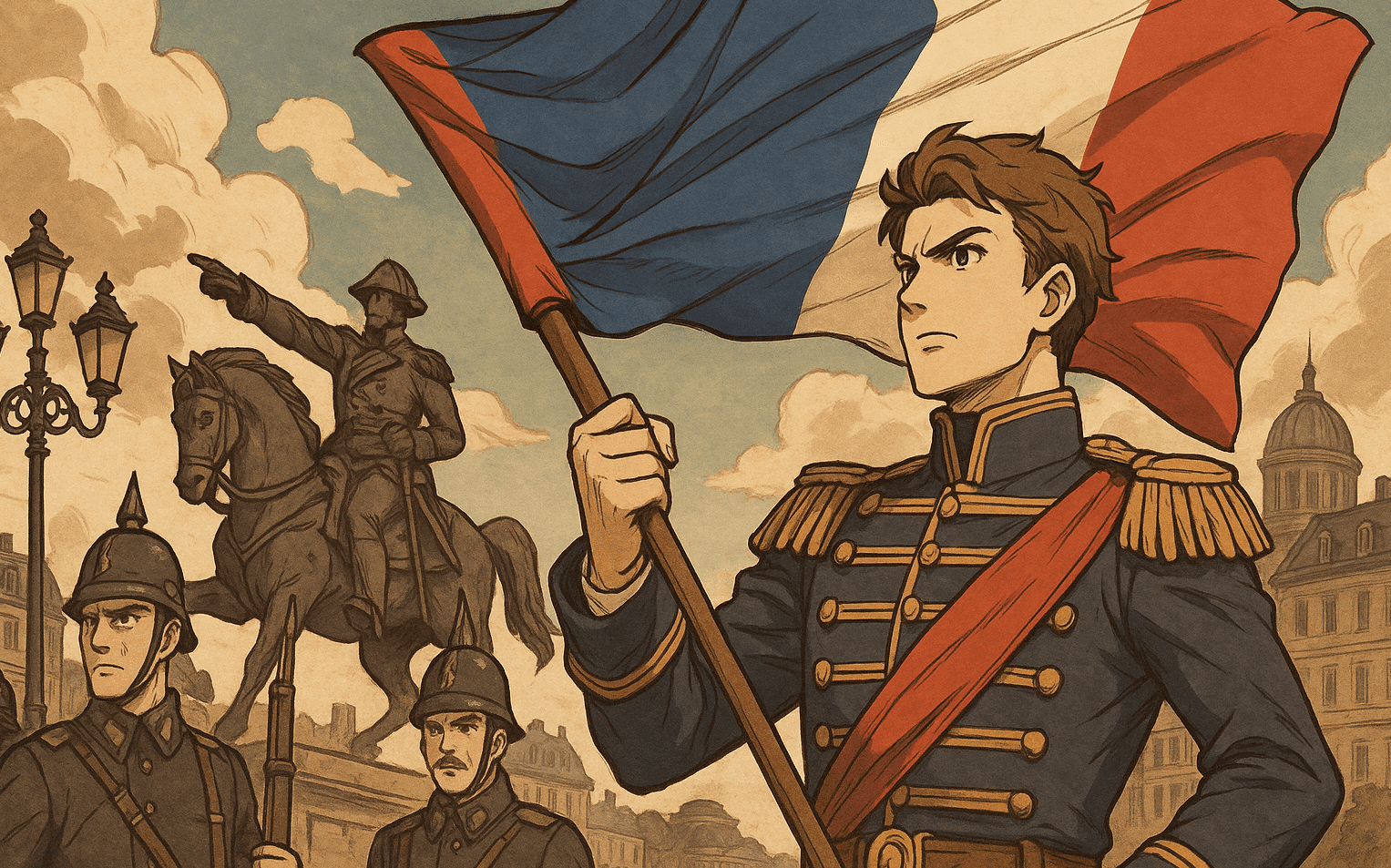
In 1882, the French government shipped free textbooks to every primary school in the country. The books opened with a map of France - including Alsace-Lorraine, the provinces Germany had seized after the Franco-Prussian War, shaded in mourning black. Seven-year-olds traced those borders with their fingers before they could multiply. By the time those children turned eighteen, they didn't need a recruiter to explain why Germany was the enemy. The textbook had done the work a decade earlier.
That is how nationalism actually operates. Not as some organic welling-up of ancient tribal feeling, but as a deliberate, engineered project. Governments, intellectuals, newspaper editors, and schoolteachers built national identity out of selective history, standardized language, shared symbols, and repeated emotional cues. The process worked so well in the nineteenth century that it redrew the map of Europe, launched a global scramble for colonies, and set the fuse for two world wars. And the techniques haven't retired. They've just migrated to new platforms.
84% — of Africa's modern national borders were drawn by European powers at or after the 1884 Berlin Conference, with virtually no input from African populations
The Factory Floor of National Identity
Before the nineteenth century, most Europeans identified with their village, their church parish, their guild, or their lord. A Bavarian peasant in 1780 felt no particular kinship with a Prussian merchant. A Sicilian fisherman had more in common with a Tunisian sailor than with a Milanese banker. "Italy" and "Germany" were geographic expressions, not political realities. Metternich said exactly that about Italy, and he wasn't wrong - at the time.
So what changed?
Three forces converged after the Congress of Vienna in 1815: Romantic intellectuals who insisted that every "people" (Volk) possessed a unique cultural soul expressed through language, folklore, and landscape; print capitalism - cheap newspapers and novels distributed by rail that created shared reading publics across regions where people had never physically met; and state institutions like public schools, conscription armies, and census offices that forced people to declare a single identity on paper.
Johann Gottfried Herder had argued decades earlier that each Volk has "its own heartbeat." Romantic painters rendered misty mountain vistas and village harvest festivals as expressions of authentic national character. Folklorists like the Brothers Grimm collected peasant tales - then cleaned them up, standardized them, and published them as German stories, not Hessian or Swabian ones. Poets wrote in vernacular languages rather than Latin or French, turning linguistic choice into political declaration.
But ideas alone don't build nations. Infrastructure does. Railways let a miner in the Rhineland and a clerk in Lombardy encounter distant compatriots in print before meeting them in person. Compulsory primary education taught children a standardized national language - often at the expense of regional dialects that had thrived for centuries. Military conscription mixed young men from different provinces, drilling shared habits and loyalties. The census demanded you pick a nationality box. Over two or three generations, these institutional systems manufactured the very identity that Romantic intellectuals claimed was ancient and organic.
Historian Benedict Anderson coined the term "imagined communities" to describe nations. Not imagined as in fake, but imagined as in constructed. You will never meet most of your fellow citizens, yet you feel a bond with them. That bond was not inevitable. It was built - through shared texts, shared calendars, shared symbols, and shared enemies. The same machinery operates today through national media, sports events, social media algorithms, and political branding.
Unification by Blood and Calculation: Italy and Germany
The two most dramatic nation-building projects of the century produced modern Italy and modern Germany. Both followed a similar recipe: Romantic idealism provided the emotional fuel, but cold-eyed political operators did the actual engineering.
Italy's Risorgimento
The Italian peninsula in 1850 was a patchwork of duchies, papal territories, and Austrian-controlled provinces, each with its own tariffs, currencies, and garrisons. Unification required somebody to cut through that mess, and the somebody turned out to be Count Camillo di Cavour, the prime minister of Piedmont-Sardinia. Cavour was no starry-eyed patriot. He was a calculating diplomat who understood that Piedmont alone couldn't beat Austria. So he cut a deal with Napoleon III of France: French military support in exchange for the territories of Nice and Savoy.
The strategy worked. Franco-Piedmontese armies won at Magenta and Solferino in 1859, and carefully managed plebiscites absorbed Tuscany, Parma, and Modena. While Cavour handled the boardroom diplomacy, Giuseppe Garibaldi supplied the romantic theater - his volunteer "Redshirts" sailing from Genoa to Sicily in 1860, then marching north through Naples with a force that grew from a thousand to tens of thousands. Rather than clash with the Piedmontese monarchy, Garibaldi theatrically handed his southern conquests to King Victor Emmanuel II. It was nation-building as both military campaign and public spectacle.
Rome remained under French bayonets until 1870, when the Franco-Prussian War forced Napoleon III to withdraw his garrison. Italian troops entered the city and declared it the capital. But here's the awkward truth the textbooks usually gloss over: at unification, only about 2.5% of the peninsula's population spoke standard Italian. The rest spoke Neapolitan, Sicilian, Venetian, Piedmontese, and dozens of other languages as mutually unintelligible as Spanish and Romanian. Massimo d'Azeglio reportedly said, "We have made Italy. Now we must make Italians." The nation-state came first. The nation had to be manufactured after the fact.
German Unification Under Prussian Leadership
German-speaking territories were even more fragmented - thirty-nine states crammed into the German Confederation, plus Danish and Austrian complications. Prussia's secret weapon wasn't poetry or folk songs. It was the Zollverein, a customs union that abolished internal tariffs and coaxed merchants in Frankfurt, Dresden, and Hamburg to rely on Prussian coinage and rail timetables. Economic integration preceded political unification by decades.
Then came Otto von Bismarck, who wielded wars the way a surgeon wields a scalpel - three deliberate, limited conflicts designed to achieve specific political outcomes. War against Denmark in 1864 over Schleswig-Holstein. War against Austria in 1866, lasting a mere seven weeks, that ejected Austria from German affairs. War against France in 1870-71, which whipped southern German states - Bavaria, Wurttemberg, Baden - into joining the Prussian-led coalition out of patriotic fervor against the French enemy.
The culmination was staged with theatrical precision: the German Empire proclaimed in the Hall of Mirrors at Versailles in January 1871. Not in Berlin or Frankfurt, but in the palace of the defeated French enemy. Every detail was a signal. Bismarck understood that national identity isn't just felt - it's performed.
Prussia establishes a free-trade zone across German states, creating economic interdependence that precedes political unity by nearly four decades.
Liberal and nationalist uprisings rock Paris, Vienna, Berlin, Budapest, and Milan. Most are crushed within a year, but they demonstrate that the old dynastic order cannot contain popular demands forever.
Cavour's diplomacy and Garibaldi's military campaigns merge Piedmont-Sardinia, the southern kingdoms, and the central duchies into a single Italian state.
Calculated conflicts against Denmark, Austria, and France forge the German Empire, proclaimed at Versailles in January 1871.
European powers carve Africa into colonial territories. No African leaders are invited. Borders drawn with rulers on maps split ethnic groups and lump rival communities together - consequences that persist today.
The first major military victory of an Asian power over a European one in modern times. The shock reverberates through colonial territories worldwide, proving that European dominance is not inevitable.
A Bosnian Serb nationalist kills Archduke Franz Ferdinand. Alliance systems and mobilization timetables convert a Balkan crisis into a continental war within weeks.
The Cracks in Empire: Nationalism Inside Multinational States
While Italy and Germany consolidated, the great multinational empires - Habsburg Austria-Hungary, the Ottoman Empire, Tsarist Russia - felt the opposite pressure. If a "people" had the right to self-govern, what happened to empires that ruled dozens of peoples?
The Habsburg answer was the Compromise of 1867, which split the empire into Austrian and Hungarian halves sharing only a monarch, a military, and a foreign policy. Hungarian elites got their own parliament in Budapest and began imposing Magyar-language schooling on Slovaks, Romanians, and Croats within their jurisdiction. Slavic inhabitants of Bohemia and Galicia immediately demanded similar deals, and the result was administrative deadlock so severe that the Austrian parliament sometimes devolved into fistfights and desk-banging that made legislation impossible.
Southeast Europe combusted in waves: the Serbian Revolution (1804-17), Greek independence in the 1820s, the Crimean War, and the Balkan crises of 1875-78. Each uprising drew outside interference from Britain, France, or Russia - powers that supported or suppressed nationalist movements based entirely on whether those movements served their strategic interests. Britain backed Greek independence (Lord Byron died at Missolonghi, romanticizing the cause for a generation) but crushed Indian self-governance aspirations. Russia championed Pan-Slavism in the Balkans while Russifying Poland and suppressing Polish uprisings in 1830 and 1863. The principle of national self-determination was selectively applied, always subordinated to great-power calculations.
The Ottoman Empire attempted its own reforms. The Tanzimat edicts (1839-76) promised equal taxation and legal rights across faiths, aiming to build a shared Ottoman civic identity that could compete with ethnic nationalism. It was a reasonable idea that came too late and lacked enforcement. Railway loans drained the sultan's treasury, local notables in Egypt and the Arab provinces leveraged both regional languages and commercial grievances to seek autonomy, and European creditors essentially took control of Ottoman finances through the Ottoman Public Debt Administration after 1881 - a prototype of the structural adjustment programs that international lenders would impose on developing nations a century later.
The Ottoman Public Debt Administration (1881) let European creditors control Ottoman tax revenues to service foreign loans. Compare this to IMF structural adjustment programs in the 1980s-90s, where debtor nations surrendered fiscal sovereignty to international lenders in exchange for bailout loans. The mechanism is strikingly similar: financial dependency becomes a lever for external political control, just without the gunboats.
The Engine Room of Empire: Why Industrialized Nations Needed Colonies
Nationalism and imperialism weren't separate stories happening at the same time. They were the same story. The national pride manufactured at home provided moral cover for extraction abroad, and the wealth extracted abroad funded the schools, armies, and infrastructure that manufactured more national pride. It was a feedback loop.
But strip away the flags and anthems and missionary rhetoric, and the core driver was economic. Coal-fired factories needed raw materials: copper from the Congo, rubber from Malaya, cotton from Egypt, palm oil from West Africa. Overproduction crises in Europe - too many goods, not enough domestic buyers - created pressure to find captive markets overseas. And surplus capital needed somewhere to go. British investors poured money into Indian railways, Argentine beef ranches, and South African gold mines not because they cared about "civilizing" anyone, but because returns were higher than anything available in Birmingham.
J.A. Hobson, a British economist writing in 1902, argued that imperialism was fundamentally a racket: wealthy elites profited from colonial ventures while ordinary taxpayers bore the military costs. His book Imperialism: A Study influenced economic thinking for decades, including Lenin's later theory that imperialism was capitalism's final stage. Whether or not you buy the full Marxist framework, Hobson's basic observation holds: the costs of empire were socialized, while the profits were privatized. That pattern didn't end with decolonization.
The Technology of Conquest
Weapon gaps made the scramble possible. The breech-loading rifle, the Maxim gun (1884), and quinine prophylaxis against malaria allowed small European detachments to defeat far larger local armies. At the Battle of Omdurman in 1898, a British-Egyptian force of 25,000 killed roughly 12,000 Mahdist soldiers and wounded 13,000 more while suffering only 47 dead. Winston Churchill, who participated as a young cavalry officer, later described the slaughter with a mix of admiration and unease.
Telegraph lines gave colonial officers near-real-time communication with ministries in London, Berlin, or Paris, shortening decision loops from months to days. Steamships compressed supply chains. And the bureaucratic technologies of census-taking, mapping, and classification allowed colonial administrators to sort populations into manageable ethnic categories - categories that often hadn't existed as rigid identities before colonial contact.
The Scramble for Africa: How a Continent Was Carved at a Conference Table
Between November 1884 and February 1885, diplomats from fourteen European nations sat in a Berlin conference hall and divided a continent none of them had fully mapped. No African leader was invited. The borders they drew with rulers on European maps split ethnic groups in half and lumped rival communities together, creating the template for almost every African nation-state that exists today.
The conference established a rule of "effective occupation" - meaning you couldn't just claim territory, you had to demonstrate administrative control. This triggered a competitive rush. France planted tricolor flags across the Sahara and pushed east from Senegal toward the Nile. Britain raced south from Egypt and north from the Cape, dreaming of a Cairo-to-Cape Town railway. Germany grabbed Tanganyika, Southwest Africa, and Cameroon. Portugal consolidated Angola and Mozambique. Italy took Eritrea and tried - disastrously - to conquer Ethiopia, suffering a humiliating defeat at Adwa in 1896 that made Ethiopia the only African state to successfully resist European colonization in this period.
King Leopold II of Belgium pulled off the most audacious move. He secured personal control - not Belgian state control, personal - over the Congo Free State, an area seventy-six times the size of Belgium. What followed was one of history's greatest atrocities. Concession companies imposed rubber quotas on villages, and soldiers enforced them by holding women and children hostage, flogging workers, and amputating hands as proof of "discipline." Casualty estimates range from 1 million to 10 million dead. When missionaries and journalists - including the British consul Roger Casement and the Polish-British novelist Joseph Conrad, whose Heart of Darkness drew on his Congo experience - exposed the horror, it triggered the first modern international human rights campaign. Belgium formally annexed the colony in 1908, ending Leopold's personal rule, though conditions improved only marginally.
Asia Under Pressure: India, China, and Japan's Divergent Paths
The British Raj: Administration as Extraction
India's shift from East India Company fiefdom to direct Crown rule followed the Sepoy Rebellion of 1857 - an uprising triggered by rifle cartridges rumored to be greased with cow and pig fat (offensive to both Hindu and Muslim soldiers), but rooted in decades of accumulated resentments over land seizures, taxation, and cultural interference. After crushing the revolt with exceptional brutality, London restructured governance through district collectors, railway grants, and universities teaching English jurisprudence.
The railway system tells the story in iron and sleeper ties. By 1900, India had the fourth-largest rail network on Earth - nearly 25,000 miles of track. But the lines didn't connect Indian cities to each other for Indian commerce. They connected cotton-growing regions to ports, grain regions to ports, mineral regions to ports. The rails ran to the coast, where goods boarded ships to Britain. It was infrastructure designed for extraction, not development.
Cotton illustrates the pattern precisely. India had been the world's leading textile producer for centuries. British tariff policy destroyed that industry by allowing cheap Manchester machine-made cloth into India duty-free while slapping heavy tariffs on Indian textiles entering Britain. India went from exporting finished cloth to exporting raw cotton - and then buying it back as expensive manufactured fabric. The Industrial Revolution in Britain was partly built on the deliberate deindustrialization of India.
Yet colonial institutions also produced unintended consequences. The Indian National Congress, founded in 1885, convened lawyers and journalists who had studied Locke and Burke in British-run universities. They used the colonizer's own political philosophy to argue for self-governance. The same English-language press that served British administration became a vehicle for nationalist organization. Empire planted the seeds of its own opposition.
China: Death by a Thousand Treaties
Britain's addiction to tea - and its inability to find anything the Chinese wanted to buy in return - led merchants to flood Canton with opium grown on Bengal plantations. When Commissioner Lin Zexu confiscated and destroyed 20,000 chests of opium in 1839, British gunboats shelled coastal forts, and the Treaty of Nanking (1842) forced China to cede Hong Kong, open five treaty ports, and pay an indemnity. A second war (1856-60) extended privileges to France, Russia, and America.
By the 1890s, railway and mining concessions had divided Manchuria, Shandong, and the Yangtze basin into "spheres of influence" where foreign powers collected tariffs, administered courts, and extracted resources with near-total impunity. The Qing court's Self-Strengthening Movement ordered arsenals and shipyards, but conservative officials blocked the administrative overhaul that would have made those investments effective. The result was a string of humiliations: defeat by Japan in 1895, the failed Hundred Days' Reform of 1898, and the Boxer Uprising of 1900, after which eight foreign nations occupied Beijing and imposed crippling indemnities.
China's experience became the template for what scholars call "semi-colonialism" - formal sovereignty maintained on paper while actual economic and political control rested with foreign powers. It's a pattern with modern echoes.
Japan: The Exception That Proved the Rule
When Commodore Perry's steam-powered warships anchored in Edo Bay in 1853, the Tokugawa shogunate faced the same technological gap that had doomed Chinese coastal defenses. But Japan's response was radically different. Within fifteen years, the Meiji Restoration toppled the shogunate and launched a modernization program that deliberately studied and copied the best systems from every major power: French legal codes, German military staff organization, British naval architecture, American agricultural methods.
Japan didn't just adopt Western technology. It reverse-engineered the entire institutional framework of an industrial power - public education, central banking, conscript armies, patent law, railroad networks - in a single generation. By 1895, Japan defeated China in war. By 1905, it defeated Russia, a European great power, at the battles of Mukden and Tsushima. The shock in European capitals was profound. An Asian nation had beaten a white European empire using Europe's own military methods. Japan annexed Korea in 1910 and positioned itself as an imperial power in its own right.
Japan's trajectory carries a deeply uncomfortable lesson about the nineteenth-century imperial system: the way to avoid being colonized was to become a colonizer. Modernization, as the era defined it, meant building the capacity for conquest.
Strategy: Self-Strengthening Movement - adopt Western military technology without reforming institutions
Political structure: Qing dynasty maintained; conservative officials blocked systemic change
Result: Military arsenals built but embedded in an unreformed bureaucracy. Lost wars to Japan (1895), suffered Boxer indemnities (1901)
Outcome by 1912: Dynasty collapsed. Republic declared. Decades of civil war followed
Strategy: Meiji Restoration - wholesale institutional transformation modeled on multiple Western powers
Political structure: Shogunate overthrown; centralized modern state built from scratch
Result: Industrialized within a generation. Defeated China (1895) and Russia (1905). Joined the imperial powers
Outcome by 1912: Major industrial and military power. Colonizer of Korea and parts of China
Manufacturing the Colonial Subject: How Empires Reorganized Societies
Colonial rule didn't just extract resources. It reorganized entire societies in ways that outlasted the colonial period by generations. And the most lasting reorganization was often the most subtle: the classification of people into rigid ethnic categories.
Before British "indirect rule" in Nigeria, identities like Hausa, Yoruba, and Igbo existed as overlapping cultural affiliations shaped by trade, marriage, and religious practice. People moved between categories. Colonial census-takers changed that. They needed neat boxes for administrative purposes - taxation, conscription, labor allocation - so they hardened fluid identities into fixed ethnic categories, assigned chiefs to each group, and governed through those appointed intermediaries. The categories became self-reinforcing: access to resources depended on which box you occupied, so people began defending those boxes fiercely. Ethnic tensions that erupted after independence - including the Nigerian Civil War of 1967-70 - had roots in colonial classification systems that were barely a century old.
In French West Africa, the Code de l'Indigenat imposed corvee labor and summary courts on colonial subjects while offering a tiny elite the possibility of French citizenship through "assimilation" - but only if they abandoned customary law, adopted French cultural practices, and demonstrated sufficient "civilization." The system created a sharp divide between a French-educated colonial elite and the mass population, a divide that shaped post-independence politics across Francophone Africa.
In India, the British census turned the fluid varna-jati system into the rigid "caste system" familiar to modern audiences. Pre-colonial caste was complex, locally variable, and partially negotiable. The colonial census fixed caste identities on paper, ranked them hierarchically, and used them for administrative purposes. Scholars like Nicholas Dirks have argued that "the caste system" as a totalizing framework was substantially a colonial construction - not invented from nothing, but rigidified and systematized in ways that served imperial governance.
Colonial powers consistently turned fluid social identities into rigid administrative categories. Those categories then became the basis for resource allocation, political representation, and eventually violent conflict. Rwanda's Hutu-Tutsi distinction, which had been a relatively flexible social boundary, was hardened into a racial classification by Belgian colonial administrators who issued identity cards specifying ethnicity. Those same categories were weaponized during the 1994 genocide. When you hear about "ancient tribal hatreds" in former colonies, check the colonial history. The hatreds are often far younger than claimed.
The Feedback Loop: How Colonial Profits Fueled Domestic Nationalism
Empire wasn't just an overseas project. It reshaped the imperial nations themselves. Colonial revenues funded the public schools that taught children to be proud of their empire. Colonial wars produced military heroes whose statues filled town squares. Colonial exhibitions - massive public spectacles where "native villages" were reconstructed for European audiences to gawk at - reinforced racial hierarchies and national pride simultaneously. The 1889 Paris Exposition drew 32 million visitors to marvel at the Eiffel Tower and walk through a reconstructed Senegalese village staffed by actual Senegalese people displayed as living exhibits.
This feedback loop connected domestic identity to overseas extraction in ways most citizens never examined. A British worker in Manchester wore cotton clothes made from Egyptian or Indian raw cotton, sweetened his tea with Caribbean sugar, and read a penny newspaper printed on wood pulp shipped from Canadian forests - all while believing that the British Empire was primarily a civilizing mission rather than an economic system. The nationalism that told him he was part of a superior civilization performing a noble duty was inseparable from the imperial economy that supplied his breakfast.
Anti-imperialist voices existed, but they were marginal. J.A. Hobson's critique reached intellectuals. Socialist congresses in Stuttgart (1907) linked colonial wars to capitalist market expansion. Dockworkers occasionally struck against shipments of looted goods. Missionaries who had gone abroad to "civilize" sometimes returned as the most vocal critics of colonial violence. But these dissenting threads never wove into a political force capable of stopping the machine - not until the wars of the twentieth century made empire's costs impossible to ignore.
19th-Century Imperialism vs. Modern Economic Influence
Here's where the history becomes uncomfortably present-tense. The formal empires are gone - the last major European colony, Portuguese Macau, was handed back in 1999. But many of the economic relationships that imperialism created persist in modified form. Scholars call it neo-colonialism, and while the term is politically loaded, the structural parallels are hard to dismiss.
Resource extraction: Colonies exported raw materials (rubber, cotton, minerals) to industrial metropoles at prices set by the colonizer
Market control: Captive colonial markets forced to buy manufactured goods from the imperial power, tariffs blocked local industry
Financial control: Ottoman Public Debt Administration, Egyptian Caisse de la Dette - foreign creditors controlled national budgets
Infrastructure: Railways and ports built to move resources to the coast for export, not to develop internal economies
Political leverage: Direct military occupation, appointed governors, gunboat diplomacy
Identity management: Colonial education in imperial languages, classification of populations into administered categories
Resource extraction: Multinational corporations extract minerals (cobalt, lithium, coltan) from developing nations at prices set by global commodity markets dominated by wealthy nations
Market control: WTO rules and trade agreements limit developing nations' ability to protect infant industries - echoing 19th-century tariff structures
Financial control: IMF structural adjustment programs require privatization, austerity, and market liberalization as conditions for loans
Infrastructure: Chinese Belt and Road Initiative builds ports and railways in Africa and Asia - critics note the routes prioritize export corridors over local connectivity
Political leverage: Sanctions, aid conditionality, military base agreements, debt-trap diplomacy allegations
Identity management: Cultural soft power through media, education, and technology platforms headquartered in wealthy nations
The Democratic Republic of Congo illustrates the continuity with painful clarity. Under Leopold II, the territory was exploited for rubber and ivory. Under Belgian colonial rule (1908-60), it was mined for copper and uranium - the uranium in the Hiroshima bomb came from the Congolese Shinkolobwe mine. After independence in 1960, the CIA helped overthrow the elected prime minister Patrice Lumumba and install the dictator Mobutu, who ensured Western corporations maintained access to the country's mineral wealth. Today, the DRC produces roughly 70% of the world's cobalt - essential for smartphone and electric vehicle batteries - much of it mined in conditions that international observers compare to nineteenth-century forced labor.
The flag changed. The extraction didn't.
This isn't to say nothing has improved - sovereign nations have legal rights, international institutions provide some accountability, and the raw violence of colonial occupation is gone. But the structural relationships between resource-rich developing nations and wealthy consuming nations bear a family resemblance to the ones that nineteenth-century imperialism created. Recognizing that resemblance isn't about assigning guilt. It's about understanding how the present was made.
A smartphone in your pocket contains cobalt from the DRC, rare earth elements from mines in China or Myanmar, tin from Indonesia, and tantalum from Central Africa. The raw materials travel to processing plants in China, assembly factories in Vietnam or India, design offices in California, and retail stores worldwide. At each step, value is added - and the share of that value captured by the countries providing raw materials is remarkably small compared to the countries providing design and branding. The geography of extraction and the geography of profit haven't changed as much as we like to think since the nineteenth century. Understanding the imperial origins of these supply chains doesn't mean boycotting your phone. It means understanding the world it connects you to.
The Road to 1914: When National Pride Became a Death Wish
As the nineteenth century closed, the nationalism that had unified Italy and Germany metastasized into something more volatile: competitive, militarized, zero-sum national rivalry. Capital cities measured status by the tonnage of their ironclad fleets and the length of their overseas telegraph cables. National honor became non-negotiable. Diplomatic compromise became weakness.
Germany demanded "a place in the sun," launching the High Seas Fleet that directly challenged British naval supremacy and backing the Berlin-Baghdad railway that threatened British and Russian interests in the Middle East. France nursed revanche against Germany after the loss of Alsace-Lorraine in 1871, pouring resources into its military and consolidating an "African corridor" from Dakar to Djibouti. Britain, alarmed by German shipbuilding and Russian expansion toward India's borders, abandoned its traditional isolation and forged alliances with former rivals - the Anglo-Japanese Alliance (1902), the Entente Cordiale with France (1904), and the convention with Russia (1907).
Crises flared with increasing frequency and decreasing resolution time. Fashoda (1898) nearly sparked Anglo-French combat over a remote Sudanese outpost. The Moroccan crises of 1905 and 1911 saw German gunboats challenging French influence in North Africa. Austria-Hungary's annexation of Bosnia in 1908 enraged Serbia and its Russian backers. Each crisis was resolved - barely - but each resolution left at least one party humiliated and eager for the next confrontation.
Meanwhile, newspapers fanned patriotic fever. The popular press, which had grown enormously since mid-century, discovered that jingoism sold papers. Editors who urged restraint lost readers to competitors who wrapped military budgets in flags. The arms race between Britain and Germany - each new dreadnought matched by the other side - was as much a media spectacle as a strategic calculation. Public opinion, manufactured through decades of nationalist education and imperial propaganda, had become a force that constrained diplomats rather than empowering them. Leaders who might have compromised found that their own citizens wouldn't let them.
By June 28, 1914, when Gavrilo Princip - a Bosnian Serb nationalist, nineteen years old, fired on Archduke Franz Ferdinand and his wife Sophie in Sarajevo - the system had no slack left. Alliance obligations activated like dominoes. Mobilization timetables, designed for speed rather than deliberation, compressed decision-making from weeks to hours. What might have remained a Balkan incident consumed the continent within five weeks. The nationalism that had built nations now burned them. The war that followed killed roughly 20 million people and dismantled the empires whose rivalries had caused it.
Anti-Colonial Seeds in Colonial Soil
Empires always produce their own opponents. Colonial mission schools and universities, built to train administrative clerks and translators, also created intellectuals who absorbed Enlightenment ideas about liberty, equality, and self-governance - and turned them against the colonizers who taught them.
Jose Rizal in the Philippines wrote novels in Spanish exposing colonial abuses, and his execution by the Spanish government in 1896 made him a martyr who galvanized the Philippine independence movement. Mohandas Gandhi, a London-trained lawyer working in South Africa, developed satyagraha - nonviolent resistance - by applying Thoreau and Tolstoy to the specific conditions of racial oppression in Natal and the Transvaal. Edward Wilmot Blyden, born in the Danish West Indies and educated in Liberia, articulated a vision of pan-African identity decades before the concept entered mainstream political discourse.
These figures didn't operate in isolation. They read each other's work. They corresponded across continents. They attended the same international conferences. The global infrastructure of empire - steamship routes, telegraph cables, postal networks, a shared language of political rights - created a counter-network of anti-colonial solidarity. The very tools built to maintain imperial control were repurposed to dismantle it.
Their critique wasn't merely moral. It was analytical. They dissected the economic logic of colonialism - how raw material extraction impoverished colonies while enriching metropoles, how racial categories served administrative convenience rather than biological reality, how the "civilizing mission" justified exploitation. That analytical tradition runs through twentieth-century independence movements, through Frantz Fanon and Kwame Nkrumah and Ho Chi Minh, all the way to contemporary scholars studying global supply chains and institutional racism. The nineteenth century didn't just create the problem. It also created the intellectual tools for diagnosing it.
The takeaway: National identity is not an ancient instinct - it is a constructed project, built through schools, media, symbols, and selective history. Imperialism was not a sideshow to nationalism - it was its economic engine and its logical extension. The borders drawn in Berlin conference rooms, the ethnic categories invented by colonial census-takers, and the extraction patterns established by imperial trade routes didn't end when colonies gained independence. They were inherited, and many persist in modified form. Understanding how these systems were built is the first step toward seeing how they still operate.
Why This Century Still Runs the World
The nineteenth century built the world you live in. Not metaphorically. Literally. The national borders on your map, the languages designated "official" in former colonies, the ethnic categories that drive politics from Nigeria to Myanmar, the trade routes that ship cobalt from Central Africa to Chinese processing plants to California design studios - all of these trace directly to decisions made between 1815 and 1914.
Understanding that lineage doesn't require you to feel guilty about history you didn't make. But it does require you to see the present clearly. When a politician wraps himself in a flag and tells you that your nation is under threat from outsiders, he's using a technique perfected by nineteenth-century state-builders. When an international lender imposes conditions on a developing nation's economic policy, the power dynamic echoes the Ottoman Public Debt Administration. When ethnic conflict erupts in a former colony along lines that colonial administrators drew, "ancient tribal hatreds" is a lazy explanation. The real explanation is usually about a hundred years old, not a thousand.
The nineteenth century teaches one lesson above all others: identity is a tool. It can be used to liberate - as when colonized peoples organized around shared experience to demand independence. And it can be used to control - as when empires sorted populations into categories designed for administrative convenience. Recognizing which function identity is serving at any given moment is one of the most practically useful skills that history can give you. The nationalists and imperialists of the nineteenth century understood this perfectly. The question is whether the rest of us have caught up.