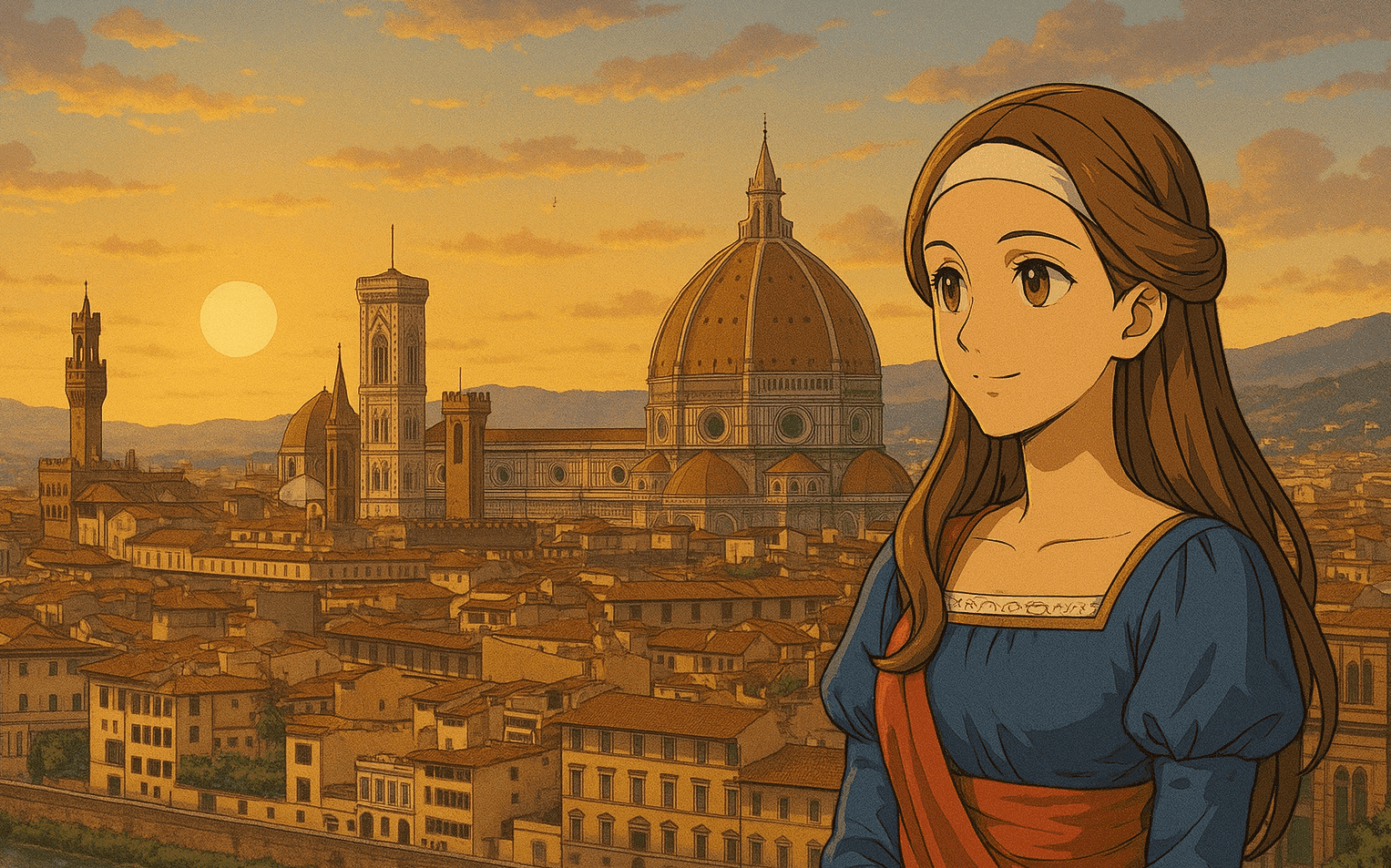
In 1462, a Florentine banker named Giovanni Tornabuoni wrote a letter to his business partner in Bruges. The subject was not interest rates or wool futures. It was a painting. He wanted Ghirlandaio to finish a chapel fresco cycle before a rival family could unveil theirs across the Arno. The commission would cost more than a merchant galley loaded with Levantine spices. Tornabuoni paid it without blinking. Why? Because in Renaissance Italy, funding art was not charity. It was strategy - a calculated investment in reputation, influence, and competitive positioning that would ripple through generations of contracts, marriages, and political alliances.
That instinct - pouring money into unproven creative talent and hoping the returns compound - sounds remarkably familiar. Swap "chapel fresco" for "Series A funding" and "rival family" for "competing startup," and you have the logic of modern venture capital. The Renaissance was, at its root, an innovation ecosystem. Money met talent, talent produced breakthroughs, breakthroughs attracted more money. The cycle fed on itself for nearly three centuries and reshaped every corner of human civilization.
~3 Centuries — Duration of the Renaissance innovation cycle (roughly 1300s to 1600s) - one of the longest sustained creative booms in recorded history
Why Italy? Geography Sitting on Top of Money
Every innovation ecosystem needs a trigger. Silicon Valley had Cold War defense contracts and Stanford's engineering school. Renaissance Italy had something older: geography sitting on top of money.
Venice commanded the eastern Mediterranean trade routes - silks, spices, dyes from Constantinople and beyond. Genoa ran the western lanes toward Iberia and North Africa. Florence controlled neither coast but dominated inland banking, and that turned out to be the killer advantage. The Medici bank, at its peak around 1450, operated branches in Rome, Venice, Naples, Milan, Geneva, Bruges, Avignon, and London. They lent to popes. They lent to kings. When Edward IV of England defaulted on a massive loan, the London branch collapsed - but the network survived. Diversification worked in the fifteenth century exactly as it works now.
The Black Death had paradoxically concentrated wealth. With a third of Europe's population dead by the 1400s, surviving merchant families inherited consolidated assets. Fewer people splitting the same pile of gold meant surplus capital looking for places to go. Some went into land. Some into trade ventures. And a surprising amount went into what we would now call R&D: art, architecture, engineering, and scholarship.
The Renaissance didn't start because people suddenly became more creative. It started because an unusual concentration of liquid capital met a network of skilled craftspeople in cities small enough that everyone knew everyone. The same pattern - capital density plus talent density plus tight networks - describes every innovation cluster from Victorian Manchester to modern Shenzhen.
Italian city-states competed ferociously. Florence against Siena. Venice against Genoa. Milan against everyone. This rivalry was not just military - it was cultural, architectural, and intellectual. When Florence raised Brunelleschi's dome, rival cities felt pressure to build something equally spectacular. Competition drove spending, spending attracted talent, and talent produced innovations that made the spending look brilliant in retrospect.
Patronage: Venture Capital Before the Term Existed
Modern venture capital operates on a simple bet: fund ten startups, expect seven to fail, hope two break even, and pray one becomes a unicorn. Renaissance patronage followed a strikingly similar logic, except the "startups" were artists, architects, and engineers - and the "unicorn" was a masterpiece that would cement your family's legacy for centuries.
The Medici family perfected this model. Cosimo de' Medici didn't just write checks. He built an ecosystem. He funded Marsilio Ficino to translate Plato's complete works from Greek - a project with zero short-term commercial value but enormous long-term cultural payoff. He bankrolled Brunelleschi's experiments. He opened libraries. He created what amounted to a talent pipeline, sponsoring young artists through guild training and funneling commissions their way as they matured.
Lorenzo "the Magnificent" took the model further. His household functioned as an incubator. A teenage Michelangelo lived under Lorenzo's roof, ate at his table, and studied ancient sculptures in his garden collection. The investment paid off spectacularly, but Lorenzo couldn't have known that when he welcomed a fifteen-year-old stonecutter's apprentice into his home. That is the venture capital mentality: bet on potential, tolerate uncertainty, and build a portfolio broad enough to absorb the misses.
Investors: Merchant families, popes, city councils
Talent pool: Guild-trained artists, architects, engineers
Deal structure: Commission-based with creative latitude
Return metric: Prestige, political influence, tourist traffic
Risk tolerance: High - patrons funded experimental techniques regularly
Investors: VC firms, angel investors, sovereign wealth funds
Talent pool: Engineers, designers, founders from university pipelines
Deal structure: Equity stake for ownership percentage
Return metric: Financial return via IPO, acquisition, dividends
Risk tolerance: High - most portfolio companies fail by design
Patronage wasn't limited to the Medici. Pope Julius II hired Michelangelo to paint the Sistine Chapel ceiling and Raphael to decorate papal apartments - simultaneously, using competition between artists as a quality-control mechanism. Ludovico Sforza brought Leonardo da Vinci to Milan not just for portraits but for canal engineering, military fortifications, and festival stage production. Leonardo was, in modern terms, a full-stack creative technologist operating under a corporate retainer. Even wool merchants in provincial towns commissioned altarpieces that doubled as advertisements for their piety and prosperity. Every commission was a signal. Every signal attracted business. The principles of brand building were already in full swing - they just hadn't been named yet.
Gutenberg's Press: The Original Internet Disruption
Around 1440, in a workshop in Mainz, a goldsmith named Johannes Gutenberg solved a problem that had bottlenecked human civilization for millennia. He figured out how to cast individual metal letters that could be arranged into pages, inked, and pressed onto paper - then rearranged and used again. The idea wasn't entirely new (the Chinese had done it with clay characters centuries earlier), but Gutenberg's innovation was a system: oil-based ink that adhered to metal, a press adapted from wine-making equipment, and an alloy of lead, tin, and antimony that cast cleanly and held up under pressure.
The results were staggering. Before Gutenberg, a single Bible might take two years of hand-copying. Afterward, a print shop could produce hundreds of identical copies in weeks. By 1500 - barely fifty years after Gutenberg's first Bible - an estimated twenty million volumes had been printed across Europe. By 1600, that number approached two hundred million.
Think about what this means in information economics terms. Before the press, knowledge was scarce, expensive, and controlled by institutions - monasteries, universities, royal courts. After the press, knowledge became cheap, portable, and increasingly impossible to gatekeep. The internet did the same thing starting in the 1990s, and both disruptions triggered nearly identical consequences: democratized access, institutional panic, an explosion of brilliant ideas alongside dangerous misinformation, and a fundamental restructuring of who holds power.
Aldus Manutius, a Venetian printer working in the 1490s, pushed the disruption further. He invented the pocket-sized book using a new italic typeface that crammed more words per page. Scholars no longer needed a library to read Virgil - they carried him in a saddlebag. Manutius also introduced the semicolon and standardized punctuation. His Aldine Press became a brand synonymous with quality and portability - the Renaissance equivalent of a Kindle ecosystem.
The Art of Seeing: How Painters Rewired Human Perception
Before the Renaissance, European paintings were flat. Intentionally flat. Medieval artists weren't incapable of depicting depth - they chose not to, because hierarchical sizing served their theological purpose better than realism. Then Filippo Brunelleschi, standing in the doorway of Florence's cathedral around 1415, demonstrated linear perspective using a painted panel and a mirror. He proved mathematically that parallel lines converge at a vanishing point, and that this convergence could be calculated and reproduced.
The impact was seismic. Within a generation, Masaccio used perspective to paint The Holy Trinity - a fresco so convincingly three-dimensional that visitors reportedly tried to step into the painted chapel. Leon Battista Alberti codified the rules in his 1435 treatise De Pictura, turning perspective from a workshop trick into a teachable system.
Leonardo da Vinci layered another innovation on top: sfumato, the technique of blending tones so gradually that edges dissolve like smoke. The Mona Lisa's famous smile works because of sfumato - the corners of her mouth are deliberately ambiguous, and your brain interprets them differently depending on where you focus. It is a painting that exploits the neuroscience of peripheral vision, executed five centuries before anyone had a vocabulary for it.
Michelangelo, working on the Sistine Chapel ceiling from 1508 to 1512, pushed human anatomy to its expressive limit. He had dissected cadavers to understand how muscles attach to bone, and he painted figures whose physical tension communicates emotion. The hand of Adam reaching toward God is not just a theological statement - it's a biomechanical study of extension, relaxation, and potential energy.
Raphael synthesized everything. Working in Rome, he blended Michelangelo's muscular drama with Leonardo's atmospheric softness, producing The School of Athens - a painting that is itself a map of the Renaissance worldview: Plato and Aristotle at the center, surrounded by mathematicians, astronomers, and philosophers, all framed within a perspective grid that makes the viewer feel present in the scene.
Renaissance perspective didn't stay in museums. It became the foundation for architectural drafting, cartography, theatrical set design, and eventually computer graphics. Every 3D video game engine calculates vanishing points using math that traces directly back to Brunelleschi's mirror experiment in 1415.
Science Breaks Free: From Dogma to Tested Evidence
For over a thousand years, European medicine ran on Galen - a second-century Greek physician whose anatomical descriptions were based largely on dissecting monkeys and pigs. Galen's errors were embedded in medical training like bugs in legacy code: everyone knew the system was imperfect, but nobody wanted to rewrite it from scratch.
Andreas Vesalius did it anyway. In 1543, at age twenty-eight, he published De Humani Corporis Fabrica - a seven-volume anatomical atlas based on actual human dissections at the University of Padua. The woodcut illustrations exposed centuries of Galenic errors in a single publication. Vesalius showed that the human jaw is one bone, not two. He demonstrated that the heart's septum has no pores. The book was a full-stack replacement of the existing knowledge base.
The same year - 1543, one of those hinge-point dates worth remembering - Nicolaus Copernicus published De Revolutionibus, arguing that Earth orbits the Sun. He had worked on the model for decades and delayed publication partly from fear of backlash. If Earth was not the center of the universe, then humanity's theological specialness required rethinking.
Galileo Galilei, working in the early 1600s, brought the scientific method closer to its modern form. He didn't just observe - he measured. He timed falling objects using his pulse as a clock. He aimed a telescope at Jupiter and tracked four moons over successive nights, recording positions with precision that anyone could replicate. When he published Sidereus Nuncius in 1610, he included diagrams so detailed that readers with their own telescopes could verify his claims. That is the essence of reproducibility - the principle that separates science from opinion.
The Church pushed back, famously. Galileo was tried, forced to recant, and spent his final years under house arrest. But the data was already out there, in print, in multiple languages, distributed by the very press technology that Gutenberg had unleashed 170 years earlier. You cannot un-print a book. The institutional attempt to suppress Copernican astronomy failed because the information infrastructure had already outgrown institutional control - a dynamic that the Enlightenment would amplify dramatically.
Petrarch champions classical Latin texts. Florentine scholars begin collecting Greek manuscripts, laying intellectual groundwork in libraries and correspondence networks.
Florence holds a public competition for bronze doors. Ghiberti wins, but the runner-up - Brunelleschi - pivots to architecture. Competition drives innovation forward.
Using a painted panel and mirror outside Florence cathedral, Brunelleschi proves three-dimensional space can be mapped onto a flat surface with mathematical rules.
Brunelleschi caps Santa Maria del Fiore with a 45,000-ton double-shell dome - no flying buttresses, no centering. Engineering tracked in daily ledgers that read like modern project documentation.
A Mainz goldsmith perfects cast metal letters, oil-based ink, and an adapted wine press. Book production costs drop ~90%, triggering an information revolution.
Greek scholars flee west carrying manuscripts of Plato, Aristotle, and Archimedes. Italian cities absorb this intellectual capital, accelerating the recovery of classical knowledge.
Luca Pacioli's Summa de Arithmetica codifies debit-credit accounting. Every modern ledger - from QuickBooks to blockchain - descends from this treatise.
Michelangelo paints over 300 figures across 5,000 square feet of ceiling - fusing anatomical precision with theological drama at unprecedented scale.
Martin Luther challenges indulgence sales. Printed pamphlets spread his arguments faster than any authority can suppress them. The Reformation begins - powered by the press.
Two books in one year overturn a millennium of inherited science. Vesalius replaces Galen's anatomy. Copernicus displaces Earth from the center of the universe.
Using an improved telescope, Galileo spots four moons orbiting Jupiter. He publishes Sidereus Nuncius, and the Copernican model gains its first telescopic evidence.
Double-Entry Bookkeeping: The Invisible Revolution
Ask someone to name a Renaissance breakthrough and they will say the Sistine Chapel or the heliocentric model. Nobody says "accounting." But double-entry bookkeeping may be the single most impactful innovation of the entire period.
Luca Pacioli, a Franciscan friar who taught geometry to Leonardo da Vinci, published Summa de Arithmetica in 1494. Buried inside was a 27-page section that standardized a system Venetian merchants had been developing for decades. The principle is elegant: every transaction gets recorded twice - once as a debit, once as a credit. If your books don't balance, something is wrong. Either you made an arithmetic error, or someone is stealing from you.
The method gave merchants a reliable way to track profit and loss across complex, multi-party, long-distance trading operations. Trust became auditable. And auditable trust enabled larger deals, longer credit terms, and more ambitious ventures. The accounting method's spread tracks suspiciously well with the growth of modern economic systems - from Venice to Amsterdam to London, following the center of commercial gravity across three centuries.
The takeaway: Double-entry bookkeeping didn't just track money - it created the information infrastructure that made modern capitalism possible. Every bank balance, corporate quarterly report, and blockchain transaction ledger descends from a system codified by a friar in 1494.
The Reformation: When the Press Weaponized Ideas
On October 31, 1517, Martin Luther nailed ninety-five theses to the door of the Castle Church in Wittenberg. His target was the sale of indulgences - papal certificates that promised reduced time in purgatory in exchange for cash. Luther's objection was theological, but his impact was technological. Within weeks, printers in multiple German cities had reproduced his theses as pamphlets. Within months, they had spread across the Holy Roman Empire. Within years, they had reached every literate corner of Europe.
Between 1517 and 1520, Luther's publications sold an estimated 300,000 copies. He wrote in vernacular German rather than Latin, which meant his arguments reached merchants and craftspeople who couldn't read scholarly texts. The press didn't just distribute Luther's ideas; it created a public sphere where those ideas could be debated, modified, and radicalized by people who had never set foot in a university.
The consequences were enormous. The Peasants' War of 1524-1525 drew partly on Reformation rhetoric. The Thirty Years' War (1618-1648) killed an estimated eight million people. But the Reformation also drove literacy rates upward, because Protestants insisted believers should read Scripture for themselves. Schools proliferated. Vernacular publishing boomed. The long-term effect was a more literate, more politically engaged population - exactly the kind that would later demand Enlightenment-era rights and constitutional governance.
Imagine a technology that lets anyone publish opinions instantly to a global audience, bypassing traditional gatekeepers. Content spreads faster than institutions can fact-check it. Some of it is brilliant. Some is dangerous. Governments scramble to regulate but can't keep up. Sound like social media in 2020? It's also the printing press in 1520. The Renaissance gave us the first version of this problem, and we still haven't solved it.
Renaissance Engineering: Building the Impossible
Brunelleschi's dome for Florence's cathedral wasn't just an architectural achievement - it was a project management case study that modern engineers still reference.
The problem: an octagonal opening 140 feet across, left uncovered since 1296 because nobody knew how to span it. Traditional Gothic solutions required flying buttresses, which the Florentines had rejected on aesthetic grounds. Brunelleschi proposed a double-shell dome - inner and outer layers with hollow space between - self-supporting during construction. Bricks laid in a herringbone pattern locked each course into the previous one, eliminating the need for centering. He designed custom hoisting machines powered by oxen and even invented a canteen system so workers could eat lunch on the scaffolding instead of climbing down.
The daily construction logs survive. Materials requisitioned. Deliveries logged. Workers tracked by task. Substandard rope rejected and noted. This level of documentation established patterns of accountability that echo through every project management framework from Gantt charts to Agile sprints.
Leonardo da Vinci pushed engineering into speculative territory. His notebooks - over 7,000 surviving pages - contain designs for flying machines, armored vehicles, hydraulic systems, and automated looms. Most were never built. But the method - observe, sketch a mechanical analog, iterate, test - is indistinguishable from modern engineering design process.
Venice's Arsenal represents a different kind of achievement: industrial-scale manufacturing. At its peak, the state-owned shipyard employed 16,000 workers and could assemble a fully equipped war galley in a single day using standardized parts and sequential assembly stations. Henry Ford's assembly line, often cited as the birth of mass production in 1913, was really the reinvention of a system Venetian shipwrights had been running four centuries earlier.
Key Figures Who Built the Renaissance
Filippo Brunelleschi (1377-1446) lost a bronze door competition and channeled his frustration into solving the biggest engineering problem in Europe. His dome remains the largest masonry dome ever built. His perspective demonstrations rewired how humans represent space.
Leonardo da Vinci (1452-1519) defies easy categorization. Painter, anatomist, engineer, botanist, weapons designer, urban planner. His willingness to cross disciplinary boundaries models the kind of polymathic thinking that modern "T-shaped" career advice tries to replicate.
Michelangelo Buonarroti (1475-1564) sculpted, painted, designed buildings, and wrote poetry with equal ferocity. The David was carved from a marble block two previous sculptors had abandoned as flawed. He saw potential where others saw waste - a mindset that translates directly to entrepreneurial thinking.
Niccolo Machiavelli (1469-1527) stripped political analysis of its moralizing veneer. The Prince is not a manual for tyrants - it's a case-study-based analysis of why some leaders succeed and others fail, written with the clinical detachment of a management consultant.
Johannes Gutenberg (c. 1400-1468) never got rich from his invention. His financial backer, Johann Fust, sued him and seized his press. Gutenberg died in relative obscurity. But his system triggered the most consequential information revolution before the internet. Startup founders who get diluted out of their own companies might find the story uncomfortably familiar.
Why the Renaissance Still Shapes Your World
Perspective and visual communication. Every architectural blueprint, every computer graphics engine, every virtual reality headset traces its spatial logic back to Brunelleschi's mirror experiment. The entire field of technical drawing descends from Renaissance perspective theory.
Accounting and financial transparency. Double-entry bookkeeping created the concept of auditable financial records, which enabled joint-stock companies, insurance markets, central banks, and every form of institutional trust that depends on verifiable numbers.
Publishing and information freedom. The printing press established the principle that ideas can be distributed faster than authorities can suppress them. Every subsequent information technology - radio, television, the internet - has reinforced that principle while repeating the Renaissance-era pattern of disruption, institutional panic, and eventual adaptation.
The scientific method. Vesalius replacing Galen. Copernicus replacing Ptolemy. Galileo demanding reproducible evidence. These established a cultural norm that observation beats tradition, that data beats authority, and that anyone with better evidence has the right to overturn the consensus.
Strip away the frescoes and doublets, and the Renaissance offers a clear blueprint for how innovation ecosystems work. Capital concentration precedes creative explosion - always. Competition between small, proximate rivals drives quality - always. Communication technology acts as the accelerant - always. Florence in 1450 and Silicon Valley in 2000 share the same structural DNA: concentrated wealth funding experimental talent in a competitive environment with rapid information sharing.
The Renaissance didn't end so much as evolve - into the Enlightenment, the Scientific Revolution, and eventually the Industrial Revolution. Each subsequent era inherited its tools: the press, the accounting system, the scientific method, the perspective grid, the principle that knowledge should be shared rather than hoarded. When Newton said he stood on the shoulders of giants, many of those giants were Renaissance figures whose innovations had been so thoroughly absorbed into the fabric of civilization that they had become invisible - infrastructure so fundamental you only notice it when it breaks.