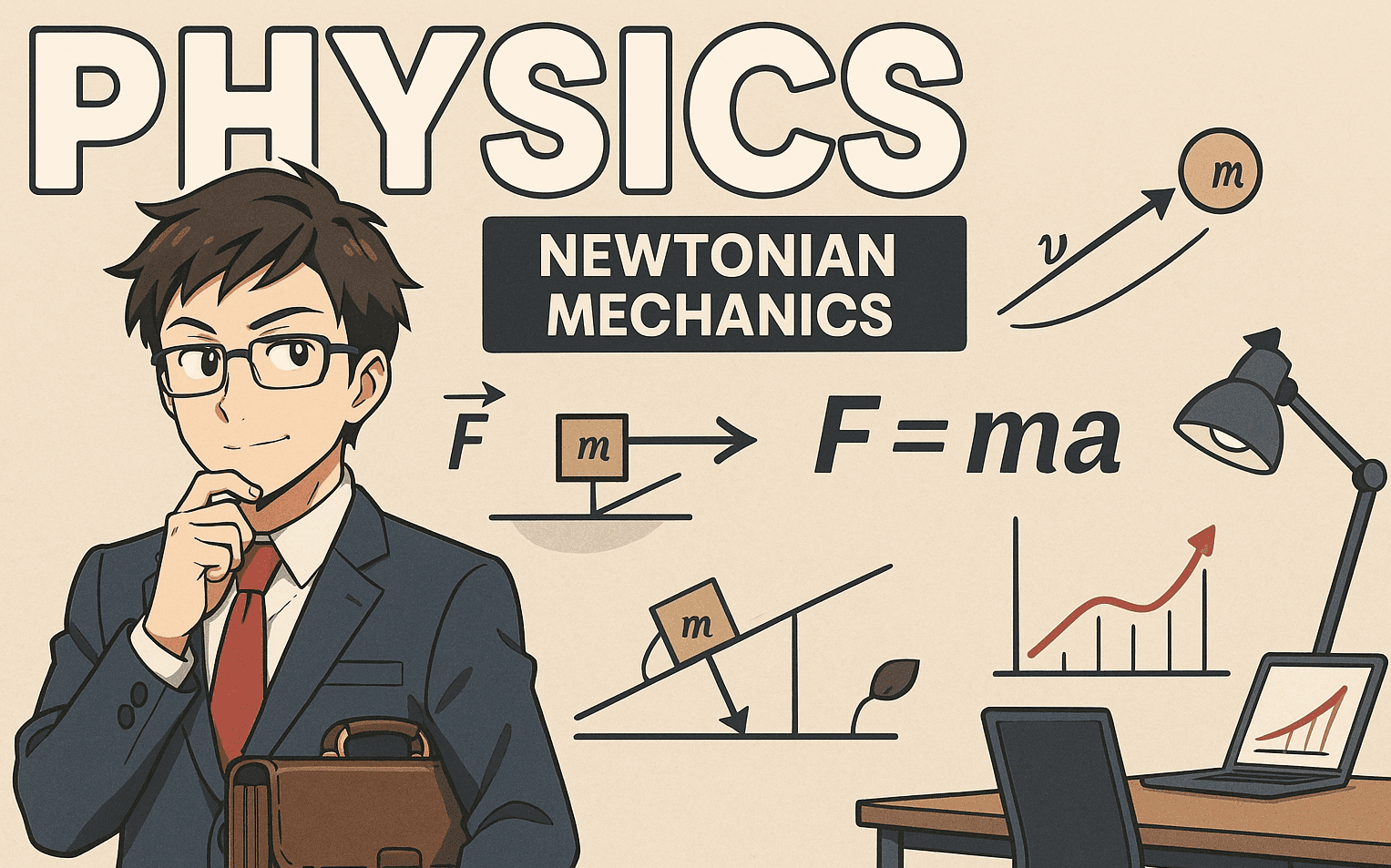
A car hits a concrete wall at 56 km/h. In the next 0.1 seconds, the front crumple zone collapses by about 60 centimeters. The seatbelt locks across your chest. The airbag fires at 300 km/h and inflates to full size before your head even starts moving forward. Your body decelerates from highway speed to zero in roughly the time it takes to blink. The physics that governs every piece of that sequence — the forces, the momentum transfer, the energy absorption — was written down by a man in 1687 who never saw an automobile. His name was Isaac Newton, and his three laws of motion remain the single most useful framework for understanding how objects move, collide, and interact in the physical world.
Newtonian mechanics isn't some dusty chapter in the history of science. It's the physics running silently behind every car you drive, every bridge you cross, every ball you throw, and every elevator ride you take. Engineers still use Newton's equations to design skyscrapers. NASA still uses them to plot spacecraft trajectories. Sports scientists use them to shave hundredths of a second off Olympic sprint times. The math is over 300 years old, and it still works with stunning precision for everything from a skateboard rolling down a ramp to a satellite orbiting Earth at 28,000 km/h.
0.1 s — The time window in which seatbelts, airbags, and crumple zones must absorb a crash's entire force — all governed by Newton's second law
Newton's First Law: The Universe Hates Change
Here's something that sounds wrong but is absolutely true: if you shoved a hockey puck across perfectly frictionless ice, it would never stop. Not after a minute. Not after a year. It would glide in a straight line at constant speed forever. That's Newton's First Law — sometimes called the law of inertia — and it says that an object at rest stays at rest, and an object in motion stays in motion at constant velocity, unless a net external force acts on it.
The key phrase is "net external force." Your intuition says objects naturally slow down and stop. But they don't — friction stops them. Air resistance stops them. The road stops them. Remove all those forces and motion just... continues. Indefinitely.
Why does this matter in your life? Because inertia is what makes car crashes lethal. When a car slams into a wall, the car stops — but your body doesn't. Your body wants to keep moving at whatever speed the car was going, because nothing has applied a force to you yet. That's the entire reason seatbelts exist. The belt is the external force that decelerates your torso along with the car instead of letting you fly into the dashboard at 60 km/h.
You're standing on a bus that brakes suddenly. You lurch forward — not because some mysterious force pushes you, but because the bus stopped and your body didn't. Your feet stopped with the floor (friction), but your upper body kept moving at the bus's original speed. The "force" you feel is actually your body resisting the change in motion. That resistance is inertia, and Newton's First Law is the reason every bus has grab handles.
Ice skating shows inertia beautifully. A figure skater gliding across the rink barely decelerates because ice provides almost no friction. Push off once, and you coast for dozens of meters. Try the same push on a gravel road and you'll stop in two steps. Same push, same inertia — but wildly different friction forces acting against you. Newton's First Law explains both outcomes with one principle.
Newton's Second Law: F = ma and Everything It Controls
If the First Law tells you what happens when there's no net force, the Second Law tells you exactly what happens when there is one. It's the equation that runs the world:
The net force on an object equals its mass times its acceleration. Three variables, one equation, limitless applications. Want to know how hard a quarterback throws a football? F = ma. Want to calculate the thrust a rocket engine needs to lift off? F = ma. Want to figure out the braking distance of a truck on wet asphalt? F = ma.
The equation cuts both ways. A larger mass means you need more force to achieve the same acceleration — which is why pushing a shopping cart is easy but pushing a stalled SUV is a workout. And for a given force, a smaller mass accelerates faster — which is why a tennis ball flies off a racket faster than a bowling ball would if you somehow managed the same swing.
Acceleration isn't just "speeding up." It's any change in velocity — including slowing down (deceleration) and changing direction. When a car takes a curve at constant speed, it's still accelerating because its direction is changing. That directional acceleration requires a force (friction from the tires), and F = ma describes it precisely.
Consider a real example with numbers. A 1,400 kg car accelerates from 0 to 100 km/h (that's 0 to 27.8 m/s) in 8 seconds. The average acceleration is . The net force required? . That's the net force — meaning the engine actually produces more than 4,860 N because it also has to overcome air drag and rolling friction. Real engineering starts here: you know the target acceleration, you know the mass, you calculate the force, and then you size the engine accordingly.
This same logic scales from toy cars to spacecraft. When NASA's Space Launch System generates 39.1 million newtons of thrust to lift a 2.6 million kg rocket, the initial acceleration is — minus the 9.8 m/s² pulling it back down from gravity, giving a net upward acceleration of about 5.2 m/s². The same equation a high schooler uses to solve a textbook problem is the same equation that gets rockets off the ground.
Newton's Third Law: Every Push Gets Pushed Back
For every action, there is an equal and opposite reaction. You've heard it. But most people misunderstand it.
The Third Law doesn't mean forces cancel out. It means forces come in pairs that act on different objects. When you push against a wall, the wall pushes back against your hand with exactly the same force. When a swimmer pushes water backward, the water pushes the swimmer forward. When a rocket's engine blasts exhaust gases downward at tremendous speed, those gases push the rocket upward with equal force.
Here's why the "equal and opposite" part doesn't mean nothing ever moves: the two forces act on different things. The rocket pushes on the gas (force A), and the gas pushes on the rocket (force B). Force A accelerates the gas downward. Force B accelerates the rocket upward. They're equal in magnitude and opposite in direction, but because they act on different objects with different masses, the accelerations are very different. The lightweight gas molecules fly away at thousands of meters per second; the massive rocket accelerates more slowly upward. Different masses, same force, different accelerations — Newton's Second and Third Laws working together.
"If every force has an equal and opposite reaction, how does anything ever accelerate? Don't the forces just cancel?" No — because action-reaction pairs act on different objects. The force on the rocket and the force on the exhaust gas are a pair. They never act on the same object, so they never cancel.
To determine if an object accelerates, look only at the forces acting on that object. A rocket accelerates because the thrust on it exceeds its weight. The equal and opposite force on the exhaust gas is irrelevant to the rocket's own acceleration — it's a force on a different body entirely.
Ice skating gives another clean example. When a skater pushes off the rink wall, the wall pushes back. But the wall is anchored to the building — enormous mass, negligible acceleration. The skater, with maybe 70 kg, glides away smoothly. Same magnitude of force, wildly different results, because mass matters. Now imagine two skaters facing each other on ice. They push against each other's hands and both slide backward. The lighter skater moves faster. Third Law in action, with the Second Law determining each skater's acceleration.
Kinematics: Describing Motion with Precision
Newton's laws explain why things move. Kinematics is the branch that describes how they move — position, velocity, acceleration, and time — without worrying about the forces behind the motion. Think of kinematics as the scoreboard and Newton's laws as the playbook.
Four equations handle nearly every constant-acceleration problem you'll ever encounter. If an object starts at velocity , accelerates at rate , and you want to know its velocity , displacement , or the time elapsed, these are your tools:
Sports are a goldmine of kinematics. Usain Bolt's 100-meter world record (9.58 seconds) involved an acceleration phase in the first 4 seconds where he went from zero to roughly 12.2 m/s, followed by a near-constant velocity phase. Using , we can calculate the distance covered during acceleration: . He covered the remaining 75.6 meters at nearly top speed. Coaches and biomechanics researchers use exactly this kind of analysis to optimize training — should the athlete spend more effort on acceleration or top-end speed?
Projectile motion is kinematics in two dimensions. A basketball player shooting a free throw launches the ball at some angle with some initial speed. Gravity pulls the ball downward at while the ball's horizontal velocity stays roughly constant (ignoring air resistance). The result is a parabolic arc. The horizontal and vertical motions are independent — gravity doesn't affect horizontal speed, and horizontal motion doesn't affect how fast the ball falls. That independence is one of the most powerful ideas in kinematics, and it's what makes projectile problems solvable by splitting them into two separate one-dimensional problems.
A soccer player takes a goal kick, launching the ball at 25 m/s at a 35-degree angle. Horizontal velocity: . Vertical velocity: . Time to reach peak height: . Total flight time (up and back down): about 2.92 s. Horizontal range: . That's nearly 60 meters — enough to clear most of the pitch. Change the angle to 45 degrees and the range maxes out at about 63.8 m. A few degrees of launch angle can mean the difference between a goal kick that reaches midfield and one that doesn't.
Forces in Action: Friction, Normal Force, and Tension
Newton's laws become genuinely useful once you can identify the specific forces acting on an object. Three forces show up in almost every real-world mechanics problem: friction, the normal force, and tension. Master these, and you can analyze everything from a box sliding down a ramp to an elevator suspended by cables.
Friction opposes relative motion between two surfaces in contact. There are two flavors. Static friction keeps things from starting to move — it's the reason you can place a book on a tilted desk and it stays put, up to a point. Its maximum magnitude is , where is the coefficient of static friction and is the normal force. Kinetic friction acts once surfaces are already sliding and has magnitude . The kinetic coefficient is almost always smaller than the static one, which is why it's harder to start pushing a heavy dresser than to keep it sliding once it's moving.
The normal force is a surface's way of saying "you shall not pass." It acts perpendicular to the contact surface and adjusts its magnitude to prevent objects from falling through. On flat ground, the normal force on an object typically equals its weight: . On a slope angled at , it drops to because only the perpendicular component of gravity pushes into the surface.
Tension travels through ropes, cables, and strings. In an idealized massless, inextensible rope, tension is the same everywhere along the rope's length. Pull one end with 50 N, and the other end pulls back with 50 N. This is how pulleys redirect force, how elevators hang from cables, and how tow trucks haul stalled vehicles.
The Free-Body Diagram: Your Most Powerful Tool
If Newton's Second Law is the engine of mechanics, the free-body diagram (FBD) is the steering wheel. It's a stripped-down sketch showing a single object and every force acting on it, drawn as arrows with direction and labeled magnitude. No decorations, no scenery — just the object and its forces.
Here's how to build one, step by step. You isolate your object of interest. You draw it as a simple shape — usually a dot or a box. Then you identify every force: gravity pulling down, normal force pushing up from any surface, friction opposing motion along the surface, tension pulling along any rope, applied forces from pushes or pulls. Each force gets an arrow whose length roughly represents its magnitude and whose direction shows where the force points.
Once the diagram is drawn, you pick a coordinate system — usually aligned with the direction of motion — and decompose every force into components along those axes. Then Newton's Second Law becomes a set of equations: and . Solve those equations, and you've cracked the problem.
For the incline shown above, if the block has mass , the slope angle is , and the coefficient of kinetic friction is , the acceleration down the slope is:
That's a real, calculable prediction. Place a 10 kg block on a 30-degree ramp with that friction coefficient, and it will accelerate at 3.2 m/s². You could verify this with a stopwatch and a ruler. That's the power of FBDs plus F = ma — they turn physical scenarios into solvable algebra problems.
Momentum: The Quantity That's Always Conserved
Momentum is mass times velocity: . It's a vector, so direction matters. A 0.15 kg baseball traveling at 40 m/s carries of momentum. A 2,000 kg car traveling at 0.003 m/s (basically a crawl) carries the same amount. The baseball and the car would have identical effects in a perfectly elastic head-on collision with a stationary object — same momentum, same impulse delivered.
Newton's Second Law is actually a momentum statement in disguise. The original formulation was closer to: the rate of change of an object's momentum equals the net force on it.
When no external forces act on a system, , and total momentum stays constant. This is the law of conservation of momentum, and it governs every collision, every explosion, every rocket launch. Two billiard balls colliding on a table? Total momentum before equals total momentum after. A rifle firing a bullet? The bullet flies forward, the rifle recoils backward, and the system's total momentum stays at zero (since it started at zero before the trigger was pulled).
Impulse: Why Airbags and Crumple Zones Work
Back to that car crash from the opening. Impulse is the change in momentum, and it equals force multiplied by the time interval during which the force acts:
This equation is the reason car safety engineering works. In a crash, the impulse — the total change in your body's momentum — is fixed. You're going from some speed to zero, and your mass isn't changing. So is a set number. The equation then becomes a tradeoff: you can have a large force over a short time, or a smaller force over a longer time. Same impulse either way.
A rigid steering column stops your chest in 0.005 seconds. The force is catastrophic. A crumple zone extends the deceleration over 0.07 seconds — 14 times longer — and the peak force drops by roughly the same factor. An airbag extends it further to about 0.15 seconds. Each of these safety systems is an engineering application of one equation: . Increase , decrease . That's not a design philosophy — it's physics.
Relative peak force on a 70 kg occupant during a 56 km/h collision. Extending the stopping time from 5 milliseconds to 150 milliseconds reduces the force from roughly 217,000 N to about 7,200 N — from fatal to survivable.
Collisions: Elastic, Inelastic, and the Messy Real World
Momentum conservation makes collisions analyzable. Two broad categories exist. In an elastic collision, both momentum and kinetic energy are conserved. Billiard balls come close to this ideal — they barely deform on impact and very little energy becomes heat or sound. In an inelastic collision, momentum is conserved but kinetic energy is not — some of it converts to heat, sound, or permanent deformation. When two cars crumple together in a crash and move as one mangled unit, that's a perfectly inelastic collision, the extreme case where maximum kinetic energy is lost.
Consider two cars of equal mass , one moving at velocity and the other stationary. In a perfectly inelastic collision (they stick together), conservation of momentum gives:
Half the original speed, and exactly 50% of the kinetic energy has vanished — absorbed as crumpling metal, shattered glass, heat, and noise. That "lost" energy is what crumple zones are designed to absorb, turning it into deformation of the car instead of deformation of you. Understanding where kinetic energy goes during collisions isn't academic — it directly determines how safety engineers design the structures that protect passengers. For more on energy transfer and conservation, see our article on energy and power.
Both momentum and kinetic energy conserved. Objects bounce apart. Approximated by billiard balls, steel ball bearings, and atomic-level particle collisions. In a head-on elastic collision between equal masses, the moving object stops dead and the stationary one takes off at the original speed.
Momentum conserved; maximum kinetic energy lost. Objects stick together and move as one. Car crashes, a bullet embedding in a block of wood, two football players tackling and falling together. Energy goes into deformation, heat, and sound.
Work, Energy, and the Conservation Principle
Work in physics has a precise definition: it's force times displacement in the direction of the force. Push a crate 5 meters across a floor with a steady 200 N force, and you've done (joules) of work. Hold a heavy barbell motionless above your head and you do zero work in the physics sense — no displacement, no work, no matter how much your muscles burn.
Work connects to energy through the work-energy theorem: the net work done on an object equals the change in its kinetic energy.
Kinetic energy is the energy of motion: . Gravitational potential energy is stored energy due to height: . When a roller coaster climbs a hill, kinetic energy converts to potential energy. When it plunges down, potential converts back to kinetic. If we ignore friction, the total mechanical energy — kinetic plus potential — stays constant throughout the ride.
A 500 kg coaster car sits at the top of a 40-meter hill, momentarily at rest. Its potential energy: . At the bottom, all of that converts to kinetic energy (ignoring friction): , so — about 101 km/h. In reality, friction and air resistance steal some of that energy as heat, which is why each successive hill on a roller coaster must be shorter than the one before it. The coaster never gets "free" energy back.
Power measures how fast work gets done: . A 75 kg person climbing a 3-meter flight of stairs in 4 seconds exerts a power output of — roughly three-quarters of a horsepower. Sprint up those stairs in 2 seconds and the power doubles to 1,102 W, even though the total work (energy expenditure) is identical. The distinction between energy and power matters enormously in engineering: a battery might store plenty of energy but deliver it too slowly for a given application, which is why electric vehicles need both high-capacity batteries and high-power motor controllers.
Gravity: The Force You Can't Escape
Every object in the universe pulls on every other object. That's Newton's law of universal gravitation, and it's deceptively simple:
Here, is the gravitational constant, and are the two masses, and is the distance between their centers. The force is always attractive, acts along the line connecting the two masses, and obeys Newton's Third Law: Earth pulls on you with exactly the same force that you pull on Earth.
Near Earth's surface, this simplifies beautifully. Combining with gives . That single number — the acceleration due to gravity — appears in virtually every mechanics problem involving objects near Earth. Drop a ball, and it accelerates at 9.8 m/s². Throw a javelin, and gravity curves its path into a parabola at 9.8 m/s². The universality of is a direct consequence of the universality of gravitational force.
For deeper coverage of orbital mechanics, tides, and gravitational fields, see our article on gravitation. And for how gravity connects to circular and rotational motion, those topics build directly on the foundations laid here.
Putting It All Together: Real Engineering Applications
The reason Newtonian mechanics has survived for over three centuries isn't elegance — it's utility. These laws are the daily working tools of millions of engineers, designers, and scientists.
Automotive engineering is wall-to-wall Newtonian mechanics. Engine power, braking distances, suspension tuning, tire grip, rollover stability — every calculation starts with F = ma and branches out through friction, torque, energy conservation, and momentum. When an engineer calculates that a 1,500 kg car traveling at 120 km/h needs a minimum of 85 meters to stop on dry pavement, that number comes from: , solved for with . The braking distance: , plus reaction time distance. Lives depend on these calculations being correct.
Structural engineering uses equilibrium conditions — the case where net force and net torque both equal zero. Every beam in a building, every cable in a suspension bridge, every bolt in a steel frame is analyzed by summing forces and torques and confirming that nothing accelerates. The Sydney Harbour Bridge contains 52,800 tonnes of steel, all of it held in place by the same equilibrium equations a physics student learns in their first semester.
Space missions still run on Newton. When NASA calculates a transfer orbit from Earth to Mars, the math is Newtonian gravity plus conservation of energy plus the Second Law. Yes, relativistic corrections exist for ultra-precise work, but the Voyager probes that are now 24 billion km from Earth were navigated there primarily with equations from the Principia.
The Mathematical Backbone: Connecting to Algebra and Beyond
One thing that separates physics from hand-waving is the math. Every claim in Newtonian mechanics is backed by equations that produce testable, numerical predictions. And the math involved isn't exotic — it's mostly algebra and basic trigonometry, with some quadratic equations when projectile motion or energy problems produce second-degree expressions.
Take a classic problem: a ball launched upward at 20 m/s. When does it hit the ground? The height equation is . Setting gives , so (the launch) or (the landing). That's a quadratic in disguise, and factoring it reveals two physical moments: departure and arrival.
When problems involve inclined planes, force decomposition requires sine and cosine. When problems involve two unknowns (say, acceleration and tension in an Atwood machine), you solve a system of linear equations. The physics provides the equations; the math solves them. Neither discipline makes full sense without the other, and students who strengthen both simultaneously tend to progress faster in each.
Where Newtonian Mechanics Breaks Down
Newton's framework isn't wrong — it's incomplete. It works brilliantly for everyday objects at everyday speeds: cars, baseballs, bridges, spacecraft, machinery. But push into extreme territory and the equations start giving wrong answers.
At speeds approaching the speed of light (about 300,000,000 m/s), Newtonian predictions fail. A particle accelerated to 99% of light speed doesn't behave the way F = ma predicts. Einstein's special relativity takes over, replacing Newton's equations with ones that account for time dilation and mass-energy equivalence. GPS satellites orbit at "only" 14,000 km/h — far below light speed — but even that requires relativistic corrections of about 38 microseconds per day. Without those corrections, GPS positions would drift by roughly 10 km daily.
At the atomic and subatomic scale, quantum mechanics replaces Newton. Electrons don't orbit nuclei like tiny planets — they exist in probability clouds. Particles can tunnel through barriers they classically shouldn't cross. The uncertainty principle sets fundamental limits on how precisely you can simultaneously know a particle's position and momentum. None of this shows up at the human scale, which is why Newton's laws still work perfectly for everything you can see with your eyes.
The takeaway: Newtonian mechanics is the physics of the human scale. It governs everything from thrown baseballs to orbiting satellites with remarkable accuracy. Its limits — near-light speeds and subatomic scales — are so far from daily experience that most engineers and scientists will use Newton's equations for their entire careers without ever needing the corrections that relativity and quantum mechanics provide.
From Principia to Your Daily Life
Newton published the Principia Mathematica in 1687. Three hundred and thirty-nine years later, the equations in that book are still load-bearing. They hold up the buildings you live and work in, keep the satellites overhead in their orbits, determine the stopping distance of every vehicle on the road, and explain why a well-placed seatbelt across your chest is the difference between walking away from a crash and not walking at all.
That's the quiet power of Newtonian mechanics. It doesn't require exotic particles or enormous accelerators. It starts with three laws, a handful of equations, and a willingness to draw a free-body diagram. From there, you can predict the arc of a soccer ball, calculate the tension in a bridge cable, design an airbag that saves lives in 0.1 seconds, or plot a course to Mars. The universe follows rules. Newton wrote the first draft, and for the world you live in, that draft is still the definitive edition.
The connections branch outward from here. Thermodynamics explains what happens to the energy that friction steals from a sliding block (it becomes heat). Electricity and magnetism reveals that the "contact forces" in Newton's mechanics — friction, tension, the normal force — are all electromagnetic at the atomic level. Waves and optics emerges when you study the vibrations of objects under restoring forces that follow F = ma. Every branch of physics grows from the roots Newton planted. Start here, and the rest of the subject unfolds naturally.