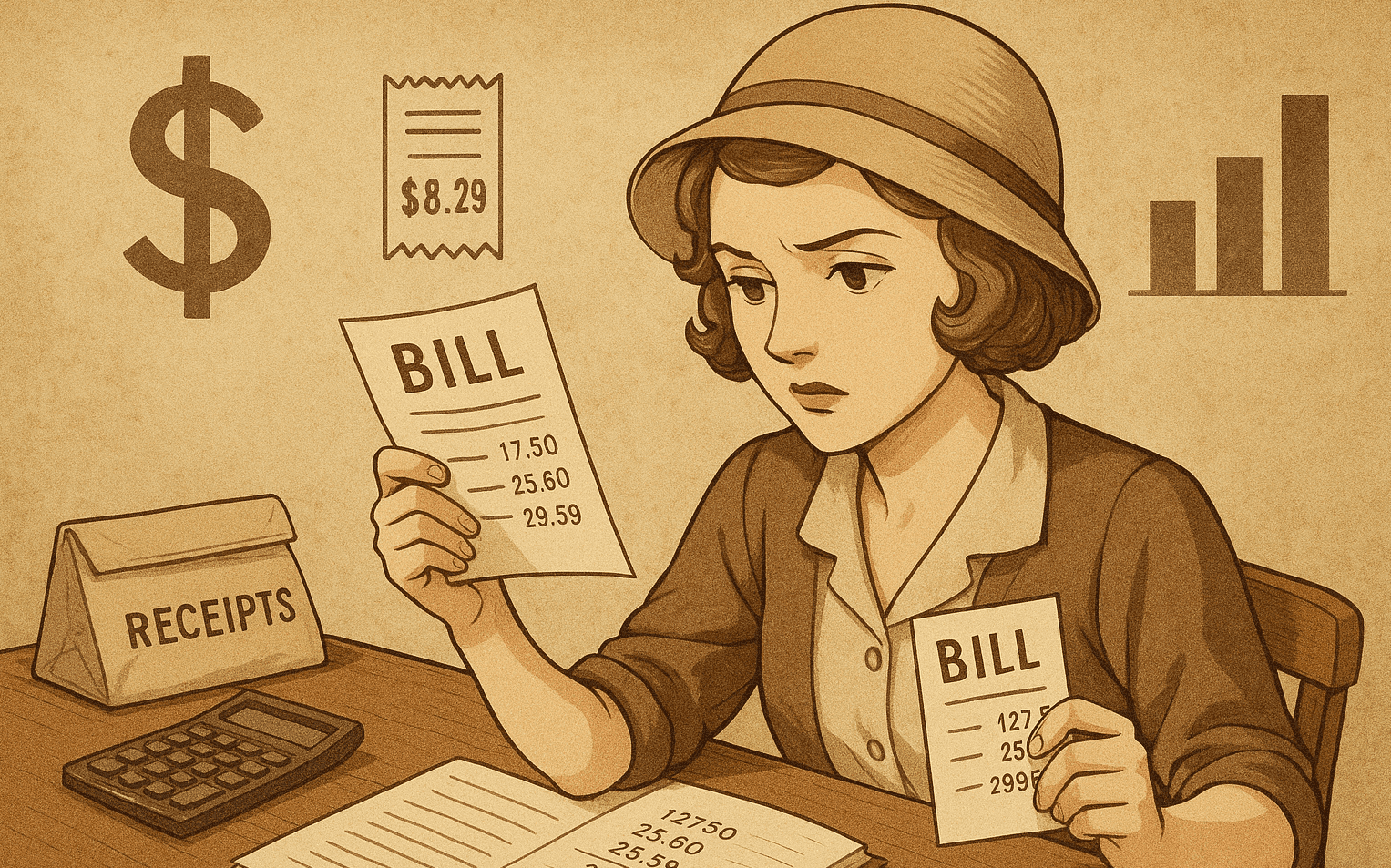
A $4.72 overdraft fee showed up on a checking statement last Tuesday. Not a catastrophe. Not even particularly painful. But the person staring at it had no idea where it came from, because they'd stopped tracking a $9.99 streaming subscription that renewed two days before payday. The math involved? Subtraction. One subtraction. The cost of skipping it? A fee that bought absolutely nothing, produced no value, and repeated three times before anyone noticed - costing $14.16 in pure waste over a quarter. Basic arithmetic is not glamorous. But when you don't use it, the world charges you a stupidity tax, and it never sends a receipt.
This is a guide to using the four operations - addition, subtraction, multiplication, division - in the thick of real life. Bills, groceries, subscriptions, transport, time management, household logistics, and the sneaky little traps that quietly drain your bank account while you're busy being an adult. No theory for theory's sake. Every section connects to a decision you'll actually face this week.
Estimate first, confirm second - the one habit that changes everything
Estimation is not laziness; it's leadership. Leaders get a quick range, decide if the choice is viable, and only then drill into precision. The rhythm is clean: round numbers to friendlier neighbors, calculate, and correct if the stakes demand it.
Picture a grocery run with three items you actually remember: $3.20, $4.50, $3.10 per unit, one of each. Round to 3 + 5 + 3 and land around 11. The exact total is $10.80, but your mind is already prepared. Toss in a fourth item hovering near $6, and your mental total flips to 17. You're in control before the receipt prints. That feeling - numbers bending to your will, not the other way around - is arithmetic doing its job.
Estimation is not about getting the right answer. It is about knowing the right neighborhood before you invest time in precision. If a rough estimate already signals "no go," you just saved yourself five minutes of exact calculation that would have reached the same conclusion.
The same approach rescues your calendar. Suppose you've accepted three "quick" calls: 20, 25, and 30 minutes. Round to half hours, stack to 1.5 hours, then claw back 15 minutes if you know two of them always end early. By the time your calendar app loads, you've already built the afternoon. This is arithmetic as planning, not as homework.
Where estimation really shines is in killing bad options fast. If a weekend getaway costs roughly $300 per person and your group has four people, you don't need a spreadsheet to know you're looking at $1,200 minimum. If your combined vacation fund sits at $800, the conversation shifts from "where should we stay?" to "can we split a closer trip or wait a month?" Estimation collapses decision trees. The four operations just accelerate the pruning.
Fixed bills, variable bills, and the arithmetic that keeps them honest
Bills split into two tribes: the ones that barely change and the ones that behave like cats on roller skates. Your power move is to separate them in your head, then apply different mental math to each.
For fixed bills - rent, base phone plan, streaming, gym - the math is mostly addition and a quick check for changes. Set a default monthly total and keep it in muscle memory. If the stack is $420 + $35 + $9 + $7, memorize $471. When a "new member fee" or "service charge" sneaks onto a statement, subtraction reveals the gap. $471 to $499 is a $28 jump. You can argue a specific number instead of ranting in generalities. Arithmetic makes disputes crisp and winnable.
Your electricity tariff is $0.14 per kWh and the meter shows an extra 230 kWh this month. Multiply $0.14 x 230. Move the decimal to make it friendly: 14 x 23 = 322. Scale back two places to get $32.20. Better yet, chunk it: ($0.14 x 200) + ($0.14 x 30) = $28.00 + $4.20 = $32.20. No surprises when the invoice lands. You already know the number before the envelope opens.
Variable bills - electricity, gas, mobile data - are where multiplication and division do the heavy lifting. The electricity example above shows the multiplication side. But mobile data demonstrates division as a diagnostic tool. If your plan covers 20 GB and you're halfway through the month at 13 GB, divide 13 by 15 days and you get around 0.87 GB per day. Multiply by the remaining 15 days to forecast 13 more. You're set to hit 26 GB, which means throttling. You have a choice: reduce daily usage to 0.47 GB for the back half or buy a top-up on your terms. Arithmetic turns panic into plan.
Water bills follow their own multiplication logic. If your household uses roughly 120 liters per person per day and there are three people, that's 360 liters daily, or about 10,800 liters a month. At $0.003 per liter, you're looking at $32.40 for water alone - before sewage charges and fixed service fees typically double it. When the bill reads $68, you can validate the number instead of staring at it with vague suspicion. The gap between "that looks high" and "that's $4 above my estimate, let me check the meter" is the gap between frustration and control.
Subscriptions, stacking discounts, and the percent trap
Promotions thrive on the fact that percentages confuse people. Two quick rules save you every time.
First, stacked discounts multiply - they don't add. A jacket priced at $100 gets a 20% discount down to $80. A further 20% off is not $60; it's $64, because 0.8 x 0.8 = 0.64. If someone brags about "40% total," you can nod politely and know better. The gap is $4 on a jacket. On a $2,000 appliance with two stacked 15% coupons? The difference between the naive calculation ($1,400) and the real one ($1,445) is $45. That's dinner for two.
20% off + 20% off = 40% total discount. A $100 item becomes $60.
20% off, then 20% off the reduced price. 0.8 x 0.8 = 0.64. A $100 item becomes $64.
Second, margin vs. markdown are not twins. If a service costs a provider $60 and they charge $100, the difference is $40. A $40 markdown from $100 is a 40% discount. But a $40 "margin" on the $60 cost is actually a 67% markup. The numbers might look similar, but the base changes the story. When you compare offers, always anchor to the same base: either all in prices or all in costs. You'll sniff out the gimmick in seconds.
For subscriptions, arithmetic helps you eliminate zombie charges. Make a list of repeating charges one time, and memorize the monthly total. Every new service is a simple addition problem. Two or three new charges creep in? Do a month-on-month subtraction against your memorized number. The delta tells you whether to audit. No angst, just a number to investigate. A Federal Reserve study found that the average American carries 2.4 subscriptions they've forgotten about. At $12 per forgotten service, that's $28.80 per month wandering out the door - or $345.60 per year. Subtraction catches it. Inattention funds it.
Groceries and the unit price game
Grocery shelves are a masterclass in managed chaos. Different sizes, different pack counts, different promotions slapped at odd angles. The antidote is to normalize everything to a unit price. Divide the price by the quantity and compare like-for-like.
If a 750 g pack costs $5.25 and a 1 kg pack costs $6.60, take $5.25 / 0.75 to convert the smaller pack to a per-kg basis: $7.00 per kg. The 1 kg pack is $6.60 per kg. Cheaper, done. You didn't burn a synapse on brand promises or bright stickers.
The same logic works on liquids. If a 1.5 L bottle is $2.10 and a 2 L bottle is $2.60, per liter you're comparing $1.40 vs. $1.30. Once you think per-unit, choices stop feeling emotional. You'll also spot "shrinkflation" because the per-unit cost drifts upward even when the sticker price is unchanged. That cereal box that used to hold 500 g and now holds 425 g at the same $4.50? Per-kg cost jumped from $9.00 to $10.59. The price tag didn't move. The arithmetic did.
For fresh produce, estimation wins time. If apples are $3.80/kg and you're eyeballing 1.3 kg, do $3.80 x 1.3 by splitting 1.3 as 1 + 0.3. You get $3.80 + $1.14 = $4.94. Your brain can accept a nickel's drift without breaking stride. Over the course of a full cart with 15 produce items, that mental discipline keeps your running total within a dollar or two of the register - which means no checkout surprises and no awkward "put that back" moments.
Transport costs without a calculator party
Transport math is mostly multiplication and division with friendly numbers. Suppose ride-hailing runs at $0.60 per km plus a base of $1.80. For a 12 km ride, 12 x $0.60 = $7.20, plus $1.80 equals $9.00. Surge at 1.3x? Multiply $9.00 x 1.3: take 10% ($0.90) and 20% ($1.80) together for 30% ($2.70), then add to $9.00 = $11.70. You didn't wait for an app to tell you what your wallet already knew.
If you're driving, fuel arithmetic builds your range. At 6.5 L/100 km and a 50 L tank, your range is 50 / 6.5 x 100. Divide 50 by 6.5: around 7.69. Multiply by 100 and land at roughly 769 km. If fuel is $1.25 per liter, a 40 L top-up is $50. Arithmetic answers the three questions that matter: how far, how much, and when to stop pretending the warning light means nothing.
Public transport thrives on pass vs. pay-as-you-go comparisons. If a monthly pass is $46 and single rides are $1.50, divide 46 by 1.50 and you get 30.67. If you ride more than 31 times, the pass wins. If you ride 20-25 times, pay single. Choices don't need philosophy; they need division. And if you commute five days a week with two rides per day, that's roughly 44 rides a month - the pass saves you $20 every cycle. Over a year, that's $240 back in your pocket for about 90 seconds of arithmetic.
Timeboxing your day with arithmetic guardrails
Time is the budget everyone mismanages because it feels slippery. Arithmetic gives it edges.
Convert everything to minutes for planning, then convert back at the end. If you have three tasks slated for 95, 55, and 70 minutes, you're staring at 220 minutes total. That's 3 hours and 40 minutes. If meetings invade, subtract the invasion from your total to see what's left. You don't wonder where the day went; you know where it's going before it leaves.
When you estimate tasks, start with the cycle time. If writing a decent email thread takes 7 minutes and you have 12 of them, that's 84 minutes. If context switching adds a 15% overhead, multiply 84 by 1.15 to reach roughly 96.6 minutes. Call it 1 hour 40 minutes and protect the block. Time math doesn't nag; it hardens plans into something durable.
Breaks require the same protocol. A six-hour stretch with two 15-minute breaks and one 30-minute meal isn't six hours of output; it's five. If your cycle is a crisp 12 minutes per unit, you're shipping 25 units, not 30. The math is simple, but the habit pays every single day. People who timebox with arithmetic routinely report 20-30% more output - not because they work harder, but because they stop lying to themselves about how much time they actually have.
Household operations - staging costs and quantities
Running a household is logistics in disguise. Laundry, cleaning supplies, paper goods, pantry staples - these are inventory problems wearing pajamas. The method: pick a unit, map normal usage, multiply to a reorder schedule.
Laundry detergent that claims "25 loads" is whispering a division problem. If you do 4 loads a week, 25 / 4 is 6.25 weeks. Reorder after five to avoid a weekend scramble. Paper towels in packs of eight that last 11 weeks mean a per-week usage around 0.73 rolls. If you have a 20-guest barbecue looming, estimate 1.2 extra rolls and adjust. Trivial? Maybe. But trivial arithmetic is how avoidable pain dies quiet deaths.
Pantry math scales the same way. If your household burns through a 2 kg bag of rice every 9 days and you want to buy enough for six weeks, that's 42 days / 9 days per bag = 4.67 bags. Buy five. If each bag costs $3.80, you're spending $19 on rice for six weeks. Multiply that logic across 8-10 staples and you have a monthly pantry budget that's built from actual consumption, not vibes.
Even chores respond to numbers. If you batch clean with a 90-minute timer, divide the rooms by time slices. Five rooms? 18 minutes apiece. Bathrooms deserve more time; bedrooms deserve less. Adjust weights: 25 + 25 + 20 + 10 + 10 = 90 minutes. Now you have a tactical plan, not a hope. And when your roommate asks why the bathroom always looks better than the bedroom? Tell them it's the ratio.
The side quests that cost you money - convenience fees and minimum orders
Delivery apps hide arithmetic in plain sight. Service fee, delivery fee, small order fee, tip - by the time you've added them, your "quick snack" is carrying a quiet 30%-45% overhead. Estimate the overhead as a multiplier before you commit.
If you see an item subtotal of $18 and you know your platform routinely adds around 35%, multiply $18 by 1.35. Ten percent of $18 is $1.80, so 30% is $5.40; add half of that ($0.90) to reach $6.30; total $24.30. If that's too salty, pivot to pickup or consolidate orders. One consolidated order of $45 with a $6 delivery fee is a 13% overhead. Three separate $15 orders with $6 fees each is a 40% overhead. Same food. Wildly different arithmetic.
Before placing any delivery order, multiply your subtotal by 1.35 to see the real cost. If the inflated number makes you flinch, the original order was never as cheap as the app wanted you to believe. Consolidating orders or switching to pickup typically cuts the overhead from 35-40% down to 5-10%.
Minimum orders also run on multiplication. If the threshold is $25 and you're at $19, you need $6 more. People toss in a random item. The better question is whether that extra item fills a real gap next week. If you buy a staple you genuinely needed tomorrow, that $6 is not waste; it's a head start. If you buy a $6 cookie because the button was shiny, that's a fee you volunteered for. Arithmetic can't fix impulse control, but it can keep you honest about what impulse control is costing.
Mental math patterns that do the heavy lifting
The brain loves patterns. Once you internalize a few, you'll chew through day-to-day numbers with real confidence.
Complements to 10 and 100 are the gold standard. Pair 8 with 2, 7 with 3, 65 with 35. If you need to add 58 and 27, climb to 60 first: 58 + 2 = 60; then add the remaining 25 to land on 85. Money behaves the same way. $19.95 plus $7.30? Bump $19.95 to $20 and give back a nickel at the end: $20 + $7.30 - $0.05 = $27.25.
The distributive property cleans multiplication. If you're pricing a bulk order at 32 x 14, split to (30 x 14) + (2 x 14) = 420 + 28 = 448. For odd pairs like 25 x 48, halve and double: 50 x 24 = 1,200. You're not performing tricks; you're lowering friction. These shortcuts draw on the same principles behind basic arithmetic operations - they just dress them in street clothes.
Percent shortcuts matter because practically every receipt, tip jar, and promotion involves one. If your cafe order is $12.40 and the platform fee floats at 12%, compute 10% ($1.24) and 2% ($0.248) for $1.488, which you can round to $1.49. Your total is around $13.89. You just disarmed a mystery fee in three seconds flat.
Debt traps, payment schedules, and arithmetic without theatrics
If you owe a balance B and you're paying a fixed amount A every month, division gives you a rough timeline. A balance of $600 chipped by $75 each month is about eight months. If there's a service charge of $5 per month, subtract it from your payment first: you're effectively paying $70 toward the balance, which stretches the timeline to 8.57 months - almost nine. That one extra month is the cost of the fee. Not abstract. Not scary. Just subtraction and division, doing their thing.
The takeaway: When a monthly charge or fee exists alongside your payments, subtract the fee from your payment amount first, then divide the balance by the reduced payment. That gives you the real payoff timeline, not the optimistic one.
Payment schedules with "three equal installments" can look like a favor, but check the math. Three payments of $36 on an item that would have cost $100 upfront? That's $108 total - $8 extra. You don't need formulas to see the premium; you need subtraction. Split it over the months and decide if the convenience is worth the spread. Neutral, clinical, adult. The same logic applies to "buy now, pay later" services. If four installments of $27.50 replace a $100 price tag, you're paying $110. The 10% premium is the price of not having $100 right now. That might be worth it. That might not. But you should know the number before you click.
Health, fitness, and the quiet power of ratios
Calories per serving, grams of protein per 100 g, minutes per kilometer - these are ratio problems. Get comfortable flipping between totals and per-units and you gain a calm kind of control over your body's logistics.
If your run covers 5.6 km in 34 minutes, divide 34 by 5.6. You'll land near 6.07 minutes per km, which is 6 minutes and 4 seconds. Training zones use that pace; improvement is subtraction. Next week, 33:10 for the same distance pushes you to 5:55/km. The math is a celebration you can measure. And when someone asks "are you getting faster?" you don't shrug - you show them a number.
Nutrition labels are division problems in disguise. If a box of cereal has 10 servings at 140 calories each, the box holds 1,400 calories. If you pour what you think is "a bowl" and it's actually 1.5 servings, you're consuming 210 calories, not 140. Over 30 mornings, that's 2,100 extra calories - roughly the equivalent of six full meals. The label didn't lie. Your pour did. Division keeps the accounting straight.
Recipe scaling is the same muscle. If a recipe calls for 1.2 L to serve 6, each serving is 0.2 L. Hosting 14? Multiply 0.2 by 14 to reach 2.8 L. You didn't juggle eight ingredients; you scaled a unit and rebuilt the total. That's safer, faster, and harder to mess up when the doorbell rings and half your guests are early.
Error-proofing: build checks into your mental math
Arithmetic goes further when you verify. The fastest check is inverse operations. After dividing 84 items into 6 boxes to get 14 each, multiply 14 by 6 to re-land at 84. Two seconds, zero debates. When you subtract to find a difference, add back to confirm. Your confidence rises with each pass, and mistakes die before they reach anyone else.
Bounds are the other guardrail. If you expect a total around $100 and you get $1,000, something slipped. Maybe a decimal wandered. Maybe a unit jumped. Build a habit of asking, "Is this the right neighborhood?" before you celebrate or panic. A quick upper-lower check catches the most embarrassing mistakes, and embarrassing mistakes are always the ones that cost the most - in money, in time, and in credibility.
The combination of reverse operations and boundary checks is what separates someone who "did the math" from someone who "got the right answer." The first person might be lucky. The second person is reliable. And reliability, when it comes to your own money and time, is not optional - it's the whole point.
The two-week habit stack for sharper decisions
Skills stick when they're daily. For two weeks, run this playbook quietly in the background of your life.
During checkouts or in ride-hailing apps, estimate first. Say the number in your head. Then confirm with the exact figure. Track how close you were - not obsessively, just with a passing mental note. With bills, keep a memorized monthly target and subtract new totals against it. Investigate the delta without huffing. The goal is not perfection; it's calibration. Your estimates will sharpen faster than you expect.
On the time front, convert your day to minutes when you plan, then group tasks by sensible cycles. Reverse-check totals after meetings. Write units in tiny letters next to numbers - kg, L, min, km, GB - because most errors are unit errors, not arithmetic ones. A number without a unit is a guess pretending to be a fact.
Avoid turning this into a ritual. This is not a lifestyle. It's a quiet, efficient operating system that frees attention for things that actually matter - like conversations, creative work, and the parts of your day that don't involve numbers at all.
From arithmetic to the bigger map
Once the four operations become reflex, doors open. Percentages lead to growth rates, which hint at exponential behavior - the same principles that explain how exponents and logarithms model real growth. Fractions and decimals unlock ratios, proportions, and unit conversions. Estimation and error bounds are your on-ramp to statistics. Each of these builds on the same four operations you already use for bills and groceries - they just apply them to bigger questions.
If you want the broader structure laid out cleanly, topic by topic with real-world tie-ins, the Hozaki math portal works as a compass for leveling up the fundamentals. And for a focused, nuts-and-bolts explainer of the skills we covered here - fraction-decimal-percent conversions, complement pairs, distributive shortcuts, and unit discipline - the dedicated basic arithmetic deep-dive is the natural next step.
Numbers are a leadership skill
You don't need a math badge to be effective. You need to make clear calls fast, in the real world, where signals are messy and time is short. Basic arithmetic gives you a repeatable way to check prices, orchestrate bills, time-box work, tame subscriptions, compare options, and sidestep the most common traps. You'll feel less reactive and more in command. People will start asking you for the number before they ask anyone else for the opinion. That's not an accident; that's competence built from the simplest tools available.
Keep the habit small. Estimate, then confirm. Normalize to per-unit. Convert units before computing. Reverse-check important totals. Do it until it's boring. Boring is good. Boring is repeatable. And repeatable arithmetic is how you turn months of scattered little decisions into cleaner money, quieter calendars, and days that actually feel like yours.